


0115 business intelligence etl extract transform load process management ppt slide




Try Before you Buy Download Free Sample Product
 Impress Your
 Audience
 100%
100% Editable
 Save Hours
 of Time


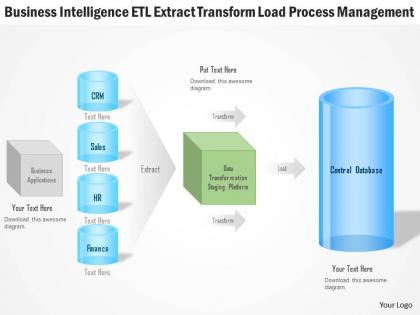
Need PowerPoint slides on business intelligence ETLP? We have a huge stack of business intelligence etl extract transform load process management PPT slide template. Explain the load process management and ETL extract transform with this unique PPT template. These presentation template slides have the visuals of computer server and data base with connectivity. This template PPT slide can be used for creating business intelligence related presentation. This ready-made business intelligent PowerPoint template can be used to define the process of online investigative preparing, examination, information mining, handle mining, complex occasion handling, business execution administration, benchmarking, content mining, prescient examination and prescriptive investigation. This format slide foundations is made after a doing immense research and examination so you can utilize this layout to help an expansive scope of business arranging changing from extraction to loading. Our representation plans in layout will assume an essential part in picking up the grouping of the watchers and will leave a staggering effect. Download this business intelligence extract transform load process management PowerPoint slide. Our 0115 Business Intelligence Etl Extract Transform Load Process Management Ppt Slide are excellently color coded. They accentuate your thoughts better.
People who downloaded this PowerPoint presentation also viewed the following :
0115 business intelligence etl extract transform load process management ppt slide with all 5 slides:
Foster harmony with our 0115 Business Intelligence Etl Extract Transform Load Process Management Ppt Slide. Convince them of the benefits of cohesive action.




FAQs for 0115 business intelligence etl extract transform load process
The ETL process in Business Intelligence comprises data extraction from source systems, transformation through cleansing and validation, and loading into data warehouses or marts. These components work together by standardizing diverse data formats, ensuring accuracy through quality checks, and enabling seamless integration, ultimately delivering consistent analytics and faster decision-making for organizations.
Data sources significantly impact ETL effectiveness through their quality, format consistency, accessibility, and integration complexity, with disparate or poorly structured sources requiring extensive transformation resources. Organizations with clean, standardized data from modern systems experience faster processing and more reliable analytics, while those managing legacy databases, unstructured files, and real-time feeds often face longer development cycles but ultimately achieve richer business insights.
Data quality serves as the foundation of effective ETL processes, determining accuracy, consistency, completeness, and reliability of transformed data across all pipeline stages. Poor data quality can cascade through extraction, transformation, and loading phases, ultimately compromising business intelligence insights, with many organizations finding that implementing robust data validation and cleansing protocols significantly enhances decision-making capabilities and operational efficiency.
Organizations ensure data integrity during extraction through comprehensive data validation, automated error detection, and source system verification protocols. These mechanisms streamline quality control by implementing real-time monitoring, checksum validations, and exception handling processes, with many financial institutions and healthcare organizations finding that proactive validation ultimately delivers cleaner datasets and more reliable business insights.
Common ETL transformation challenges include data quality inconsistencies, complex business rule implementation, performance bottlenecks with large datasets, schema mapping difficulties, and handling real-time processing requirements. These obstacles often impact organizations across retail, healthcare, and financial services, where data accuracy and processing speed directly affect customer experiences, regulatory compliance, and operational efficiency, ultimately requiring strategic resource allocation and robust infrastructure investment.
Choosing the right ETL tools involves evaluating data volume requirements, integration capabilities, scalability needs, budget constraints, and technical expertise within your organization. Consider cloud-based solutions like Azure Data Factory or Talend for scalability, while traditional tools like Informatica suit complex enterprise environments, with many organizations finding that hybrid approaches deliver optimal performance and cost-effectiveness.
Traditional ETL extracts data, transforms it in a staging area, then loads it into the warehouse, while ELT extracts data, loads it directly into the target system, then transforms it using the system's processing power. Modern ELT approaches leverage cloud platforms and big data technologies to handle larger volumes more efficiently, with organizations in retail and finance finding faster processing times and reduced infrastructure costs.
The ETL process supports real-time analytics through stream processing, change data capture, and micro-batch operations that continuously transform and load data. Modern ETL tools enable organizations to process transactional data instantly, with financial services and e-commerce companies finding that real-time insights significantly enhance fraud detection, customer personalization, and operational decision-making capabilities.
Data loading best practices include implementing incremental loading strategies, establishing robust error handling and logging mechanisms, validating data quality before insertion, optimizing batch sizes for performance, and creating rollback procedures for failed loads. These approaches streamline operations by minimizing processing time, ensuring data integrity, and maintaining system reliability, with many organizations finding that strategic loading schedules and automated monitoring ultimately deliver enhanced operational efficiency and reduced downtime costs.
Automation enhances ETL workflow efficiency by eliminating manual data handling, reducing processing time, and minimizing human errors through scheduled data extraction, transformation, and loading processes. Organizations across sectors like banking and retail leverage automated ETL pipelines to streamline data integration, accelerate reporting cycles, and ultimately deliver faster business insights while significantly reducing operational costs.
ETL significantly impacts data governance and compliance by establishing standardized data lineage, quality controls, audit trails, and regulatory reporting frameworks. Through automated validation rules and transformation protocols, organizations in healthcare, finance, and retail enhance data accuracy, ensure GDPR and HIPAA compliance, and streamline regulatory audits, ultimately delivering transparent governance and reduced compliance risks.
ETL integration with big data requires distributed processing frameworks, schema-on-read approaches, and real-time streaming capabilities, unlike traditional batch processing with structured databases. Organizations handling massive datasets from IoT sensors, social media, and customer interactions use technologies like Hadoop and Spark to process unstructured information faster, ultimately delivering more comprehensive analytics and competitive insights.
Organizations should monitor data processing speed, error rates, data quality scores, system resource utilization, and pipeline completion times in their ETL processes. These metrics enable businesses to identify bottlenecks, ensure data accuracy, and optimize resource allocation, with many financial services and retail companies finding that proactive monitoring reduces processing costs while delivering faster, more reliable business insights.
Cloud-based ETL solutions enable organizations to scale data processing dynamically by automatically adjusting resources based on demand, eliminating infrastructure constraints, and reducing upfront costs. These platforms streamline operations through seamless integration with existing systems, faster deployment cycles, and enhanced collaboration capabilities, with many enterprises finding that cloud ETL delivers improved agility and competitive advantage.
Future ETL trends include real-time streaming processing, cloud-native architectures, AI-powered data transformations, automated pipeline orchestration, and edge computing integration. These technologies streamline data workflows by reducing latency, enhancing scalability, and minimizing manual intervention, with many organizations finding that modern ETL approaches deliver faster insights and competitive advantage in increasingly data-driven markets.
-
I discovered this website through a google search, the services matched my needs perfectly and the pricing was very reasonable. I was thrilled with the product and the customer service. I will definitely use their slides again for my presentations and recommend them to other colleagues.
-
Appreciate the research and its presentable format.