


0115 technology predictive data analytics networking social icons ppt slide





Try Before you Buy Download Free Sample Product
 Impress Your
 Audience
 100%
100% Editable
 Save Hours
 of Time


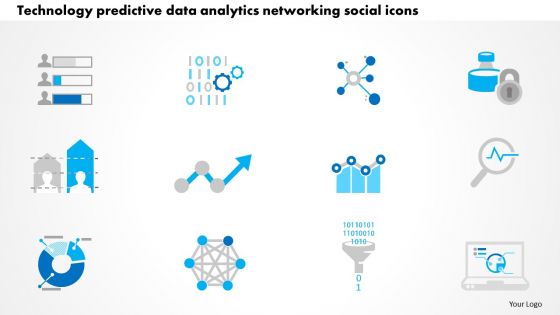
Give an edge to your presentations and create a niche for them with the use of our technology predictive data analytics networking social icons PPT slide. The provided predictive analytics PowerPoint presentation template encompasses numerous statistical technique icons for making future decisions. Spread knowledge on data mining, machine learning and predictive modeling with our predictive analytics technology PPT slide design. In your business, these predictive model presentation examples can be aptly applied for calculating the business associated risk and opportunities. There are several fields like insurance, finance, telecom, healthcare, retail, etc where these technical technology driven networking PPT icons be applied. Apart from this if you have a slideshow related to data mining, even then predictive modeling PPT presentation infographic be applied to talk about information gathering. The presentation slide background contains twelve modern era social networking icons to decipher your knowledge on explanatory variables and predictive variables. Use the technology predictive data analytics networking PPT PowerPoint visuals to leave a stunning impact on your audience.
People who downloaded this PowerPoint presentation also viewed the following :
0115 technology predictive data analytics networking social icons ppt slide with all 5 slides:
Use our 0115 Technology Predictive Data Analytics Networking Social Icons Ppt Slide to effectively help you save your valuable time. They are readymade to fit into any presentation structure.


FAQs for 0115 technology predictive data analytics networking social
Predictive analytics forecasts future outcomes using machine learning, statistical modeling, and pattern recognition, while descriptive analytics summarizes historical data through reporting, dashboards, and trend analysis. While descriptive analytics helps organizations understand what happened in past performance, predictive analytics enables strategic planning, risk mitigation, and proactive decision-making, ultimately delivering competitive advantage.
Businesses can effectively utilize predictive analytics to improve customer retention by analyzing customer behavior patterns, identifying at-risk segments, personalizing engagement strategies, and implementing proactive intervention campaigns. Through machine learning algorithms, companies streamline churn prediction, enhance targeted offers, and automate retention workflows, with many organizations finding that predictive insights ultimately deliver significantly higher customer lifetime value and competitive advantage.
Machine learning enhances predictive data analytics by automating pattern recognition, improving prediction accuracy through continuous learning, and processing vast datasets to identify complex relationships. These algorithms enable organizations to refine forecasting models, reduce human bias, and deliver more precise insights, with sectors like healthcare and finance finding significantly improved patient outcomes and risk assessment capabilities.
Common challenges include data quality issues, insufficient technical expertise, integration complexities with existing systems, resistance to change, and high implementation costs. While these obstacles can seem daunting, many organizations find that strategic planning, phased rollouts, and comprehensive training help overcome these barriers, ultimately delivering improved decision-making and competitive advantage.
Data quality significantly impacts predictive model accuracy by affecting training data integrity, feature reliability, and algorithmic performance through incomplete, inconsistent, or biased datasets. Poor data quality leads to flawed predictions, reduced model confidence, and compromised business decisions, while high-quality data enables financial institutions, healthcare providers, and retailers to achieve reliable forecasting, ultimately delivering competitive advantage and strategic insights.
Predictive analytics extends across healthcare for patient outcome predictions, manufacturing for equipment maintenance scheduling, retail for inventory optimization, transportation for route planning, and energy for demand forecasting. These applications streamline operations by reducing costs, minimizing downtime, and enhancing service delivery, with many organizations finding that cross-industry implementation delivers significant competitive advantages and operational efficiency.
Organizations should focus on metrics including prediction accuracy, model precision and recall, business impact ROI, time-to-insight, and operational efficiency gains. These performance indicators enable companies to measure both technical effectiveness and commercial value, with many financial services and retail organizations finding that tracking customer acquisition costs, revenue lift, and process automation savings ultimately delivers measurable competitive advantage.
Ethical considerations include data privacy protection, algorithmic bias prevention, informed consent protocols, transparency in decision-making processes, and accountability for automated outcomes. Organizations must balance predictive insights with individual rights, ensuring fair treatment across demographics while maintaining data security, with many institutions finding that ethical frameworks ultimately enhance customer trust and regulatory compliance.
Predictive analytics enhances supply chain management by forecasting demand patterns, identifying potential disruptions, optimizing inventory levels, and streamlining delivery routes. Through machine learning algorithms, companies like Amazon and Walmart anticipate customer needs, reduce stockouts, and minimize transportation costs, ultimately delivering improved operational efficiency and competitive advantage in increasingly complex global markets.
Popular predictive analytics tools include Python with scikit-learn, R, SAS, IBM SPSS, Tableau, Microsoft Azure Machine Learning, and Apache Spark. These platforms streamline model development by automating data preprocessing, feature selection, and algorithm testing, with many financial services and retail organizations finding that integrated toolsets significantly reduce development time while enhancing model accuracy and deployment efficiency.
Combining predictive analytics with real-time data processing enables immediate insights, dynamic model adjustments, faster decision-making, enhanced accuracy, and proactive responses to changing conditions. This strategic combination streamlines operations by delivering instant predictions, minimizing delays, and optimizing resource allocation, with many financial institutions and retail organizations finding that real-time predictive capabilities significantly enhance customer experiences and competitive advantage.
Businesses ensure predictive model relevance through continuous data monitoring, regular model retraining with fresh datasets, and implementing adaptive algorithms that learn from new patterns. Companies across retail, finance, and healthcare increasingly deploy automated model validation systems, real-time performance tracking, and agile updating processes, ultimately maintaining competitive advantage while delivering accurate insights in dynamic market conditions.
Feature engineering transforms raw data into meaningful variables that enhance model accuracy, involving data cleaning, normalization, variable creation, dimensionality reduction, and domain-specific transformations. This strategic process enables organizations across sectors like finance and healthcare to improve fraud detection, optimize loan approvals, and enhance patient diagnostics, ultimately delivering more reliable predictions and competitive advantage.
SMEs can leverage predictive analytics through cloud-based platforms, pre-built analytics tools, and strategic partnerships with analytics providers, minimizing upfront infrastructure costs while accessing powerful capabilities. Many retail businesses, healthcare clinics, and manufacturing companies start with focused applications like inventory optimization or customer retention, ultimately delivering improved decision-making and competitive advantage without requiring extensive technical expertise.
Professionals in predictive data analytics need statistical analysis, machine learning algorithms, programming languages like Python and R, data visualization tools, and domain expertise in their industry. These skills enable analysts to extract meaningful insights from complex datasets, build accurate forecasting models, and communicate findings effectively to stakeholders, with many organizations finding that cross-functional knowledge ultimately delivers competitive advantage.
-
Very unique, user-friendly presentation interface.
-
Innovative and Colorful designs.
-
Good research work and creative work done on every template.
-
Out of the box and creative design.
-
Designs have enough space to add content.
-
Informative design.
-
Commendable slides with attractive designs. Extremely pleased with the fact that they are easy to modify. Great work!