


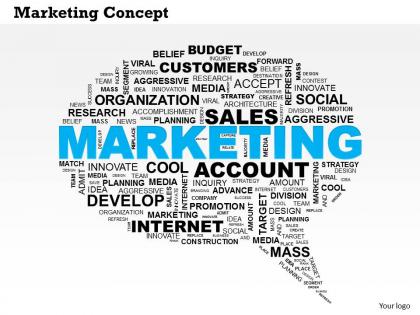
0514 marketing word cloud powerpoint slide template




Try Before you Buy Download Free Sample Product
 Impress Your
 Audience
 100%
100% Editable
 Save Hours
 of Time


Feel it in your genes with our 0514 Marketing Word Cloud Powerpoint Slide Template. Gain complete confidence in your capability.
People who downloaded this PowerPoint presentation also viewed the following :
0514 marketing word cloud powerpoint slide template with all 3 slides:
Bask in the glow of our 0514 Marketing Word Cloud Powerpoint Slide Template. They will put you in the centre of the beam.
FAQs for 0514 marketing word cloud
Key elements of a successful marketing strategy include clear target audience identification, compelling value proposition development, strategic channel selection, consistent brand messaging, and measurable performance metrics. These components work together by aligning customer needs with business objectives, optimizing resource allocation across touchpoints, and enabling data-driven optimization, with many organizations finding that integrated approaches deliver higher ROI and sustainable competitive advantage.
Digital marketing trends emphasize real-time data analytics, personalized customer targeting, interactive content engagement, and multi-channel social media integration, while traditional marketing relies on broad demographic targeting through print, radio, and television. Through advanced automation and AI-driven insights, businesses achieve precise audience segmentation, immediate campaign adjustments, and measurable ROI tracking, ultimately delivering enhanced customer experiences and competitive advantage.
Storytelling transforms marketing campaigns by creating emotional connections, building brand authenticity, and making complex messages memorable through relatable narratives. These techniques enhance customer engagement by humanizing brands, differentiating products in crowded markets, and fostering trust, with many organizations finding that compelling stories drive higher conversion rates and long-term loyalty.
Small businesses can leverage social media for marketing by creating targeted content, engaging directly with customers, utilizing cost-effective advertising options, and building brand awareness through consistent posting. Platforms like Instagram and Facebook enable restaurants, retail shops, and service providers to showcase products, share customer testimonials, and run promotional campaigns, ultimately delivering increased visibility and customer acquisition at minimal cost.
Businesses should track conversion rates, customer acquisition cost, return on investment, customer lifetime value, and engagement metrics across digital channels. These metrics enable organizations to optimize campaign performance, allocate resources strategically, and demonstrate marketing's impact on revenue growth, with many companies finding that comprehensive tracking ultimately delivers better targeting and significantly improved competitive advantage.
Audience segmentation enhances marketing impact by enabling targeted messaging, personalized content delivery, and optimized resource allocation across distinct customer groups. Through demographic, behavioral, and psychographic segmentation, organizations achieve higher conversion rates, improved customer engagement, and reduced acquisition costs, with many retail and financial services companies finding that segmented campaigns deliver significantly better ROI than broad-spectrum approaches.
Essential marketing automation tools include CRM platforms, email marketing software, social media schedulers, lead scoring systems, and analytics dashboards. These technologies streamline campaign management, personalize customer interactions, and track performance metrics, with many organizations finding that integrated automation delivers faster lead conversion, reduced manual tasks, and significantly improved ROI across their marketing efforts.
Content marketing drives brand awareness and customer engagement through storytelling, educational resources, social media campaigns, SEO-optimized articles, and interactive experiences that showcase expertise while building trust. These strategies enhance visibility, foster meaningful connections, and encourage audience participation, with many organizations finding that consistent, valuable content ultimately delivers stronger customer relationships, increased brand loyalty, and sustainable competitive advantage in crowded markets.
Best practices for creating compelling marketing presentations include clear value propositions, data-driven storytelling, audience-specific messaging, visual consistency, and strong calls-to-action. These approaches streamline communication by focusing on customer pain points, demonstrating ROI through metrics, and maintaining brand coherence, with many organizations finding that targeted presentations significantly enhance client engagement and accelerate sales conversions.
Visual elements in presentations significantly influence audience perception by enhancing comprehension, building credibility, and creating emotional connections through strategic use of colors, imagery, and design consistency. Well-designed visuals streamline complex information delivery, with many organizations finding that professional presentations increase audience engagement by up to 40%, ultimately delivering stronger persuasion and memorable messaging that drives business outcomes.
Email marketing optimization strategies include A/B testing subject lines and content, segmenting audiences by demographics and behavior, personalizing messages, timing sends strategically, and analyzing open rates and click-through metrics. These approaches enhance engagement by delivering relevant content to targeted recipients, improving deliverability, and maximizing conversions, with many organizations finding that personalized, data-driven campaigns significantly boost customer retention and revenue growth.
Cultural differences significantly impact global marketing strategies through language adaptation, cultural values alignment, consumer behavior understanding, and localized messaging approaches. Companies must navigate varying communication styles, purchasing patterns, and brand perceptions across regions, with many multinational organizations finding that strategic cultural customization enhances market penetration, builds stronger customer relationships, and ultimately delivers competitive advantage in diverse international markets.
Marketers should prioritize data privacy, transparent advertising practices, honest product representation, respect for consumer autonomy, and responsible targeting methods. These ethical foundations build long-term customer trust and brand credibility, with many organizations finding that transparent communication and authentic messaging ultimately deliver stronger customer relationships, reduced regulatory risks, and sustainable competitive advantage in increasingly conscious markets.
Customer feedback enhances marketing efforts by identifying audience preferences, revealing messaging gaps, and uncovering new market opportunities through direct insights. Through social listening, surveys, and review analysis, businesses can refine targeting strategies, personalize content delivery, and optimize campaign performance, with many retailers and service providers finding that customer-driven adjustments significantly improve conversion rates and brand loyalty.
Emerging technologies shaping marketing's future include artificial intelligence, augmented reality, voice search optimization, blockchain verification, and advanced analytics platforms. These innovations streamline customer targeting, enhance personalized experiences, and automate campaign optimization, with retail and financial services finding that AI-driven insights ultimately deliver higher conversion rates and competitive advantage.
-
Illustrative design with editable content. Exceptional value for money. Highly pleased with the product.
-
Excellent template with unique design.