


0614 dna replication medical images for powerpoint




Try Before you Buy Download Free Sample Product
 Impress Your
 Audience
 100%
100% Editable
 Save Hours
 of Time


Set your imagination free with our 0614 DNA Replication Medical Images For PowerPoint. They will be the building blocks of your impressive presentation.
People who downloaded this PowerPoint presentation also viewed the following :
0614 dna replication medical images for powerpoint with all 10 slides:
Get cheered enthusiastically with our 0614 DNA Replication Medical Images For PowerPoint. They will all express their happiness.
FAQs for 0614 dna replication medical
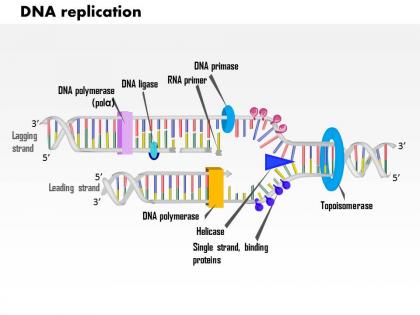
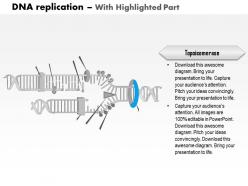
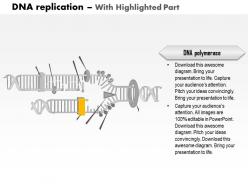
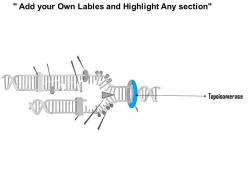
Okay so DNA helicase unwinds the double helix first. Then DNA polymerase comes in and does the actual copying work. Primase drops down these RNA primers - basically just tells polymerase where to start copying. You'll also need DNA ligase to seal up all the gaps afterward. Topoisomerase is kinda interesting too - it stops the DNA from getting super twisted up ahead of the replication fork (which honestly would be a disaster). The whole process runs like an assembly line. Each enzyme handles one specific part. Pro tip: nail down the leading vs lagging strand concept first, then everything else clicks way easier.
So basically prokaryotes are way simpler - their DNA just chills in the cytoplasm and replicates super fast from one starting point. Eukaryotes? Total mess honestly. They've got multiple origins firing at once, everything's slower, and it's all crammed in the nucleus with histones wrapped around everything. Oh and the speed difference is crazy - prokaryotes hit like 1000 nucleotides per second while eukaryotes crawl along. For your test though, just remember single origin vs multiple origins. That's what they'll probably ask about.
So basically, DNA replication starts at these specific spots called origins of replication. Prokaryotes keep it simple - just one origin (oriC) where DnaA proteins latch onto AT-rich sequences. Eukaryotes? Total overachievers. They've got multiple origins per chromosome because their DNA is ridiculously long. Origin recognition complexes (ORCs) do the heavy lifting there, binding to autonomously replicating sequences. Honestly, it's pretty wild how cells nail the timing on this stuff. Focus on those protein-DNA interactions when you're studying - that's where the magic happens.
So basically, DNA polymerase is super picky - it only works 5' to 3'. This means one strand (the leading strand) gets copied smoothly along with the replication fork. But the other strand? Total pain. It has to be synthesized backwards in these little chunks called Okazaki fragments, then ligase stitches them together later. That's why replication looks so weird and asymmetric in textbook diagrams - it's actually happening that way! Pretty wild how evolution figured this out. Oh and this whole mess is why PCR primer design can be tricky sometimes.
So Okazaki fragments are basically these short DNA pieces - like 1000-2000 nucleotides each. They happen because DNA polymerase is picky and only works 5' to 3' direction. Since the two strands run opposite ways, one gets made smoothly but the other? Has to be built in little backward chunks. Kinda weird but it works! Then DNA ligase glues all the fragments together into one complete strand. Oh and if you're doing PCR stuff later, this whole process explains why you need specific enzymes and temps. Makes way more sense once you get the discontinuous synthesis thing down.
So DNA polymerase has this cool 3' to 5' exonuclease thing that's basically like hitting backspace - catches about 99% of screw-ups right away. Then there's mismatch repair that comes through afterward cleaning up whatever got missed. Together they get error rates down to like 1 in 10 billion, which is honestly insane when you think about it. Oh and if you're doing PCR stuff, that's why those fancy high-fidelity polymerases work so much better than regular Taq. Way cleaner bands.
Oh helicases! Those are the enzymes that unzip DNA by breaking hydrogen bonds between base pairs. They crawl along using ATP energy and basically pry the strands apart - like tiny molecular crowbars. The replication fork forms because of this action. DNA polymerases can't do their job without helicases opening things up first. They're always working ahead of the copying machinery, which makes sense when you think about it. Without them, your DNA would stay locked together and replication just wouldn't happen. Pretty wild how something microscopic generates enough force to separate those bonds!
So basically, when DNA copies itself, it keeps one old strand and makes one new strand in each copy. Pretty smart system, honestly. Your cells can check for mistakes by comparing the new part against the original template - like having an answer key. This keeps your genetic info super stable generation after generation, but not *too* stable (mutations still happen sometimes, which is actually good for evolution). Each time cells divide, the daughter cells get this half-old, half-new DNA combo. It's kind of like... hmm, maybe like keeping a backup while updating files? Anyway, that's why your genes don't just fall apart over time.
So basically your cells have this built-in timer called telomeres that get shorter every time they divide. Once they hit a certain point, the cell just stops working or dies - which actually prevents tumors since normal cells can't replicate forever. Pretty clever system, right? But here's where it gets messy: this same process makes us age and causes all sorts of tissue problems over time. Cancer cells are sneaky though - they turn their telomerase back on to keep dividing indefinitely. That's partly why they're so hard to stop. The whole telomerase regulation thing is fascinating if you're digging into aging or cancer stuff.
So basically, environmental stress makes your cells screw up DNA copying way more often. Temperature spikes, UV light, chemicals - they all mess with the proofreading mechanisms that usually catch mistakes. Heavy metals are the worst offenders honestly. Your cells do try to fix things by cranking up repair systems, but when stress gets really bad those pathways just can't keep up. You should definitely check out heat shock proteins though - they're pretty amazing at keeping the whole replication machinery stable. That's probably where you'll see the biggest difference in terms of protection.
So basically, DNA replication screws up in a few main ways. Base mispairing happens when polymerase gets lazy and pairs A with C instead of T - boom, point mutation next round. Slippage is worse though, especially with repetitive sequences. Microsatellites are the worst culprits here, causing insertions or deletions left and right. Your mismatch repair systems usually catch this stuff, but they're not perfect. When they miss errors or get overwhelmed, those mistakes stick around permanently. Oh, and if you're cramming for an exam on this, definitely focus on error-prone polymerases and repeat sequences first - they'll probably show up.
Oh hey so basically your regular DNA polymerases (Pol I, II, III) get stuck when they hit damaged DNA - like they just can't deal with it. That's where the specialized ones jump in, like Pol IV and V. They do this thing called "translesion synthesis" which sounds fancy but really just means they can work around DNA damage that would totally stop normal replication. Sure, they make way more mistakes, but honestly? Better to have some errors than a dead cell, right? Think of them as your DNA's emergency crew - not perfect, but they get the job done when things go sideways.
So DNA replication is basically what controls whether cells can actually divide or not. It happens during S phase, and cells won't move forward to mitosis until they've got perfect chromosome copies. Smart setup, honestly. If something goes wrong with replication - like it's incomplete or there are errors - checkpoint proteins jump in and stop division completely. Can't have damaged DNA getting passed down to daughter cells. This is actually super relevant if you're doing cell culture work since replication problems will totally mess with your timing and division rates. Kind of annoying but makes sense from a biological standpoint.
Okay so replicative stress is basically when your DNA replication machinery gets jammed up - think traffic jam but for chromosomes. When forks stall repeatedly, you end up with single-strand breaks and potential chromosome chaos. Cells hate this obviously, so they fire up damage control through ATR/Chk1 pathways (super important stuff if you're diving deep into this). The whole mess can trigger cell cycle arrest or even kill the cell entirely. Chronic issues here? You're looking at aging, cancer risk, and genetic disorders. It's wild how one cellular traffic jam can snowball into such major problems.
So the coolest stuff happening right now is with single-molecule techniques and cryo-EM - you can literally watch replication happening in real-time, which honestly blew my mind when I first saw it. Lots of focus on how the replisome deals with obstacles like DNA damage and when it crashes into transcription machinery. Proofreading mechanisms are hot again too. How different polymerases work together during error correction is fascinating. Oh, and chromatin structure effects on fork progression - that's getting major attention. Start with papers on replisome stalling and restart mechanisms if you want the most useful stuff right now.
-
Graphics are very appealing to eyes.
-
Editable templates with innovative design and color combination.
-
Nice