


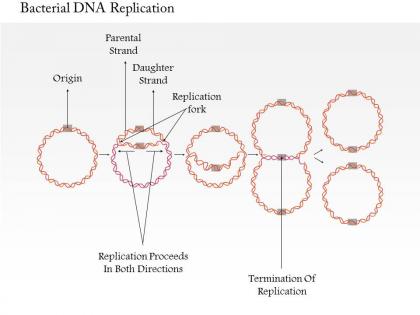
0714 bacterial dna replication medical images for powerpoint




Try Before you Buy Download Free Sample Product
 Impress Your
 Audience
 100%
100% Editable
 Save Hours
 of Time


Lay emphasis with our 0714 Bacterial DNA Replication Medical Images For PowerPoint. They help pinpoint the crucial elements.
People who downloaded this PowerPoint presentation also viewed the following :
0714 bacterial dna replication medical images for powerpoint with all 9 slides:
Eschew half measures with our 0714 Bacterial DNA Replication Medical Images For PowerPoint. They discourage crude attempts.






FAQs for 0714 bacterial dna replication medical
Key enzymes in bacterial DNA replication include DNA helicase, primase, DNA polymerase III, DNA polymerase I, and DNA ligase, each performing critical functions in the replication process. These enzymes work systematically by unwinding the double helix, synthesizing RNA primers, adding nucleotides to growing strands, replacing primers with DNA, and sealing strand breaks, ultimately delivering accurate genetic duplication essential for bacterial reproduction and cellular division.
Bacterial DNA exists as a single, circular chromosome located in the nucleoid region without histones, while eukaryotic DNA comprises multiple linear chromosomes wrapped around histone proteins within the nucleus. This structural difference enables bacteria to replicate more rapidly through a single origin of replication, streamlining cellular division processes compared to eukaryotes' multiple replication origins, ultimately delivering faster reproduction rates and enhanced adaptability in rapidly changing environments.
The origin of replication (oriC) serves as the essential starting point for bacterial DNA replication, containing specific DNA sequences that attract and bind initiator proteins like DnaA. This specialized region enables precise replication timing and coordination by recruiting helicase enzymes, DNA polymerases, and other replication machinery, ultimately ensuring accurate chromosome duplication and proper cell division across bacterial populations.
Bacterial cells ensure DNA replication fidelity through DNA polymerase proofreading activity, mismatch repair systems, and post-replication repair mechanisms that collectively minimize copying errors. These quality control processes enable pharmaceutical companies, biotechnology firms, and research institutions to leverage bacterial systems for reliable protein production, ultimately delivering consistent therapeutic outcomes and enhanced research accuracy.
Single-stranded binding proteins (SSBs) stabilize unwound DNA strands during bacterial replication by preventing secondary structure formation, protecting against nuclease degradation, and facilitating polymerase access to template strands. These proteins enhance replication efficiency by maintaining optimal DNA conformation, coordinating with helicase activity, and ensuring seamless progression of replication machinery, ultimately delivering faster, more accurate bacterial reproduction.
Bacterial DNA replication initiates at the origin of replication (oriC) through DnaA protein binding, helicase unwinding, and primase synthesis of RNA primers. Regulatory mechanisms include DnaA titration by GATC methylation, SeqA protein inhibition, and coordinated cell cycle checkpoints, ensuring replication occurs once per cell division while maintaining genomic stability and enabling consistent bacterial growth across diverse environments.
Leading strand synthesis occurs continuously in the 5' to 3' direction following the replication fork, while lagging strand synthesis happens discontinuously through Okazaki fragments. These complementary processes enable efficient bacterial replication by allowing DNA polymerase to work within its directional constraints, with leading strands facilitating rapid, uninterrupted synthesis and lagging strands ensuring complete genomic duplication through coordinated fragment assembly.
DNA polymerases add nucleotides by catalyzing phosphodiester bond formation between the 3'-hydroxyl group of the growing strand and the 5'-phosphate of incoming nucleotides, while simultaneously proofreading for accuracy. These enzymes enable continuous leading strand synthesis and discontinuous lagging strand replication through Okazaki fragments, ultimately delivering high-fidelity DNA duplication essential for bacterial reproduction and genetic stability.
The replisome complex serves as the central molecular machinery coordinating bacterial DNA replication, integrating DNA helicases, primase, and DNA polymerases to ensure synchronized leading and lagging strand synthesis. This strategic combination streamlines replication efficiency, minimizes errors through proofreading mechanisms, and enables rapid bacterial reproduction, with many microorganisms achieving doubling times under optimal conditions.
Supercoiling dynamics significantly influence bacterial DNA replication by creating tension ahead of replication forks, requiring topoisomerases to relieve accumulated positive supercoils and maintain optimal unwinding conditions. This molecular coordination enables efficient progression through chromosomal regions, with DNA gyrase and topoisomerase IV working together to prevent replication stalling, ultimately ensuring seamless genomic duplication and cellular division processes.
Bacteria employ several mechanisms to resolve replication fork stalling, including RecA-mediated homologous recombination, PriA-dependent restart pathways, and specialized helicases like Rep and UvrD that remove protein roadblocks. These repair systems work synergistically through fork regression, template switching, and lesion bypass strategies, ultimately enabling bacterial cells to maintain genomic integrity while continuing rapid replication cycles essential for their competitive survival advantage.
Bacterial DNA replication contributes to genetic diversity through spontaneous mutations during copying, horizontal gene transfer via plasmids and conjugation, and recombination events that shuffle genetic material. These mechanisms enable bacteria to rapidly adapt to environmental changes, develop antibiotic resistance, and evolve new metabolic capabilities, ultimately delivering enhanced survival advantages in increasingly competitive microbial ecosystems.
RNA primers serve as essential starting points for DNA synthesis in bacterial replication, providing the 3'-OH group that DNA polymerase requires to begin adding nucleotides. These short RNA sequences are synthesized by primase, positioned at replication origins and Okazaki fragment initiation sites, and later removed by DNA polymerase I's 5' exonuclease activity, with DNA ligase sealing the remaining gaps to ensure continuous strand integrity.
Environmental factors influence bacterial DNA replication through temperature fluctuations, pH levels, nutrient availability, and oxidative stress conditions that directly impact polymerase enzyme efficiency and fidelity. These variables affect replication speed and error rates, with extreme conditions potentially compromising genomic stability, while optimal environments enable precise replication processes that maintain cellular integrity and support bacterial growth across diverse ecosystems.
Studies of bacterial DNA replication have revealed how resistance genes are copied and transferred between bacteria, how mutations in replication machinery affect antibiotic sensitivity, and how certain antibiotics target DNA synthesis processes. These insights enable pharmaceutical companies and healthcare organizations to develop targeted therapies, optimize treatment protocols, and design combination strategies, ultimately delivering more effective interventions against resistant strains.
-
Very unique and reliable designs.
-
Topic best represented with attractive design.