


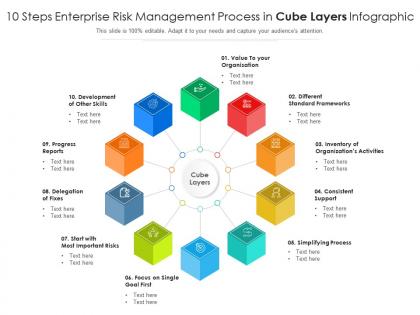
10 steps enterprise risk management process in cube layers infographic




Try Before you Buy Download Free Sample Product
 Impress Your
 Audience
 100%
100% Editable
 Save Hours
 of Time


Our 10 Steps Enterprise Risk Management Process In Cube Layers Infographic are topically designed to provide an attractive backdrop to any subject. Use them to look like a presentation pro.
People who downloaded this PowerPoint presentation also viewed the following :
10 steps enterprise risk management process in cube layers infographic with all 2 slides:
Use our 10 Steps Enterprise Risk Management Process In Cube Layers Infographic to effectively help you save your valuable time. They are readymade to fit into any presentation structure.
FAQs for 10 steps enterprise risk management process in
Key components of an effective ERM framework include risk governance structures, comprehensive risk assessment processes, strategic risk appetite statements, integrated monitoring systems, and robust reporting mechanisms. These elements work together by establishing clear accountability, enabling proactive threat identification, and streamlining decision-making processes, with many organizations finding that this strategic combination ultimately delivers enhanced operational resilience and competitive advantage.
Organizations align ERM strategies with business objectives by integrating risk assessment into strategic planning, establishing risk appetite statements that reflect business goals, and embedding risk considerations into decision-making processes. Through cross-functional collaboration between risk managers and business leaders, companies enhance operational efficiency, protect revenue streams, and maintain competitive advantage, with many finding that aligned strategies ultimately deliver sustainable growth and stakeholder confidence.
Culture serves as the foundation for successful ERM implementation, influencing risk awareness, decision-making processes, communication patterns, and accountability structures throughout the organization. A strong risk-conscious culture enables seamless integration of risk considerations into daily operations, strategic planning, and performance management, with many organizations finding that cultural alignment significantly enhances risk identification, mitigation effectiveness, and overall business resilience.
Technology enhances ERM effectiveness by automating risk identification, enabling real-time monitoring, and providing predictive analytics for proactive decision-making. Through AI-powered platforms, organizations streamline compliance tracking, enhance data accuracy, and accelerate incident response times, with many financial institutions and healthcare systems finding that integrated risk dashboards ultimately deliver greater operational transparency and strategic competitive advantage.
Common ERM implementation challenges include cultural resistance to risk transparency, inadequate cross-departmental coordination, insufficient senior leadership support, complex technology integration requirements, and inconsistent risk assessment methodologies across business units. Many organizations find that overcoming these obstacles requires dedicated change management programs, standardized risk frameworks, and sustained executive commitment, ultimately delivering enhanced operational resilience and strategic decision-making capabilities.
Regulatory requirements fundamentally shape Enterprise Risk Management by mandating specific compliance frameworks, reporting standards, and risk assessment protocols across industries. Financial institutions must adhere to Basel III guidelines, while healthcare organizations follow HIPAA requirements, ultimately driving organizations to implement comprehensive risk monitoring systems that ensure regulatory compliance while enhancing operational resilience and strategic decision-making capabilities.
Organizations should measure ERM effectiveness through key risk indicators (KRIs), risk appetite adherence rates, incident frequency and severity trends, business continuity response times, and regulatory compliance scores. These metrics enable companies to track risk mitigation progress across financial services, manufacturing, and healthcare sectors, while demonstrating improved operational resilience and strategic decision-making capabilities to stakeholders.
Organizations conduct comprehensive risk assessments through systematic risk identification, likelihood evaluation, impact analysis, risk mapping, and stakeholder engagement across all business units. This integrated approach enables companies to prioritize threats, allocate resources strategically, and develop targeted mitigation strategies, with many financial institutions and healthcare organizations finding that comprehensive assessments significantly enhance operational resilience and regulatory compliance.
ERM and corporate governance are intrinsically linked, with ERM serving as a critical component of effective governance frameworks that ensures systematic risk oversight, strategic decision-making, and regulatory compliance. Through integrated risk assessment and board-level reporting, organizations streamline governance processes, enhance stakeholder transparency, and deliver stronger accountability measures, with many enterprises finding that this strategic combination ultimately strengthens competitive positioning.
Organizations effectively communicate risks to stakeholders through clear, tiered reporting frameworks, regular dashboards with visual risk indicators, tailored messaging for different audience levels, and structured governance meetings. These approaches streamline transparency by presenting complex data in digestible formats, establishing consistent communication cadences, and enabling proactive decision-making, with many enterprises finding that standardized risk reporting enhances stakeholder confidence and strategic alignment.
Organizations can foster proactive risk management culture through regular risk assessments, comprehensive employee training, clear escalation protocols, cross-departmental collaboration, and leadership commitment to transparency. These practices enhance operational resilience by encouraging early risk identification, streamlining communication channels, and embedding risk awareness across all organizational levels, with many enterprises finding that consistent leadership modeling and employee empowerment ultimately delivers stronger competitive positioning.
Emerging risks like cyber threats and climate change fundamentally reshape ERM strategies by requiring dynamic risk assessment frameworks, integrated cross-functional responses, and enhanced scenario planning capabilities. Organizations increasingly adopt real-time monitoring systems, strengthen cybersecurity protocols, and develop climate resilience plans, with many financial institutions and manufacturing companies finding that proactive risk adaptation delivers competitive advantage and operational continuity.
Leadership drives enterprise-wide risk management by establishing risk governance frameworks, allocating strategic resources, and fostering organizational risk awareness cultures. Through executive sponsorship and clear accountability structures, leaders enable consistent risk assessment protocols, cross-functional collaboration, and integrated decision-making processes, with many organizations finding that strong leadership commitment ultimately delivers enhanced operational resilience and competitive advantage.
Scenario analysis strengthens risk management by modeling potential future events, stress-testing current strategies, identifying vulnerabilities across multiple business units, and evaluating response effectiveness under various conditions. Through comprehensive scenario planning, organizations enhance strategic decision-making, improve resource allocation, and build resilient operational frameworks, with many financial institutions and multinational corporations finding that regular scenario exercises ultimately deliver competitive advantages and superior crisis preparedness.
Integrating ERM with strategic planning delivers enhanced decision-making capabilities, improved resource allocation, better risk visibility, and stronger competitive positioning. Through this strategic combination, organizations can anticipate market volatility, optimize investment strategies, and align operational priorities with risk tolerance, with many enterprises finding that integrated approaches ultimately reduce unexpected losses while accelerating strategic goal achievement.
-
Excellent Designs.
-
Awesomely designed templates, Easy to understand.
-
Content of slide is easy to understand and edit.
-
Helpful product design for delivering presentation.