


100 days plan defining approach and growing capabilities




Try Before you Buy Download Free Sample Product
 Impress Your
 Audience
 100%
100% Editable
 Save Hours
 of Time


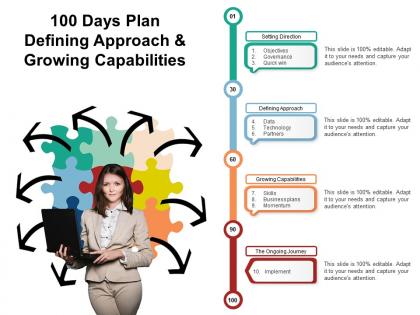
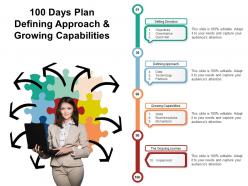
Presenting this set of slides with name 100 Days Plan Defining Approach and Growth Capabilities. This business template will help you reach your destination much easier and faster. The PowerPoint template helps you in analyzing all the hindrances occurring in your business’ growth. This PPT keeps your agenda of the business on the track. The PowerPoint Presentation doesn’t let you go off the track you are working on. This slideshow is a three stage process. The stages in this process are 100 day plan, 100 day action plan and 100 day strategy. The various dimensions that need to be carried out in the process are setting of direction, defining approach at the end of 30 days, growing capabilities at the end of 60 days and the ongoing journey from 90 days till 100 days. Using this attractive PowerPoint slideshow of ours you can attract your audience in a large proportion. Continue on course to your destination with our 100 Days Plan Defining Approach And Growing Capabilities. Ensure your agenda doesn't get derailed.
People who downloaded this PowerPoint presentation also viewed the following :
100 days plan defining approach and growing capabilities with all 6 slides:
Enlighten folks on the importance of ethics with our 100 Days Plan Defining Approach And Growing Capabilities. Highlight examples of good character.



FAQs for 100 days plan defining approach
Key components include clear goal setting, skill assessment, learning milestones, accountability measures, and regular progress reviews. These elements work together by establishing focused objectives, identifying development gaps, and creating structured pathways for growth, with many professionals finding that this systematic approach delivers measurable improvements in capabilities and career advancement within organizations.
Organizations can tailor 100-day plans by setting specific productivity metrics, implementing targeted workflow improvements, establishing regular feedback loops, and introducing collaborative tools aligned with team strengths. Through phased implementation, companies in sectors like manufacturing and financial services streamline operations, reduce bottlenecks, and enhance communication, ultimately delivering measurable efficiency gains and stronger team performance.
Goal setting provides the strategic foundation for 100-day plans by establishing clear, measurable objectives, defined timelines, specific accountability measures, and milestone tracking systems. These structured targets enable organizations to maintain focused execution, measure progress consistently, and course-correct when needed, with many companies finding that well-defined goals ultimately deliver faster results and sustained momentum.
Measuring a 100-day plan's effectiveness involves comparing actual outcomes against initial objectives, tracking key performance indicators, analyzing completion rates of milestones, and gathering stakeholder feedback. Organizations typically conduct comprehensive reviews examining quantitative metrics like revenue growth or cost reduction alongside qualitative assessments, with many finding that structured evaluation processes enable better strategic planning and ultimately deliver improved execution for future initiatives.
Common pitfalls include setting unrealistic expectations, lacking stakeholder buy-in, insufficient resource allocation, poor milestone tracking, and inadequate flexibility for adjustments. These challenges can derail progress through overcommitment, miscommunication, and rigid planning, with many organizations finding that balanced goal-setting, regular check-ins, and adaptive frameworks ultimately deliver sustainable momentum and measurable results.
A 100-day plan adapts to remote environments by emphasizing digital communication tools, virtual check-ins, and clear milestone tracking systems. Remote managers can leverage video conferencing platforms, collaborative project management software, and regular one-on-one sessions to maintain accountability, while establishing structured feedback loops and celebrating achievements virtually, ultimately delivering stronger team cohesion and measurable progress.
Project management tools like Asana, Trello, Monday.com, Microsoft Project, and Gantt chart software can effectively track 100-day plan progress through milestone tracking, task dependencies, and real-time dashboards. These platforms streamline progress monitoring by automating status updates, facilitating team collaboration, and providing visual analytics, with many organizations finding that integrated tracking systems enhance accountability and deliver faster goal achievement.
Visual presentation templates enhance 100-day plan communication by standardizing layouts, improving data clarity, ensuring consistent branding, and simplifying complex timelines into digestible formats. These templates streamline stakeholder presentations, enable faster progress tracking, and deliver clearer milestone visualization, with many organizations finding that structured visual frameworks significantly improve team alignment and executive buy-in across implementation phases.
Overcoming resistance during 100-day plan implementation requires transparent communication, early stakeholder involvement, clear role definitions, and regular progress celebrations. Organizations find success by addressing concerns proactively, providing necessary training and resources, and demonstrating quick wins that build momentum, ultimately creating buy-in while maintaining team cohesion throughout the transformation process.
Feedback can be integrated through scheduled check-ins at 30, 60, and 90-day milestones, regular stakeholder surveys, and real-time performance metrics tracking. These mechanisms enable course corrections, identify emerging challenges, and capture insights from team members, customers, and leadership, ultimately ensuring the plan remains agile and delivers measurable outcomes while building organizational learning capabilities.
Best practices for reviewing and revising a 100-day plan include establishing weekly check-ins, tracking measurable milestones, gathering stakeholder feedback, documenting lessons learned, and adjusting timelines based on real-world constraints. These review mechanisms enable organizations to maintain strategic focus while adapting to changing priorities, with many leadership teams finding that regular revisions ultimately deliver stronger execution and sustainable momentum.
A 100-day plan aligns with long-term strategic goals by establishing foundational initiatives, key performance metrics, and stakeholder engagement frameworks that directly support broader organizational objectives. These short-term milestones create momentum through early wins, resource optimization, and strategic positioning, with many organizations finding that focused quarterly execution ultimately delivers measurable progress toward multi-year visions.
Accountability ensures 100-day plan success by establishing clear ownership, regular progress reviews, and transparent reporting mechanisms that maintain momentum and focus. Through structured check-ins and milestone tracking, organizations create responsibility frameworks that prevent delays, identify obstacles early, and drive consistent execution, with many leadership teams finding that shared accountability accelerates results and enhances strategic outcomes.
Effective stakeholder communication involves regular progress updates, transparent milestone tracking, visual dashboards, and structured feedback sessions throughout the timeline. These approaches streamline alignment by establishing clear expectations, addressing concerns proactively, and maintaining engagement, with many organizations finding that consistent communication ultimately delivers stronger buy-in and accelerated implementation across teams.
Successful 100-day plans include CEO transitions focusing on stakeholder meetings and quick wins, digital transformation initiatives prioritizing system integration and employee training, and merger integrations emphasizing cultural alignment and operational synergies. These strategic approaches deliver measurable outcomes by establishing clear milestones, maintaining stakeholder engagement, and creating momentum for long-term success, with many organizations finding that structured early execution significantly enhances overall project viability.
No Reviews