


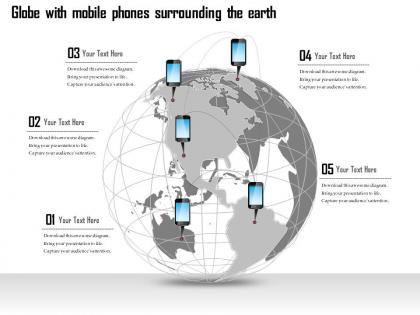
1114 globe with mobile phones surrounding the earth ppt slide




Try Before you Buy Download Free Sample Product
 Impress Your
 Audience
 100%
100% Editable
 Save Hours
 of Time


Folks consider you an excellent choice due to our 1114 Globe With Mobile Phones Surrounding The Earth Ppt Slide. Get elected to the helm of affairs.
People who downloaded this PowerPoint presentation also viewed the following :
1114 globe with mobile phones surrounding the earth ppt slide with all 5 slides:
Our 1114 Globe With Mobile Phones Surrounding The Earth Ppt Slide generate bonhomie. A good group culture will evolve.


FAQs for 1114 globe with mobile phones surrounding the
Key factors driving mobile connectivity growth in developing regions include affordable smartphone penetration, expanding 4G and 5G infrastructure, mobile-first financial services, government digitization initiatives, and innovative low-cost data plans. These developments enable businesses to reach previously underserved markets through mobile banking, e-commerce, and digital services, with many telecommunications providers finding that strategic partnerships with local governments accelerate market expansion while delivering enhanced economic opportunities.
5G technology enhances mobile connectivity by delivering significantly faster data speeds, ultra-low latency, and massive device capacity compared to 4G and earlier networks. Through advanced infrastructure and spectrum efficiency, organizations in healthcare, manufacturing, and financial services can enable real-time applications, seamless IoT integration, and enhanced customer experiences, ultimately delivering competitive advantage in an increasingly connected business landscape.
Mobile connectivity significantly enhances remote work productivity by enabling seamless access to cloud applications, real-time communication tools, video conferencing platforms, and collaborative workspaces from anywhere. Through reliable mobile networks, remote teams streamline project coordination, accelerate decision-making processes, and maintain consistent workflow continuity, with many organizations finding that enhanced mobile infrastructure delivers improved employee satisfaction and competitive operational efficiency.
Businesses can leverage mobile connectivity to improve customer engagement through push notifications, location-based marketing, mobile apps, real-time customer support, and personalized messaging campaigns. These strategies enable companies to reach customers instantly, deliver targeted offers based on behavior and location, and provide seamless omnichannel experiences, ultimately driving higher conversion rates and customer loyalty across retail, hospitality, and service industries.
Mobile connectivity serves as the critical backbone enabling IoT devices to communicate, transmit data, and function remotely across vast networks. Through 4G, 5G, and cellular technologies, organizations can deploy IoT solutions in manufacturing, healthcare, and smart cities, ultimately delivering real-time monitoring, predictive maintenance, and enhanced operational efficiency at unprecedented scale.
Enhanced mobile security practices mitigate connectivity risks through multi-factor authentication, encrypted data transmission, regular software updates, and comprehensive device management protocols. These measures enable organizations to protect sensitive information while maintaining operational flexibility, with financial institutions and healthcare providers finding that robust mobile security frameworks ultimately deliver improved customer trust and regulatory compliance.
Rural areas face significant challenges in achieving reliable mobile connectivity, including limited infrastructure investment, geographical barriers like mountains and forests, lower population density making tower deployment less economically viable, and higher costs for network expansion. These obstacles result in coverage gaps, slower data speeds, and unreliable service quality, with many rural communities finding that inadequate connectivity limits access to essential services, economic opportunities, and digital resources.
Mobile connectivity significantly influences social media usage by enabling real-time content sharing, location-based interactions, and instant messaging capabilities across platforms. Through enhanced network speeds and smartphone integration, users increasingly engage with multimedia content, live streaming, and mobile-first features, while businesses leverage improved connectivity for targeted advertising and customer engagement, ultimately delivering more personalized experiences.
Mobile connectivity enhances healthcare access by enabling telemedicine consultations, remote patient monitoring, digital health records, appointment scheduling systems, and medication adherence apps. Through these technologies, rural communities receive specialist care, hospitals streamline patient management, and healthcare providers deliver faster diagnoses while reducing costs, ultimately improving patient outcomes and operational efficiency.
Mobile connectivity is transforming e-commerce by enabling seamless shopping experiences, real-time inventory management, location-based services, and instant payment processing. Through mobile platforms, retailers streamline customer interactions, personalize recommendations, and facilitate one-click purchases, while consumers increasingly expect faster checkout processes and mobile-optimized interfaces, ultimately delivering enhanced convenience and competitive advantage.
Mobile connectivity infrastructure expansion presents both environmental challenges and opportunities, including increased energy consumption, electronic waste generation, carbon emissions from network operations, habitat disruption from tower installations, and resource extraction for device manufacturing. However, mobile technologies also enable environmental monitoring, smart grid optimization, and remote work capabilities, with many telecommunications companies increasingly adopting renewable energy sources and sustainable practices to minimize their ecological footprint while delivering enhanced connectivity.
Cultural differences influence mobile connectivity adoption through varying technology acceptance patterns, infrastructure investment priorities, and generational digital divides across different societies. Countries with collectivist cultures often see faster adoption in business applications, while individualistic societies prioritize personal connectivity features, with regions like Southeast Asia and Nordic countries demonstrating distinct mobile-first approaches that ultimately deliver different competitive advantages and market opportunities.
Emerging advancements include 6G networks, satellite-cellular integration, AI-powered network optimization, edge computing enhancement, and quantum communication protocols. These technologies streamline connectivity by delivering ultra-low latency, seamless global coverage, and intelligent resource allocation, with telecommunications companies and enterprises finding that enhanced mobile infrastructure ultimately enables faster digital transformation and competitive advantage.
Mobile connectivity trends vary significantly across age groups, income levels, geographic regions, and education backgrounds, with younger demographics favoring smartphones and social platforms while older users prioritize basic communication features. These demographic patterns enable businesses to tailor their mobile strategies more effectively, with retail companies, financial services, and healthcare organizations finding that targeted approaches deliver better customer engagement and significantly improved service adoption rates.
Mobile connectivity revolutionizes education by enabling remote learning access, real-time collaboration, personalized content delivery, interactive multimedia experiences, and seamless resource sharing across diverse platforms. Educational institutions increasingly find that mobile-enabled learning enhances student engagement, reduces geographical barriers, and delivers cost-effective scalable solutions, ultimately transforming traditional classroom models into flexible, accessible learning environments.
-
Great quality slides in rapid time.
-
Visually stunning presentation, love the content.