


3 circles with arrows connected business process steps




Try Before you Buy Download Free Sample Product
 Impress Your
 Audience
 100%
100% Editable
 Save Hours
 of Time


Our 3 Circles With Arrows Connected Business Process Steps cause elation. Experience happiness beyond expectation.
People who downloaded this PowerPoint presentation also viewed the following :
Content of this Powerpoint Presentation
Description:
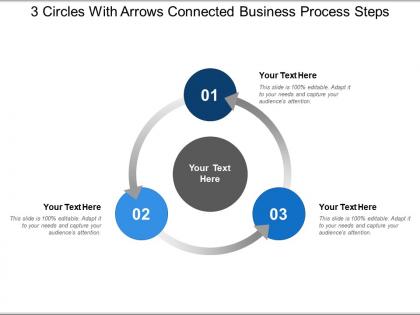
The image shows a PowerPoint slide designed to present a three-step business process. It features three circles, each labeled with a number from 01 to 03, indicating a sequence. The circles are connected by arrows that flow clockwise, suggesting a cyclical process or a series of steps that repeat or lead into one another.
Each circle has a placeholder saying "Your Text Here," which allows the presenter to describe what each step in the process entails. This customizable feature is reiterated by a note on the slide that states "This slide is 100% editable. Adapt it to your needs and capture your audience's attention."
Use Cases:
Circular process diagrams are essential in sectors that benefit from illustrating a sequence of steps or stages in a cyclical workflow.
1. Manufacturing:
Use: Depicting product lifecycle stages
Presenter: Process Engineers
Audience: Operational teams, management
2. Software Development:
Use: Outlining agile development cycles
Presenter: Project Managers
Audience: Developers, stakeholders
3. Marketing:
Use: Presenting campaign development phases
Presenter: Marketing Strategists
Audience: Marketing team, brand managers
4. Pharmaceutical:
Use: Drug development and approval process
Presenter: Research Scientists
Audience: Regulatory teams, investors
5. Education:
Use: Curriculum development process
Presenter: Curriculum Coordinators
Audience: Educators, academic staff
6. Environmental Services:
Use: Waste management and recycling processes
Presenter: Environmental Planners
Audience: Municipal teams, community organizations
7. Event Planning:
Use: Stages of event organization
Presenter: Event Planners
Audience: Vendors, event staff
3 circles with arrows connected business process steps with all 5 slides:
Eliminate hard feelings with our 3 Circles With Arrows Connected Business Process Steps. Benefit from a congenial environment.





FAQs for 3 circles with arrows connected
**INPUT**: What are the key components of an effective business process flow? **OUTPUT**: Effective business process flows include clear start and end points, defined roles and responsibilities, decision gates, performance metrics, and standardized procedures. These components streamline operations by eliminating bottlenecks, enhancing accountability, and ensuring consistency across departments, with many organizations finding that well-structured flows ultimately deliver faster cycle times and improved customer experiences. [Word count: 54 words]
Mapping business processes improves organizational efficiency by identifying bottlenecks, eliminating redundant steps, and standardizing workflows across departments. This visualization enables organizations to streamline operations, reduce cycle times, and enhance resource allocation, with many companies finding that process mapping delivers cost reductions of 15-30% while improving service delivery and employee productivity.
Technology streamlines business process flows through automation, real-time analytics, workflow management systems, artificial intelligence, and integration platforms. These solutions enhance operational efficiency by eliminating manual bottlenecks, accelerating decision-making, and enabling seamless data exchange across departments, with many organizations finding that strategic technology adoption delivers faster services, reduced costs, and improved competitive positioning.
Businesses can identify bottlenecks by analyzing process maps, tracking performance metrics, monitoring resource utilization, conducting time studies, and gathering employee feedback about workflow obstacles. Through data analytics and process visualization tools, organizations streamline operations by pinpointing delays, resource constraints, and inefficient handoffs, ultimately delivering faster turnaround times and enhanced operational efficiency.
Best practices for documenting business process flows include using standardized notation like BPMN, defining clear start and end points, identifying decision points and exceptions, and involving actual process participants in validation. These practices enhance operational efficiency by ensuring accuracy, facilitating training, and enabling continuous improvement, with many organizations finding that well-documented processes reduce onboarding time and improve compliance significantly.
Determining the right metrics involves identifying key performance indicators aligned with business objectives, stakeholder expectations, customer satisfaction levels, operational efficiency targets, and quality standards. Organizations typically focus on cycle time, error rates, cost per transaction, and customer feedback scores, with many finding that combining quantitative data with qualitative insights delivers comprehensive process visibility and competitive advantage.
Techniques to streamline repetitive tasks include automation software, workflow templates, batch processing, standardized procedures, and digital integration tools. These approaches enhance operational efficiency by reducing manual errors, accelerating task completion, and freeing resources for strategic activities, with many organizations finding that automated workflows deliver faster processing times and improved accuracy.
Employee feedback enhances business process optimization by identifying operational bottlenecks, revealing workflow inefficiencies, and uncovering automation opportunities that management might overlook. Through structured feedback systems, organizations streamline resource allocation, reduce task redundancy, and accelerate service delivery, with many companies finding that frontline insights ultimately deliver significant cost reductions and improved customer experiences.
**INPUT**: What tools and software are recommended for visualizing business process flows? **OUTPUT**: Recommended tools include Microsoft Visio, Lucidchart, Bizagi, ProcessOn, and Draw.io, each offering drag-and-drop functionality and collaborative features. These platforms streamline workflow documentation by providing customizable templates, real-time collaboration, and integration capabilities, with many organizations finding that visual process mapping enhances operational efficiency and facilitates better cross-departmental communication. **Word count: 54 words**
Businesses should revisit process flows quarterly for operational reviews and annually for comprehensive strategic assessments, with additional revisions triggered by technology changes, regulatory updates, or performance gaps. Many organizations find that regular quarterly check-ins enable rapid adaptation to market shifts, while annual deep-dives ensure processes align with growth objectives, ultimately delivering sustained operational efficiency and competitive advantage.
Common pitfalls include overcomplicating workflows, skipping stakeholder input, ignoring system integration requirements, failing to define clear decision points, and neglecting regular process reviews. These oversights often result in bottlenecks, miscommunication, and inefficient resource allocation, with many organizations finding that thorough planning and continuous optimization ultimately deliver streamlined operations and enhanced productivity.
Cross-functional collaboration enhances business process design by bringing diverse perspectives, identifying bottlenecks across departments, and ensuring seamless handoffs between teams. When representatives from sales, operations, IT, and customer service collaborate, organizations streamline workflows, reduce redundancies, and create more efficient processes, ultimately delivering faster customer responses and improved operational efficiency.
A well-defined process flow significantly enhances customer satisfaction by reducing wait times, minimizing errors, and ensuring consistent service delivery across all touchpoints. Through streamlined operations, businesses like banks and retail companies deliver faster loan approvals, accurate order fulfillment, and seamless customer interactions, ultimately building trust and loyalty while gaining competitive advantage.
Training employees on process flows enhances overall performance by improving task execution, reducing errors, and accelerating decision-making across operations. Through comprehensive process understanding, organizations streamline workflows, minimize bottlenecks, and ensure consistent service delivery, with many companies finding that well-trained teams achieve significantly higher productivity and customer satisfaction rates.
Businesses can adopt strategies including regular process audits, employee feedback systems, technology automation, performance metrics tracking, and cross-functional team reviews for continuous improvement. These approaches streamline operations by identifying bottlenecks, reducing redundancies, and enhancing workflow efficiency, with many organizations finding that systematic improvement cycles ultimately deliver faster service delivery and significant cost reductions.
-
I discovered this website through a google search, the services matched my needs perfectly and the pricing was very reasonable. I was thrilled with the product and the customer service. I will definitely use their slides again for my presentations and recommend them to other colleagues.
-
Best way of representation of the topic.