


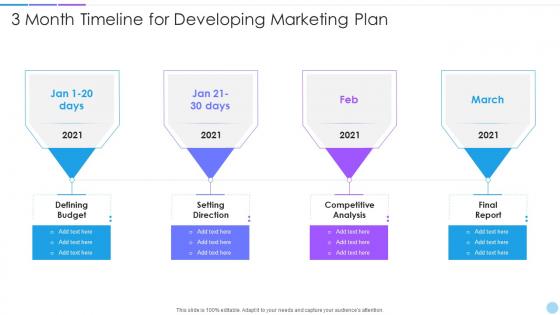
3 Month Timeline For Developing Marketing Plan




Try Before you Buy Download Free Sample Product
 Impress Your
 Audience
 100%
100% Editable
 Save Hours
 of Time


Our 3 Month Timeline For Developing Marketing Plan are topically designed to provide an attractive backdrop to any subject. Use them to look like a presentation pro.
People who downloaded this PowerPoint presentation also viewed the following :
3 Month Timeline For Developing Marketing Plan with all 6 slides:
Use our 3 Month Timeline For Developing Marketing Plan to effectively help you save your valuable time. They are readymade to fit into any presentation structure.






FAQs for 3 Month Timeline For
Key components of a successful marketing plan timeline include campaign phases, milestone deadlines, budget allocation periods, content creation schedules, and performance review checkpoints. These elements work together by ensuring strategic coordination across teams, maintaining consistent market presence, and enabling real-time adjustments, with many organizations finding that structured timelines deliver improved ROI and faster campaign execution.
Businesses can set realistic marketing timelines by analyzing historical campaign data, factoring in resource availability, stakeholder approval processes, and seasonal market dynamics. Through strategic planning that accounts for content creation cycles, testing phases, and potential revisions, organizations streamline execution while building buffer time, ultimately delivering campaigns that meet objectives without compromising quality or team burnout.
Market research plays a foundational role in shaping marketing plan timelines by informing campaign duration, resource allocation, seasonal timing, and competitive positioning strategies. Through comprehensive audience analysis and competitive intelligence, organizations can optimize launch sequences, adjust promotional phases, and align messaging cadences with customer buying cycles, ultimately delivering more targeted campaigns and higher conversion rates.
Companies can prioritize marketing activities by evaluating impact potential, resource requirements, target audience alignment, and strategic business objectives. Through data-driven assessment frameworks, organizations streamline resource allocation, focus on high-ROI initiatives first, and sequence campaigns strategically, with many finding that prioritizing customer acquisition during peak seasons and retention during slower periods ultimately delivers enhanced efficiency and competitive advantage.
Tools for creating marketing plan timelines include project management platforms like Asana, Trello, and Monday.com, specialized marketing software such as CoSchedule and HubSpot, and visual planning tools like Gantt charts in Microsoft Project. These platforms streamline campaign coordination, automate task assignments, and provide real-time collaboration features, with many marketing teams finding that integrated dashboards significantly enhance workflow efficiency and campaign execution across multiple channels.
Seasonal trends significantly impact marketing campaign timing by dictating peak demand periods, consumer behavior shifts, and competitive landscape changes throughout the year. Retail businesses often launch back-to-school campaigns in July, holiday promotions in October, and fitness products in January, while travel companies align campaigns with booking seasons, ultimately enabling strategic resource allocation and maximizing campaign effectiveness during high-conversion windows.
Businesses should avoid unrealistic deadlines, insufficient buffer time for revisions, overlooking seasonal market fluctuations, and failing to coordinate cross-departmental dependencies. Many organizations find that inadequate stakeholder input and rigid scheduling without contingency planning ultimately derail campaigns, while successful companies build flexibility into timelines, enabling faster adaptation and sustained competitive advantage.
Marketing timelines should be reviewed monthly for tactical adjustments and quarterly for strategic pivots, with major campaigns requiring weekly monitoring during execution phases. This approach enables organizations to respond to market shifts, seasonal trends, and performance data while maintaining strategic momentum, with many successful companies finding that regular timeline flexibility ultimately delivers better ROI and competitive responsiveness.
Effective timeline management strategies include regular milestone reviews, buffer time allocation, cross-functional communication protocols, progress tracking dashboards, and resource contingency planning. These approaches streamline project coordination by establishing clear accountability, enabling proactive issue resolution, and maintaining stakeholder alignment, with many marketing teams finding that structured check-ins and flexible resource allocation ultimately deliver more predictable campaign launches and improved ROI.
Different marketing types require varying lead times and execution schedules, with digital campaigns launching within days, social media content requiring consistent daily posting, and print materials needing 4-6 weeks for production and distribution. These diverse timelines necessitate strategic coordination and staggered planning phases, with many organizations finding that integrated campaigns combining all three channels deliver optimal market penetration and customer engagement.
Milestones can be effectively integrated through campaign launch dates, lead generation targets, conversion benchmarks, budget checkpoints, and performance review periods. These strategic markers enable marketing teams to track progress systematically, adjust tactics based on real-time data, and maintain accountability across channels, with many organizations finding that milestone-driven timelines enhance campaign optimization and deliver measurable ROI improvements.
Marketing plan timelines adapt to different target audiences by adjusting campaign durations, messaging frequencies, and channel deployment based on each segment's buying behaviors, decision-making processes, and engagement preferences. For instance, B2B audiences often require longer nurturing cycles with quarterly touchpoints, while consumer segments may need rapid, weekly social media campaigns, ultimately enabling more targeted resource allocation and higher conversion rates across diverse market segments.
Aligning marketing timelines with sales goals ensures coordinated efforts that maximize revenue generation, optimize resource allocation, and create seamless customer journeys from awareness to purchase. This strategic synchronization enables marketing campaigns to deliver qualified leads precisely when sales teams need them, while ensuring product launches, promotional activities, and lead nurturing efforts directly support quarterly targets and business growth objectives.
Feedback loops can be incorporated through scheduled review points, performance milestone assessments, campaign analytics checkpoints, and post-campaign evaluations at predetermined intervals throughout the timeline. These systematic touchpoints enable marketing teams to gather customer insights, measure campaign effectiveness, and adjust strategies in real-time, ultimately delivering improved ROI and more targeted future campaigns.
Successful marketing campaign timelines include Apple's months-long product launch buildups with teaser campaigns, Nike's seasonal sport-specific campaigns aligned with major events, Coca-Cola's year-round brand storytelling with holiday intensifications, and Amazon's strategic Prime Day preparations spanning weeks. These campaigns streamline audience engagement, maximize brand visibility, and coordinate across multiple channels, with many brands finding that longer preparation periods ultimately deliver higher conversion rates and stronger market impact.
-
Wide collection of templates available. SlideTeam has made it easier to create presentations in just a few minutes.
-
“Ample and amazing variety of templates available, really helpful for making professional PPT for day to day workings.”