


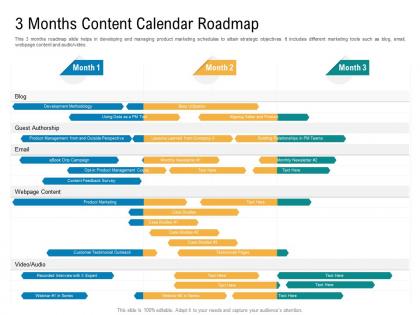
3 months content calendar roadmap timeline powerpoint template




Try Before you Buy Download Free Sample Product
 Impress Your
 Audience
 100%
100% Editable
 Save Hours
 of Time


Our 3 Months Content Calendar Roadmap Timeline Powerpoint Template are topically designed to provide an attractive backdrop to any subject. Use them to look like a presentation pro.
People who downloaded this PowerPoint presentation also viewed the following :
3 months content calendar roadmap timeline powerpoint template with all 2 slides:
Use our 3 Months Content Calendar Roadmap Timeline Powerpoint Template to effectively help you save your valuable time. They are readymade to fit into any presentation structure.

FAQs for 3 months content calendar roadmap
An effective content calendar template should include content type, publication date, target audience, distribution channels, responsible team members, content status, and performance metrics tracking. These elements streamline content planning by enabling better resource allocation, ensuring consistent messaging across platforms, and facilitating collaboration, with many marketing teams finding that comprehensive templates ultimately deliver improved campaign coordination and measurable content ROI.
Businesses can tailor content calendar templates by aligning content types, posting frequencies, and platform choices with their specific objectives, whether driving brand awareness, lead generation, or customer retention. Through strategic customization of themes, campaign timing, and performance metrics tracking, organizations streamline their marketing efforts while maintaining consistent messaging, ultimately delivering more targeted content that resonates with their audience and drives measurable results.
Popular content calendar tools include Trello, Asana, CoSchedule, Hootsuite, and Google Sheets, each offering different collaboration and automation features. These platforms streamline content planning by enabling team collaboration, automated scheduling, and performance tracking, with many marketing teams finding that integrated tools like CoSchedule significantly enhance workflow efficiency and content consistency.
Content calendars should be reviewed weekly for immediate adjustments and comprehensively updated monthly to maintain strategic alignment, with quarterly reviews ensuring long-term relevance. Many marketing teams find that this layered approach enables them to respond quickly to trending topics, seasonal opportunities, and campaign performance data, while maintaining consistent brand messaging and ultimately delivering more targeted audience engagement across all channels.
High-impact content types include educational resources, industry insights, customer success stories, product demonstrations, and seasonal campaigns. These content formats enhance audience engagement by addressing pain points, showcasing expertise, and building trust, with many organizations finding that strategic combinations of educational and promotional content ultimately deliver stronger lead generation and customer retention.
Seasonal trends can be incorporated by mapping key holidays, industry-specific cycles, weather patterns, and cultural events directly into your template's monthly framework. This strategic approach enables businesses to align content with consumer behavior shifts, capitalize on predictable demand spikes, and maintain relevance throughout the year, with many organizations finding that seasonal planning significantly enhances engagement rates.
Audience research serves as the foundation for content calendar development by identifying target demographics, preferred content formats, optimal posting times, engagement patterns, and platform preferences. This strategic insights enable marketers to create highly targeted content schedules that resonate with specific audience segments, ultimately delivering improved engagement rates and stronger ROI across all marketing channels.
Visual elements enhance content calendar usability by incorporating color coding for different content types, icons for platforms and status indicators, timeline views for deadline tracking, and drag-and-drop functionality for easy scheduling adjustments. These design features streamline workflow management by enabling quick content identification, reducing scheduling conflicts, and facilitating team collaboration, ultimately delivering faster content planning and improved campaign coordination.
Common content calendar mistakes include overambitious posting schedules, neglecting audience preferences, ignoring seasonal trends, poor content variety planning, and inadequate buffer time for revisions. Many organizations find that unrealistic timelines, insufficient collaboration workflows, and failure to track performance metrics ultimately compromise content quality and team efficiency, while strategic planning with realistic deadlines enhances consistency and engagement.
A content calendar facilitates better collaboration by providing centralized visibility into content schedules, responsibilities, and deadlines, enabling team members to coordinate efforts, avoid duplicated work, and align on strategic messaging. Through shared planning platforms, marketing teams, designers, and content creators can seamlessly track project progress, provide timely feedback, and ensure consistent brand voice across all channels, ultimately delivering more cohesive campaigns.
Key metrics include engagement rates, website traffic, lead generation, conversion rates, social media reach, and content performance across channels. These measurements enable organizations to optimize their content strategy by identifying high-performing topics, preferred formats, and optimal posting times, ultimately delivering improved ROI and stronger audience connections across marketing initiatives.
A content calendar helps repurpose content by tracking original pieces and mapping adaptations across platforms, scheduling cross-platform variations, and identifying optimal timing for each format. Through strategic planning, businesses can transform blog posts into social media series, infographics, and video content, ultimately maximizing content ROI while maintaining consistent messaging across channels.
Strategies include creating buffer time slots, maintaining evergreen content reserves, implementing modular content blocks, establishing rapid approval workflows, and designating flexible publication dates. These approaches enable organizations to pivot quickly during market shifts, seasonal changes, or trending topics, with many marketing teams finding that strategic flexibility ultimately delivers stronger audience engagement and competitive responsiveness.
A content calendar supports SEO objectives by enabling strategic keyword targeting, consistent publishing schedules, seasonal content optimization, and comprehensive topic coverage across your website. Through systematic planning, businesses can align content with search trends, maintain regular posting frequency that search engines favor, and ensure balanced keyword distribution, ultimately improving organic rankings and driving sustainable website traffic growth.
Integrating social media planning into a content calendar enhances cross-platform consistency, streamlines campaign coordination, improves resource allocation, enables strategic timing optimization, and facilitates performance tracking across channels. This strategic combination allows marketing teams to maintain unified messaging while maximizing engagement through coordinated launches, with many organizations finding that integrated planning delivers significantly improved ROI and operational efficiency.
-
It saves your time and decrease your efforts in half.
-
Easily Editable.
-
Attractive design and informative presentation.
-
Content of slide is easy to understand and edit.
-
Best Representation of topics, really appreciable.
-
The Designed Graphic are very professional and classic.
-
Wonderful templates design to use in business meetings.
-
Understandable and informative presentation.
-
Attractive design and informative presentation.