


3 months timeline for financial planning




Try Before you Buy Download Free Sample Product
 Impress Your
 Audience
 100%
100% Editable
 Save Hours
 of Time


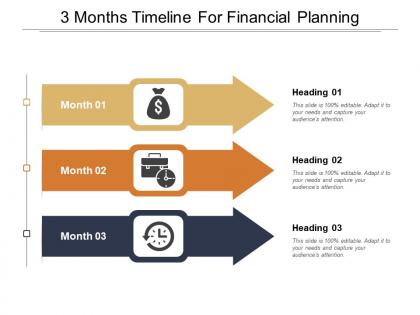
Financial planning is the foremost thing done by any organization for all the business task. Every event that carried out basically depends on two factors that are time and money. 3 months timeline for financial planning presentation template helps you in discussing the financial plan of business projects. You can share the total expenses of the project such as business registration fees, licensing and permits, starting inventory, deposited rent, down payments on property and equipment, utility set up fees with the help of a financial plan PowerPoint slide. You can discuss other expenses, for example, operating expenses which include salaries, rent or mortgage payments, telecommunication, utilities, raw materials, storage, distribution, promotion, loan payments, office supplies, maintenance etc. The arrow figure slide helps you go motivate your team to work hard and smartly so that the organization achieves the target within a given frame of time and in fewer expenses. You can calculate the profit earned after achieving the target. Delve on fresh changes with our 3 Months Timeline For Financial Planning. Make it easier for everyone to absorb.
People who downloaded this PowerPoint presentation also viewed the following :
3 months timeline for financial planning with all 5 slides:
You need to finish this presentation and get back to your life. Our 3 Months Timeline For Financial Planning are ready now to get you back to what really matters.



FAQs for 3 months timeline
Key components of a financial planning timeline include goal setting, risk assessment, budget allocation, investment strategy, and regular review periods. These elements work together by establishing clear milestones, aligning resources with objectives, and enabling course corrections, with many organizations finding that structured timelines streamline decision-making and ultimately deliver measurable financial outcomes.
Individuals can prioritize financial goals by aligning objectives with life stage needs, focusing on emergency funds and debt reduction in early careers, homeownership and family planning in middle years, and retirement maximization later. Through strategic resource allocation and regular reassessment, people streamline their financial journey while adapting to changing circumstances, ultimately delivering long-term security and enhanced financial stability.
**INPUT**: What tools or software are recommended for creating a financial planning timeline? **OUTPUT**: Recommended tools include Microsoft Excel, QuickBooks, Mint, YNAB (You Need A Budget), and specialized software like MoneyGuidePro or eMoney Advisor. These platforms streamline budget tracking, goal setting, and progress monitoring through automated data integration, customizable dashboards, and scenario planning features, with many financial advisors finding that comprehensive software ultimately enhances client engagement and planning accuracy.
Financial planning timelines should be reviewed annually at minimum, with updates triggered by major life events like marriage, career changes, home purchases, or economic shifts. Regular reviews enable organizations and individuals to adjust investment strategies, realign goals with current circumstances, and optimize resource allocation, with many financial advisors finding that quarterly assessments enhance long-term outcomes and strategic positioning.
Strategies for managing unexpected expenses include establishing emergency funds, implementing scenario-based budgeting, utilizing contingency reserves, maintaining flexible spending categories, and diversifying revenue streams. These approaches enable organizations to absorb financial shocks by reallocating resources quickly, adjusting operational priorities, and maintaining cash flow stability, ultimately delivering greater financial resilience without derailing long-term strategic objectives.
Age significantly impacts investment strategies through risk tolerance adjustments, time horizon considerations, and asset allocation shifts from growth-focused to income-generating investments. Younger investors typically pursue aggressive growth portfolios with higher equity exposure, while those nearing retirement increasingly emphasize capital preservation and dividend-yielding assets, ultimately enabling age-appropriate wealth accumulation and financial security.
Emergency funds serve as foundational safety nets in financial planning timelines, providing liquidity for unexpected expenses while protecting long-term investment strategies from premature withdrawals. These reserves enable individuals and families to maintain their planned savings trajectories, investment contributions, and debt repayment schedules during financial disruptions, ultimately delivering stability and preserving wealth-building momentum across all timeline phases.
Debt management integrates into financial planning timelines through strategic prioritization, systematic repayment schedules, and coordinated milestone tracking alongside savings goals. By allocating specific percentages of income to high-interest debts first while maintaining emergency funds, individuals create sustainable frameworks that accelerate wealth building, with many finding that structured debt elimination ultimately enhances their long-term investment capacity and financial flexibility.
Common retirement planning milestones include establishing emergency funds, maximizing employer 401(k) matches, eliminating high-interest debt, increasing retirement contributions annually, and diversifying investment portfolios. These strategic benchmarks enable individuals to build wealth systematically through compound growth, tax advantages, and risk management, with many financial advisors finding that structured timelines ultimately deliver greater retirement security and financial independence.
Balancing short-term and long-term financial goals requires strategic allocation through diversified investment portfolios, emergency fund maintenance, and systematic savings approaches that address immediate needs while building wealth. Financial planners increasingly recommend the 50/30/20 rule and automated contributions, with many finding that regular timeline reviews and flexible budget adjustments ultimately deliver both financial security and growth opportunities.
SMART goals provide structure and measurability to financial planning timelines by ensuring objectives are Specific, Measurable, Achievable, Relevant, and Time-bound. This framework enables individuals and organizations to track progress systematically, allocate resources strategically, and maintain accountability throughout their financial journey, ultimately delivering clearer milestones and higher success rates in achieving long-term wealth objectives.
Major life events significantly alter financial planning timelines by creating new priorities, shifting resource allocation, and establishing different saving targets with revised deadlines. Marriage often involves combining financial goals and extending timelines for joint objectives, while homebuying typically accelerates short-term savings timelines but extends mortgage planning horizons, ultimately requiring more dynamic, adaptable financial strategies.
Without a structured financial planning timeline, organizations face increased risk of budget overruns, missed investment opportunities, inadequate cash flow management, and poor resource allocation decisions. These planning gaps often result in reactive rather than strategic financial decisions, with many businesses finding that delayed planning ultimately compromises their competitive position and long-term growth potential.
Individuals can account for inflation by using real returns rather than nominal returns, increasing savings rates annually, and adjusting future expense projections upward by historical inflation rates of 2-3%. Through inflation-protected securities and conservative growth assumptions, many financial planners recommend building 25-30% inflation buffers into long-term goals, ultimately preserving purchasing power across decades.
Resources for professional financial planning timeline assistance include certified financial planners (CFPs), fee-only financial advisors, robo-advisors with planning tools, employer-sponsored financial wellness programs, and comprehensive financial planning software platforms. These professionals and technologies streamline goal-setting, risk assessment, and investment allocation by providing personalized roadmaps, automated rebalancing, and regular progress monitoring, ultimately delivering strategic clarity and enhanced financial outcomes for individuals and families.
No Reviews