


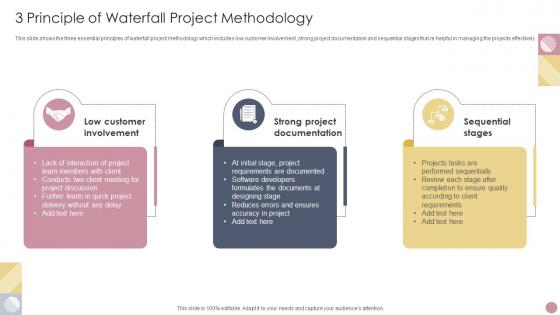
3 Principle Of Waterfall Project Methodology




Try Before you Buy Download Free Sample Product
 Impress Your
 Audience
 100%
100% Editable
 Save Hours
 of Time


This slide shows the three essential principles of waterfall project methodology which includes low customer involvement, strong project documentation and sequential stages that re helpful in managing the projects effectively.
People who downloaded this PowerPoint presentation also viewed the following :
3 Principle Of Waterfall Project Methodology with all 6 slides:
Use our 3 Principle Of Waterfall Project Methodology to effectively help you save your valuable time. They are readymade to fit into any presentation structure.





FAQs for 3 Principle Of
The key phases of Waterfall methodology include requirements gathering, system design, implementation, testing, deployment, and maintenance, executed sequentially with each phase dependent on the previous one's completion. This linear approach streamlines project management by establishing clear deliverables and milestones at each stage, with many organizations finding that structured phase gates enhance accountability and resource allocation, ultimately delivering predictable timelines and comprehensive documentation for complex development projects.
Waterfall follows a sequential, linear approach where each phase must complete before the next begins, while Agile emphasizes iterative development, continuous feedback, and adaptive planning throughout the project lifecycle. Organizations in banking and manufacturing often prefer Waterfall for regulatory compliance projects, whereas tech companies and startups leverage Agile for faster product releases, enhanced customer collaboration, and reduced time-to-market, ultimately delivering greater flexibility in an increasingly dynamic business environment.
Projects with well-defined requirements, stable scope, and minimal expected changes are best suited for Waterfall, including construction projects, manufacturing processes, regulatory compliance initiatives, and software with clear specifications. This structured approach delivers predictability and control through sequential phases, with industries like aerospace, pharmaceuticals, and government contracting finding that the linear progression enables better resource planning, risk management, and stakeholder alignment, ultimately ensuring consistent deliverables.
Project managers ensure effective documentation in Waterfall by establishing standardized templates, conducting regular documentation reviews at each phase gate, and implementing version control systems with clear approval workflows. These practices enable seamless knowledge transfer between phases, support compliance requirements, and maintain project continuity, with many organizations finding that structured documentation processes ultimately reduce rework and accelerate delivery timelines.
Waterfall methodology's primary advantages include clear project structure, predictable timelines, comprehensive documentation, defined deliverables, and straightforward progress tracking. This sequential approach streamlines project management by establishing firm requirements upfront, minimizing scope creep, and enabling accurate resource allocation, with many organizations finding that it delivers enhanced accountability and stakeholder confidence in regulated industries.
Common challenges with the Waterfall approach include limited flexibility for scope changes, delayed testing that can reveal costly issues late in development, reduced client collaboration during execution phases, and difficulty adapting to evolving requirements. While these constraints can create project risks, many organizations find that combining Waterfall's structured documentation with iterative feedback loops helps minimize these limitations, ultimately delivering more predictable timelines and clearer accountability in complex enterprise environments.
Teams maintain effective communication in Waterfall projects through structured documentation, regular phase gate reviews, clear handoff protocols, and centralized project management systems that track requirements and deliverables. These approaches enable seamless information transfer between phases, minimize misunderstandings, and ensure stakeholder alignment, with many organizations finding that formal communication plans and milestone meetings ultimately deliver greater project transparency and reduced rework costs.
Stakeholder feedback in Waterfall methodology primarily occurs during formal phase reviews and approval gates, with structured documentation requirements and sign-offs at each stage completion. While this approach ensures comprehensive stakeholder alignment and clear expectations, many organizations find that early stakeholder engagement during requirements gathering significantly reduces costly changes later, ultimately delivering more predictable project outcomes and enhanced stakeholder satisfaction.
Teams effectively manage scope creep in Waterfall projects through comprehensive upfront requirements documentation, formal change control processes, and strict stakeholder approval protocols for modifications. These structured approaches enable project managers to maintain timeline adherence, budget control, and deliverable quality, with many organizations finding that clear communication channels and detailed project charters ultimately deliver predictable outcomes and enhanced client satisfaction.
Effective Waterfall timeline management tools include Microsoft Project, Smartsheet, Gantt Project, TeamGantt, and Wrike, which excel at sequential phase planning and dependency tracking. These platforms streamline project scheduling by providing comprehensive Gantt charts, resource allocation features, and milestone tracking capabilities, with many project managers finding that integrated reporting functions ultimately deliver enhanced visibility and stakeholder communication throughout lengthy development cycles.
Waterfall methodology addresses risk management through upfront planning, detailed documentation, and phase-gate reviews that identify potential issues before progression. While this structured approach enables comprehensive risk assessment and mitigation strategies during initial phases, it can struggle with emerging risks, with many organizations finding that combining traditional risk frameworks with iterative feedback loops ultimately delivers more robust project outcomes.
Requirement gathering forms the foundation of Waterfall methodology, as subsequent phases depend entirely on comprehensive, accurate initial documentation, making thorough stakeholder interviews, user story mapping, and detailed functional specifications critical. Organizations in sectors like banking and healthcare conduct structured workshops, prototype reviews, and sign-off processes to ensure requirements are complete and unchangeable, ultimately delivering predictable timelines and reduced project risks.
Waterfall methodology adapts to changes through formal change control processes, phase gate reviews, and structured requirement modification procedures. While traditionally rigid, modern implementations incorporate early stakeholder feedback loops, iterative documentation updates, and hybrid approaches that allow controlled flexibility, with many organizations finding that strategic checkpoints enable necessary adjustments while maintaining project structure and deliverable quality.
In Waterfall methodology, testing occurs as a dedicated phase after development completion, creating a sequential timeline where issues are identified later in the project cycle. This contrasts with iterative models where testing happens continuously throughout each sprint or cycle, enabling earlier defect detection, faster feedback loops, and reduced costs, with many organizations finding that integrated testing approaches deliver more reliable outcomes and streamlined project timelines.
Successful Waterfall projects include NASA's Apollo moon landing program, Boeing's aircraft development initiatives, major infrastructure constructions like bridges and dams, large-scale ERP implementations in manufacturing, and comprehensive banking system overhauls. These projects succeeded through Waterfall's structured approach by establishing clear requirements upfront, maintaining rigorous documentation standards, and following sequential phases, with many organizations finding that this methodology delivers predictable timelines and comprehensive quality control for complex, well-defined initiatives.
-
Perfect template with attractive color combination.
-
“You have the structure in place that are easy to explore new opportunities.I will be recommending your services to other people.”