


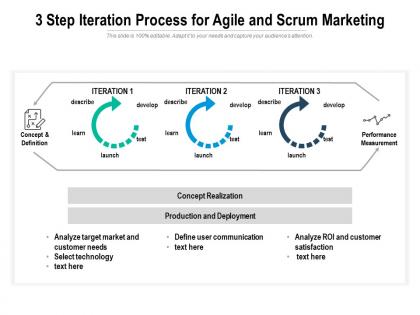
3 step iteration process for agile and scrum marketing




Try Before you Buy Download Free Sample Product
 Impress Your
 Audience
 100%
100% Editable
 Save Hours
 of Time


Our 3 Step Iteration Process For Agile And Scrum Marketing are topically designed to provide an attractive backdrop to any subject. Use them to look like a presentation pro.
People who downloaded this PowerPoint presentation also viewed the following :
3 step iteration process for agile and scrum marketing with all 2 slides:
Use our 3 Step Iteration Process For Agile And Scrum Marketing to effectively help you save your valuable time. They are readymade to fit into any presentation structure.

FAQs for 3 step iteration process for agile
Agile Marketing principles include iterative campaign development, data-driven decision making, cross-functional collaboration, rapid experimentation, and customer-centric adaptability, distinguishing it from traditional marketing's long-term planning cycles. These methodologies enable marketing teams to respond quickly to market changes, test campaigns in real-time, and optimize strategies continuously, with many organizations finding faster time-to-market and improved ROI.
Teams effectively implement Agile methodologies in marketing by establishing cross-functional squads, conducting regular sprint planning sessions, adopting iterative campaign development, implementing daily standups, and utilizing data-driven retrospectives. This approach enables marketers to respond quickly to market changes, test campaigns in real-time, and optimize strategies continuously, with many organizations finding significantly improved campaign performance and faster time-to-market.
Customer feedback serves as the foundation for Agile Marketing strategies, driving iterative campaign development, real-time content adjustments, personalized messaging optimization, and data-driven decision making. This continuous feedback loop enables marketing teams to rapidly pivot campaigns, enhance customer experiences, and deliver more targeted solutions, with many organizations finding that customer-centric agility significantly improves conversion rates and brand loyalty.
Agile Marketing facilitates faster decision-making through iterative sprint cycles, real-time data analysis, cross-functional collaboration, and rapid testing protocols that enable immediate campaign adjustments. By breaking campaigns into manageable phases with continuous feedback loops, marketing teams can pivot strategies within days rather than weeks, ultimately delivering more responsive customer experiences and improved ROI in today's dynamic marketplace.
Agile Marketing teams should focus on velocity metrics, customer engagement rates, conversion funnel performance, campaign ROI, and time-to-market measurements. These metrics enable teams to track sprint effectiveness, optimize content performance, and demonstrate business impact, with many marketing organizations finding that this data-driven approach delivers faster campaign iterations and improved competitive positioning.
Cross-functional collaboration enhances Agile Marketing effectiveness by breaking down silos, accelerating decision-making, and ensuring diverse perspectives inform campaign strategies. Teams combining marketing, sales, product development, and customer service can pivot faster based on real-time feedback, deliver more cohesive customer experiences, and ultimately achieve better market responsiveness and competitive advantage.
Essential Agile Marketing tools include project management platforms like Jira and Trello, collaboration software such as Slack and Microsoft Teams, analytics dashboards, content management systems, and marketing automation platforms. These technologies streamline campaign workflows, enhance cross-functional communication, and enable real-time performance tracking, with many marketing teams finding that integrated toolsets significantly accelerate campaign delivery and improve strategic responsiveness.
Marketing sprints involve executing campaigns in focused, time-boxed iterations typically lasting 1-4 weeks, allowing teams to test strategies, gather feedback, and optimize rapidly. These short cycles enable marketers to launch targeted email campaigns, social media initiatives, or content experiments quickly, while maintaining flexibility to pivot based on performance data, ultimately delivering faster market responses and improved campaign effectiveness across diverse channels.
Agile Marketing enhances digital marketing by enabling rapid campaign iteration, real-time performance monitoring, and quick strategy pivots based on data insights. Through cross-functional sprints and continuous testing, marketing teams can optimize ad spend, improve conversion rates, and respond faster to market changes, with many organizations finding significantly improved ROI and campaign effectiveness.
Organizations transitioning to Agile Marketing face challenges including cultural resistance to change, difficulty breaking down traditional silos, lack of proper training and skills, and struggles with implementing iterative processes. These obstacles often require significant mindset shifts across teams, with many companies finding that establishing cross-functional collaboration, investing in upskilling programs, and gradually adopting agile methodologies ultimately delivers enhanced campaign responsiveness and competitive advantage.
Agile Marketing promotes experimentation and innovation by encouraging rapid testing, iterative campaigns, and data-driven decision making through short sprint cycles and continuous feedback loops. This approach enables marketing teams to quickly validate ideas, pivot strategies based on real-time results, and foster creative risk-taking, ultimately delivering more effective campaigns and competitive market responsiveness.
Storytelling in Agile Marketing creates emotional connections with audiences while enabling rapid content iteration and testing across multiple touchpoints and campaigns. Through data-driven narrative adjustments, customer feedback loops, and cross-functional collaboration, marketing teams deliver personalized experiences, enhance brand authenticity, and accelerate campaign optimization, ultimately driving higher engagement rates and competitive advantage.
Marketers prioritize tasks in Agile environments by evaluating business impact, customer value, resource requirements, and strategic alignment with quarterly goals. Through sprint planning sessions and backlog grooming, marketing teams can streamline campaign development, enhance cross-functional collaboration, and accelerate time-to-market, with many organizations finding that this systematic approach delivers measurable ROI improvements.
Agile Marketing aligns with business goals through iterative planning cycles, regular stakeholder feedback loops, and data-driven priority adjustments that ensure marketing efforts directly support revenue targets and strategic initiatives. By implementing quarterly business reviews, cross-functional collaboration frameworks, and performance metrics tied to organizational KPIs, marketing teams can rapidly pivot resources toward high-impact activities that deliver measurable business outcomes.
Successful Agile Marketing case studies include Spotify's squad-based campaign development, ING Bank's cross-functional marketing teams, and Microsoft's iterative product launches. These organizations streamline campaign creation, enhance customer responsiveness, and accelerate time-to-market through rapid testing cycles, with many finding that this approach delivers significantly improved ROI and competitive advantage.
-
Unique research projects to present in meeting.
-
Great experience, I would definitely use your services further.
-
Really like the color and design of the presentation.
-
Nice and innovative design.
-
Great designs, really helpful.