


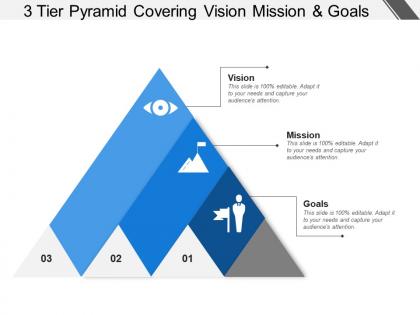
3 tier pyramid covering vision mission and goals




Try Before you Buy Download Free Sample Product
 Impress Your
 Audience
 100%
100% Editable
 Save Hours
 of Time


Our 3 Tier Pyramid Covering Vision Mission And Goals help you deal with the big boys. They add a lot to your demeanour.
People who downloaded this PowerPoint presentation also viewed the following :
3 tier pyramid covering vision mission and goals with all 5 slides:
Our 3 Tier Pyramid Covering Vision Mission And Goals allow you to cut costs down. It comes at a great discount.
FAQs for 3 tier pyramid covering vision
The Pyramid Framework is a structured communication method that presents information hierarchically, starting with the main conclusion followed by supporting arguments and detailed evidence. It enhances clarity by organizing complex data logically, enabling audiences to grasp key messages quickly, while businesses across sectors find it streamlines presentations, improves decision-making processes, and delivers more persuasive stakeholder communications.
The Pyramid Framework improves presentation clarity by organizing information hierarchically, starting with key conclusions followed by supporting arguments, evidence, and detailed data. This structure enables audiences to grasp main messages immediately while maintaining engagement through logical flow, with many executives and consultants finding that pyramid-structured presentations deliver faster decision-making and enhanced audience retention.
The Pyramid Framework comprises a clear thesis at the top, supporting arguments in the middle tier, and detailed evidence or data at the base. This structured approach streamlines complex presentations by organizing ideas hierarchically, enabling executives to grasp key messages quickly while providing comprehensive backup data, ultimately delivering more persuasive and efficient business communications.
The Pyramid Framework inverts traditional presentation flow by starting with conclusions and key insights upfront, then providing supporting details, while conventional structures build chronologically toward recommendations. This approach enables executives to grasp essential information immediately, streamlines decision-making processes, and enhances audience engagement, with many organizations finding that pyramid-structured presentations deliver faster approvals and clearer strategic alignment.
The Pyramid Framework proves most effective in complex problem-solving scenarios, strategic consulting presentations, executive communications, research analysis, and policy recommendations. Organizations tackling multifaceted challenges, from financial services restructuring to healthcare system optimization, find that this structure streamlines decision-making by presenting conclusions first, ultimately enabling faster executive buy-in and clearer strategic direction.
The Pyramid Framework seamlessly integrates with methodologies like MECE structuring, SCQA storytelling, and executive summary formats, creating comprehensive presentation architectures. Many consulting firms and corporations combine these approaches to deliver more compelling narratives, with the pyramid's top-down logic enhancing audience engagement while other frameworks provide supporting structure and context.
Presenters can ensure accurate Pyramid Framework implementation by starting with their main conclusion upfront, grouping supporting arguments into logical categories, and arranging evidence hierarchically from most to least important. Through systematic structure checks, clear topic sentences, and consistent logical flow, organizations streamline complex communications, enhance audience comprehension, and deliver more persuasive presentations, ultimately improving stakeholder engagement across departments.
Visual aids that complement the Pyramid Framework include hierarchical charts, tiered diagrams, flowcharts, infographics, and structured slide layouts with clear heading hierarchies. These tools enhance comprehension by mirroring the framework's logical progression from main conclusion to supporting details, with many consulting firms and corporate presentations finding that visual hierarchy reinforces message clarity and audience retention.
The Pyramid Framework enhances audience retention by presenting the most critical information first, followed by supporting details in logical hierarchies. This top-down approach mirrors natural thinking patterns, enabling audiences to grasp key messages immediately and build understanding progressively, with presenters finding that structured information flows significantly improve comprehension and recall rates.
The Pyramid Framework excels in consulting, financial services, legal practices, and strategic planning across organizations requiring clear, logical communication structures. Through its top-down approach, businesses in sectors like investment banking, management consulting, and corporate strategy deliver more persuasive presentations, streamlined reports, and compelling proposals, ultimately enhancing client relationships and decision-making processes.
Common pitfalls include overloading slides with excessive detail, burying key messages beneath supporting points, and failing to establish clear logical connections between pyramid levels. Many presenters also struggle with maintaining audience engagement by presenting information linearly rather than strategically, with successful business presentations finding that starting with conclusions first, then supporting evidence, delivers significantly better comprehension and decision-making outcomes.
The Pyramid Framework enhances presentation storytelling by structuring narratives with a clear main message at the top, supported by logical arguments and evidence below. This approach enables presenters to deliver compelling stories that guide audiences through complex information systematically, while maintaining engagement and ensuring key messages resonate, ultimately delivering stronger persuasion and clearer communication outcomes.
Audience analysis is crucial when implementing the Pyramid Framework, as it determines the appropriate starting point, level of detail, and supporting evidence structure. By understanding stakeholder priorities, expertise levels, and decision-making criteria, communicators can strategically sequence their key message and supporting arguments, ultimately delivering more persuasive presentations that resonate with specific audience needs and drive desired outcomes.
The Pyramid Framework adapts seamlessly to digital presentations through interactive elements, clickable navigation between pyramid levels, embedded multimedia content, and progressive disclosure features. Digital platforms enable presenters to layer information dynamically, allowing audiences to drill down into specific pyramid sections while maintaining the logical top-down flow, ultimately delivering more engaging and personalized presentation experiences.
McKinsey's client presentations, TED talks by business leaders, corporate strategy briefings, and venture capital pitch decks frequently employ the Pyramid Framework effectively. These presentations succeed by leading with key recommendations or insights, then systematically supporting them with data, case studies, and logical reasoning, ultimately delivering clearer communication and faster decision-making for audiences.
-
Good research work and creative work done on every template.
-
Excellent Designs.