


3 Year Financial Plan For Retail Business




Try Before you Buy Download Free Sample Product
 Impress Your
 Audience
 100%
100% Editable
 Save Hours
 of Time


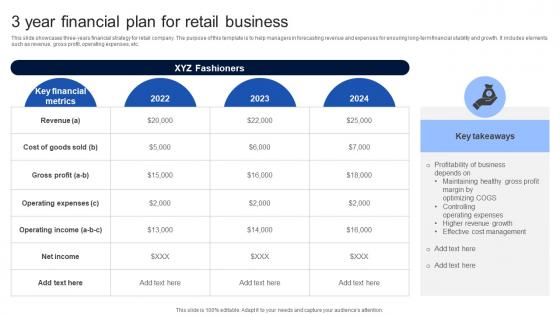
This slide showcases three years financial strategy for retail company. The purpose of this template is to help managers in forecasting revenue and expenses for ensuring long term financial stability and growth. It includes elements such as revenue, gross profit, operating expenses, etc.
People who downloaded this PowerPoint presentation also viewed the following :
3 Year Financial Plan For Retail Business with all 9 slides:
Use our 3 Year Financial Plan For Retail Business to effectively help you save your valuable time. They are readymade to fit into any presentation structure.









FAQs for 3 Year Financial Plan
Key components of an effective financial plan include budgeting frameworks, cash flow projections, risk assessment protocols, investment allocation strategies, and performance monitoring systems. These elements work together by establishing clear financial targets, optimizing resource allocation, and enabling data-driven decision making, with many organizations finding that integrated planning ultimately delivers improved operational efficiency and sustainable growth outcomes.
Determining financial goals involves assessing your current income, expenses, and desired lifestyle outcomes, with short-term goals typically spanning 1-3 years and long-term goals extending beyond five years. Financial advisors recommend using the SMART framework to establish specific, measurable objectives like emergency funds or retirement targets, while regularly reviewing and adjusting these goals as circumstances change, ultimately delivering clearer financial direction and improved wealth-building strategies.
**INPUT**: What strategies can be implemented to create a sustainable budget? **OUTPUT**: Sustainable budgeting strategies include zero-based budgeting, automated expense tracking, emergency fund allocation, debt reduction prioritization, and regular financial reviews. These approaches streamline financial management by enhancing spending visibility, minimizing unnecessary costs, and accelerating goal achievement, with many organizations and individuals finding that consistent monitoring ultimately delivers improved cash flow and long-term financial stability. [Word count: 54 words]
Building an emergency fund serves as the foundational safety net within comprehensive financial planning, protecting against unexpected expenses, job loss, medical bills, and major repairs while preventing debt accumulation. This strategic cash reserve, typically covering three to six months of expenses, enables individuals and families to maintain their long-term investment strategies, retirement contributions, and financial goals during economic uncertainty, ultimately delivering peace of mind and financial stability.
Risk assessment serves as the foundation of effective financial planning, helping identify potential market, credit, operational, and liquidity threats that could impact investment portfolios and business objectives. Through comprehensive risk evaluation, financial institutions and corporations can optimize asset allocation, establish appropriate contingency reserves, and develop diversified strategies that balance growth opportunities with protection measures, ultimately delivering more resilient financial outcomes and sustainable long-term performance.
Investment diversification contributes to robust financial planning by spreading risk across multiple asset classes, sectors, and geographic regions, reducing portfolio volatility while maintaining growth potential. Through strategic allocation among stocks, bonds, real estate, and commodities, investors can weather market downturns more effectively, ultimately delivering more consistent returns and enhanced long-term wealth preservation.
Different investment vehicles present varied tax implications including tax-deferred accounts like 401(k)s and IRAs, tax-free growth in Roth accounts, taxable capital gains on stocks and bonds, and tax-advantaged options like municipal bonds. These considerations enable strategic tax planning by optimizing asset location, timing withdrawals effectively, and balancing current versus future tax obligations, ultimately delivering enhanced after-tax returns and long-term wealth preservation.
Retirement planning should integrate systematic savings allocation, investment diversification across growth and income assets, employer benefit maximization, and regular timeline assessments. Through strategic combination of 401(k) contributions, IRAs, and market investments, individuals can build substantial wealth accumulation while minimizing tax burdens, ultimately delivering financial security and lifestyle preservation in later years.
Financial planning tools include budgeting software like Mint and YNAB, investment platforms such as Personal Capital and Vanguard, retirement calculators, tax preparation software, and comprehensive planning applications like eMoney Advisor. These technologies streamline financial management by automating expense tracking, portfolio analysis, and goal monitoring, with many financial advisors and institutions finding that integrated platforms deliver enhanced client experiences and more accurate long-term projections.
Adjusting your financial plan involves reassessing income, expenses, goals, and risk tolerance, then realigning budgets, savings rates, and investment strategies accordingly. Major life changes like marriage require combining financial goals and debt obligations, while job transitions may necessitate updating emergency funds, retirement contributions, and insurance coverage, ultimately ensuring your plan remains strategically aligned with evolving circumstances.
Regular financial plan reviews ensure your strategy remains aligned with changing life circumstances, market conditions, and evolving financial goals through systematic assessment and strategic adjustments. These reviews enable proactive responses to income changes, family transitions, and economic shifts, with many financial advisors finding that quarterly assessments ultimately deliver improved investment performance and enhanced long-term financial security.
Debt management integrates into financial plans through strategic prioritization of high-interest obligations, establishing systematic repayment schedules, and aligning debt reduction with savings goals. By incorporating debt-to-income ratios and cash flow analysis, individuals and businesses streamline their financial obligations while maintaining liquidity, ultimately delivering improved credit profiles and enhanced capacity for future investments.
Common financial planning mistakes include setting unrealistic goals, neglecting emergency funds, underestimating expenses, failing to diversify investments, and ignoring inflation impacts. These oversights often stem from inadequate research and emotional decision-making, with many individuals finding that regular plan reviews and professional guidance help streamline their approach, ultimately delivering better long-term outcomes and enhanced financial security.
Inflation erodes purchasing power over time, requiring financial projections to account for rising costs of goods, services, and operational expenses through adjusted discount rates and escalated assumptions. Financial institutions and corporations increasingly incorporate multiple inflation scenarios into their models, enabling more realistic budgeting, investment planning, and strategic resource allocation that maintains competitive advantage despite economic volatility.
Setting measurable milestones enhances financial plan effectiveness by providing clear progress indicators, enabling regular performance assessment, and facilitating timely course corrections when needed. These benchmarks create accountability frameworks that help organizations track cash flow targets, revenue goals, and expense management objectives, while enabling stakeholders to make data-driven adjustments that ultimately deliver improved financial outcomes and strategic alignment.
-
Slideteam offers pocket-friendly products. As a college student this is a really necessary thing to look at while paying for something.
-
Impressive templates. Designing a presentation is fun now!