


30 60 90 Days Plan For Embedded Systems Development Embedded System Applications




Try Before you Buy Download Free Sample Product
 Impress Your
 Audience
 100%
100% Editable
 Save Hours
 of Time


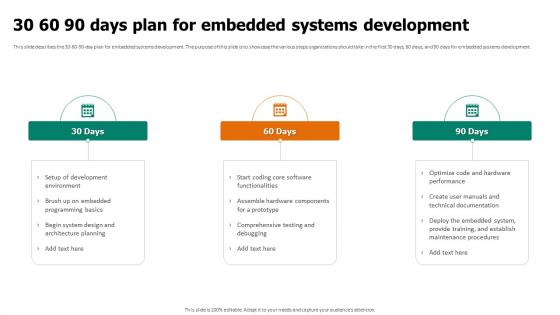
This slide describes the 30-60-90-day plan for embedded systems development. The purpose of this slide is to showcase the various steps organizations should take in the first 30 days, 60 days, and 90 days for embedded systems development.
People who downloaded this PowerPoint presentation also viewed the following :
30 60 90 Days Plan For Embedded Systems Development Embedded System Applications with all 9 slides:
Use our 30 60 90 Days Plan For Embedded Systems Development Embedded System Applications to effectively help you save your valuable time. They are readymade to fit into any presentation structure.








FAQs for 30 60 90 Days Plan For Embedded Systems Development
Key components for embedded system design include microcontrollers or processors, memory architecture, input/output interfaces, power management systems, and real-time operating systems. These elements work together by optimizing performance constraints, ensuring reliable hardware-software integration, and meeting specific application requirements, with industries like automotive, healthcare, and industrial automation finding that strategic component selection ultimately delivers enhanced functionality, reduced costs, and competitive market advantage.
Determining the appropriate microcontroller involves evaluating processing power requirements, memory needs, input/output capabilities, power consumption constraints, and communication interfaces like UART, SPI, or I2C. These specifications align with your application's demands, with many developers in automotive, medical devices, and IoT finding that matching controller capabilities to system requirements ultimately delivers optimal performance and cost-effectiveness.
RTOS provides deterministic task scheduling, memory management, interrupt handling, and inter-process communication for embedded systems requiring predictable timing responses. These operating systems enable developers to build reliable applications in automotive control units, medical devices, and industrial automation by ensuring critical tasks execute within strict deadlines, ultimately delivering enhanced system performance and operational safety.
Power consumption can be optimized through dynamic voltage scaling, sleep mode implementation, efficient processor selection, low-power component integration, and intelligent task scheduling algorithms. These strategies enable manufacturers in automotive, IoT, and medical device sectors to extend battery life significantly, reduce operational costs, and deliver competitive advantages, with many finding that strategic power management ultimately enhances product reliability and market positioning.
**INPUT**: What are the best practices for interfacing sensors and actuators in embedded applications? **OUTPUT**: Best practices include proper signal conditioning, implementing robust communication protocols, ensuring adequate power management, using appropriate filtering techniques, and establishing reliable error handling mechanisms. These approaches streamline system performance by minimizing noise interference, optimizing power consumption, and enhancing data accuracy, with many manufacturing and automotive organizations finding that systematic interface design ultimately delivers improved operational efficiency and reduced maintenance costs.
Software development in resource-constrained embedded environments requires prioritizing memory optimization, real-time performance requirements, and power efficiency from the initial design phase. Through modular programming, efficient algorithms, and hardware abstraction layers, developers can streamline code execution while minimizing resource consumption, with many automotive and IoT manufacturers finding that strategic component selection ultimately delivers faster processing and extended battery life.
Unit testing, integration testing, hardware-in-the-loop simulation, boundary testing, and stress testing are most effective for validating embedded systems functionality and reliability. These methodologies work together by isolating component issues, verifying system interactions, and simulating real-world conditions, with many manufacturers in automotive, medical devices, and IoT finding that comprehensive testing reduces deployment risks while ensuring robust performance.
Robust security in embedded systems requires implementing hardware-based encryption, secure boot processes, regular firmware updates, access control mechanisms, and network security protocols. These security layers work together by protecting data integrity, preventing unauthorized access, and enabling remote vulnerability patching, with many IoT manufacturers finding that comprehensive security frameworks ultimately deliver enhanced customer trust and regulatory compliance in increasingly connected environments.
Supply chain considerations significantly impact component selection by affecting availability, cost stability, lead times, and long-term support for embedded systems. These factors influence design decisions across industries, with automotive manufacturers prioritizing components with guaranteed multi-year availability, while consumer electronics companies focus on cost-effective alternatives, ultimately ensuring project viability and minimizing production risks.
Effective embedded systems documentation includes requirements specifications, system architecture diagrams, hardware schematics, software flowcharts, and testing protocols. These comprehensive records streamline development by enabling clear communication between hardware and software teams, facilitating debugging processes, and ensuring regulatory compliance, with many organizations finding that structured documentation ultimately reduces development cycles and enhances product reliability.
Common pitfalls in embedded systems development include inadequate power management, insufficient memory allocation, poor real-time performance optimization, inadequate security protocols, and limited scalability planning. These challenges can be avoided by implementing comprehensive testing frameworks, adopting modular design architectures, and establishing rigorous validation processes early in development cycles, with many technology companies finding that proactive planning significantly reduces costly redesigns and accelerates time-to-market deployment.
Embedded system scalability is addressed through modular architectures, standardized interfaces, over-provisioned hardware resources, and abstraction layers that separate applications from hardware dependencies. These design principles enable manufacturers in automotive, IoT, and industrial automation to adapt systems for varying performance requirements, integrate new features seamlessly, and extend product lifecycles, ultimately delivering competitive advantage in rapidly evolving markets.
Debugging complex embedded applications involves hardware-based debugging through JTAG interfaces, software debugging using breakpoints and trace analysis, real-time monitoring with oscilloscopes and logic analyzers, and simulation testing in controlled environments. These techniques enable developers to identify timing issues, memory conflicts, and hardware integration problems efficiently, with many automotive and IoT manufacturers finding that comprehensive debugging strategies significantly reduce development cycles and improve product reliability.
Simulation tools streamline embedded systems design by enabling virtual prototyping, algorithm validation, hardware-software co-verification, and performance optimization before physical implementation. Through platforms like MATLAB/Simulink and hardware emulators, engineers accelerate development cycles, reduce costly prototyping iterations, and identify potential issues early, ultimately delivering more reliable products with faster time-to-market and reduced development costs.
Current IoT trends reshaping embedded systems development include edge computing integration, AI/ML capabilities at device level, enhanced security protocols, low-power wireless connectivity, and real-time data processing requirements. These advancements enable manufacturers in automotive, healthcare, and smart home sectors to deliver faster response times, reduced bandwidth costs, and improved user experiences, while many organizations find that strategic embedded-IoT integration provides significant competitive advantages in increasingly connected markets.
-
Amazing product with appealing content and design.
-
Fantastic collection of visually appealing PowerPoint templates. They certainly uplift the look of the presentation.