


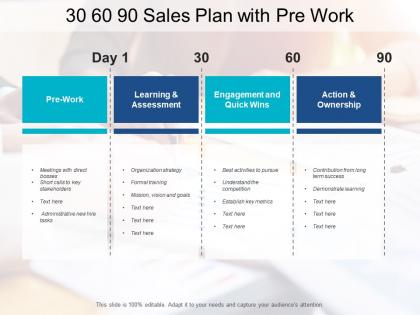
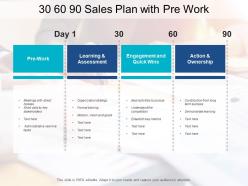
30 60 90 sales plan with pre work




Try Before you Buy Download Free Sample Product
 Impress Your
 Audience
 100%
100% Editable
 Save Hours
 of Time


Investigate discrepancies with our 30 60 90 Sales Plan With Pre Work. Expose any false accounts.
People who downloaded this PowerPoint presentation also viewed the following :
30 60 90 sales plan with pre work with all 5 slides:
Bring in the joy with our 30 60 90 Sales Plan With Pre Work. Create an interesting interaction for all.



FAQs for 30 60 90 sales plan
Effective 30-60-90 sales plans include territory analysis, prospect identification, relationship building strategies, pipeline development goals, and performance metrics tracking. These components work together by establishing clear learning objectives for the first 30 days, relationship-building targets for 60 days, and revenue generation milestones by 90 days, ultimately delivering structured onboarding and accelerated sales performance.
New sales professionals should prioritize learning and relationship-building in the first 30 days, active prospecting and initial sales activities in the 60-day phase, and performance optimization with strategic account development in the 90-day period. This structured approach enables salespeople to build foundational knowledge, establish credibility with prospects and team members, and ultimately deliver measurable results, with many organizations finding that systematic onboarding accelerates revenue generation and long-term success.
Success metrics for 30-60-90 day sales plans include lead generation rates, conversion percentages, pipeline velocity, customer acquisition costs, and revenue targets at each milestone. These measurements enable sales teams to track progression systematically, identify performance gaps early, and adjust strategies accordingly, with many organizations finding that consistent metric monitoring ultimately delivers improved forecasting accuracy and accelerated deal closure rates.
Sales leaders can support their teams by providing clear expectations, regular check-ins, mentorship opportunities, necessary resources, and constructive feedback throughout each phase. Through structured coaching sessions and performance tracking, leaders help salespeople navigate initial learning curves, build client relationships, and achieve targets, while identifying obstacles early and adjusting strategies, ultimately ensuring team success and accelerated revenue growth.
Common pitfalls include setting unrealistic targets, lacking specific metrics, ignoring market research, poor territory analysis, and insufficient customer segmentation. Many sales professionals find that overly ambitious goals without proper foundation work, inadequate competitor analysis, and failing to align with existing team processes ultimately undermine execution, while successful plans balance achievable milestones with strategic market understanding.
The 30-60-90 sales plan adapts to different industries by adjusting target metrics, customer touchpoints, compliance requirements, relationship-building timelines, and market-specific objectives. For example, technology sectors emphasize product demonstrations and technical partnerships, while healthcare focuses on regulatory compliance and longer relationship cycles, ultimately enabling sales teams to align strategies with industry dynamics and accelerate market penetration.
Tools for executing a 30 60 90 sales plan include CRM systems, sales analytics platforms, pipeline management software, performance tracking dashboards, and territory mapping tools. These resources streamline goal tracking, automate follow-ups, and provide real-time insights, with many sales organizations finding that integrated platforms enhance accountability, accelerate onboarding, and ultimately deliver measurable revenue growth.
Customer feedback integrates into 30 60 90 sales plans through regular collection points, analysis sessions, and strategy adjustments at each milestone. Sales teams can implement feedback loops by conducting client surveys, tracking satisfaction metrics, and analyzing objection patterns, ultimately refining approaches, enhancing customer experiences, and increasing conversion rates throughout the progression.
Team collaboration serves as the foundation for executing 30 60 90 sales plan objectives by enabling knowledge sharing, coordinated prospecting efforts, and streamlined communication across departments. Through regular team meetings, shared CRM systems, and cross-functional partnerships with marketing and customer success, sales organizations accelerate goal achievement, ultimately delivering faster onboarding and sustained revenue growth.
Effectively communicating a 30 60 90 sales plan requires clear visual presentations, structured timelines, and specific metrics for each phase. Through comprehensive dashboards and regular stakeholder meetings, sales leaders can showcase learning objectives, relationship-building targets, and revenue goals, while demonstrating measurable milestones that align with organizational priorities and competitive positioning.
Salespeople can adapt their plans by continuously monitoring market trends, adjusting target customer segments, realigning value propositions with current pain points, and modifying outreach channels based on buyer behavior shifts. Through regular competitive analysis and customer feedback loops, sales professionals can pivot messaging strategies, update pricing approaches, and refine territory focus, ultimately maintaining competitive advantage in dynamic markets.
Salespeople should prepare for obstacles by conducting thorough market research, identifying potential client objections, establishing backup strategies for key accounts, and building strong relationships with internal support teams. Through proactive planning and regular plan reviews, sales professionals can anticipate challenges like longer sales cycles or competitive pressures, ultimately maintaining momentum and achieving targets even when market conditions shift unexpectedly.
Successful 30-60-90 sales plans typically focus on relationship building in month one, product mastery and initial prospecting in month two, and quota achievement through strategic selling in month three. These structured approaches enable new professionals to systematically develop client relationships, understand market dynamics, and deliver measurable results, with many organizations finding that clear milestone-based frameworks accelerate onboarding and drive consistent performance outcomes.
Personal development is crucial in 30 60 90 sales plans, encompassing skill enhancement, product knowledge mastery, relationship building techniques, and performance optimization strategies. Through structured learning phases, sales professionals streamline their approach to client acquisition, territory management, and revenue generation, with many organizations finding that comprehensive development frameworks ultimately deliver higher conversion rates and sustainable competitive advantage.
Sales teams should aim for relationship building and territory understanding in the 30-day phase, pipeline development and initial deals in the 60-day phase, and consistent quota achievement with strategic account expansion by day 90. These progressive milestones enable organizations to track performance systematically, with many companies finding that structured expectations ultimately deliver predictable revenue growth and enhanced team accountability.
No Reviews