


3cs of marketing 7





Try Before you Buy Download Free Sample Product
 Impress Your
 Audience
 100%
100% Editable
 Save Hours
 of Time


Stop wasting time on the design details. Our range of 3Cs of Marketing 7 will take care of all the cosmetic details for you.
People who downloaded this PowerPoint presentation also viewed the following :
3cs of marketing 7 with all 5 slides:
Irrespective of the concept that you are trying to demonstrate no matter how abstract you think it is our 3Cs of Marketing 7 can help make it easier. There is a readymade slide for all fields of life.



FAQs for 3cs
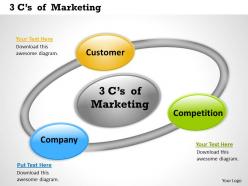
The 3Cs of Marketing are Company (internal capabilities and resources), Customers (target market needs and behaviors), and Competitors (market positioning and strategies). These elements interact strategically, with companies analyzing customer demands while monitoring competitor activities to identify market gaps, ultimately enabling businesses to develop differentiated value propositions that leverage internal strengths against competitive weaknesses while delivering superior customer experiences.
Effectively applying the 3Cs framework involves thoroughly analyzing your Company's strengths and capabilities, understanding your Customers' needs and preferences through market research, and evaluating your Competitors' positioning and strategies. This strategic combination enables businesses to identify market gaps, differentiate their offerings, and optimize resource allocation, with many organizations finding that regular 3Cs analysis delivers enhanced competitive advantage and more targeted customer experiences.
Customer understanding forms the foundation of the first C by enabling businesses to identify target demographics, analyze purchasing behaviors, assess needs and pain points, and map customer journeys effectively. Through comprehensive market research and data analytics, organizations can segment audiences more precisely, develop targeted messaging strategies, and create personalized experiences, ultimately delivering enhanced customer satisfaction and competitive advantage.
Companies can effectively analyze competitors through market research, SWOT analysis, benchmarking studies, customer feedback analysis, and social media monitoring. These methods enable businesses to identify competitor strengths, weaknesses, pricing strategies, and market positioning, with many organizations finding that systematic competitor analysis ultimately delivers strategic insights for differentiation and competitive advantage.
Market research surveys, customer interviews, demographic analysis, behavioral data tracking, and social media analytics help identify target segments. These techniques enable businesses to understand customer needs, preferences, and purchasing patterns across different industries like retail and financial services, ultimately delivering more personalized marketing strategies and improved customer acquisition rates.
Market context significantly influences 3Cs implementation by determining competitive intensity, customer behavior patterns, and company resource allocation strategies. In saturated markets like telecommunications, companies must differentiate through superior customer experience and operational efficiency, while emerging markets like renewable energy allow for broader positioning strategies, ultimately requiring businesses to adapt their competitive approach based on market maturity and dynamics.
Amazon exemplifies successful 3Cs application by analyzing customer preferences through data analytics, monitoring competitor pricing and services, and leveraging their logistics capabilities and technology infrastructure. Their strategic combination of understanding customer needs, competitive positioning, and internal strengths has enabled them to dominate e-commerce while expanding into cloud services, ultimately delivering market leadership.
Brands can adapt their marketing approach by conducting regular competitor analysis, repositioning their value proposition, adjusting pricing strategies, exploring new distribution channels, and enhancing customer engagement tactics. Through strategic pivots like targeted digital campaigns or innovative service offerings, companies in sectors like retail and financial services deliver differentiated experiences, ultimately maintaining competitive advantage while responding to evolving market dynamics.
The 3Cs framework enhances digital marketing by analyzing customers through data analytics and social listening, evaluating competitors via SEO tools and social media monitoring, and assessing company capabilities across digital channels. This strategic combination enables businesses to optimize content targeting, identify market gaps, and allocate resources effectively, ultimately delivering personalized customer experiences and sustainable competitive advantage.
Common pitfalls include overemphasizing competitor analysis while neglecting customer insights, misaligning company capabilities with market demands, treating the 3Cs as isolated elements rather than interconnected strategies, and failing to regularly update assessments in dynamic markets. These oversights often result in missed opportunities, resource misallocation, and strategic blind spots, with many organizations finding that balanced, integrated analysis delivers stronger competitive positioning and market responsiveness.
The 3Cs of Marketing—Customer, Company, and Competition—adapt uniquely across industries based on market dynamics, regulatory requirements, and consumer behavior patterns. In healthcare, customer analysis focuses on patient outcomes and compliance, while retail emphasizes purchasing behaviors and seasonal trends, with financial services prioritizing trust-building and regulatory adherence, ultimately enabling targeted strategies that deliver competitive advantage.
Startups can leverage the 3Cs by conducting thorough customer research to identify target segments, analyzing competitors to find market gaps and differentiation opportunities, and honestly assessing their unique capabilities and resource constraints. This strategic combination enables startups to position themselves effectively, allocate limited resources efficiently, and develop focused marketing messages that resonate with specific audiences while building sustainable competitive advantages in increasingly crowded markets.
Market evolution requires systematically monitoring customer behavior shifts, competitive landscape changes, and internal capability developments through regular data analysis, customer feedback collection, and competitive intelligence gathering. Organizations should establish quarterly review cycles that evaluate emerging customer needs, new competitor strategies, and evolving company strengths, with many businesses finding that this structured reassessment enables strategic pivots and maintains competitive advantage.
Consumer trends significantly reshape the 3Cs by altering customer expectations, intensifying competitive landscapes, and demanding enhanced company capabilities across digital channels, sustainability practices, and personalized experiences. As preferences evolve toward social responsibility and omnichannel engagement, organizations must continuously realign their customer understanding, competitive positioning, and internal competencies, with many finding that agile adaptation of the 3Cs framework delivers sustained market relevance.
The 3Cs framework seamlessly integrates with models like SWOT analysis, Porter's Five Forces, and the 4Ps of marketing, creating comprehensive strategic frameworks. Many organizations combine Customer, Company, and Competitor analysis with segmentation strategies, positioning models, and digital marketing approaches, ultimately delivering deeper market insights and more robust marketing strategies that enhance competitive advantage across diverse industries.
-
Very well designed and informative templates.
-
Attractive design and informative presentation.