


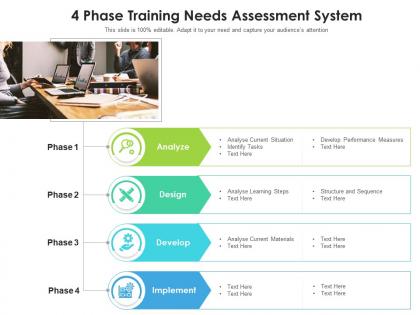
4 phase training needs assessment system




Try Before you Buy Download Free Sample Product
 Impress Your
 Audience
 100%
100% Editable
 Save Hours
 of Time


Our 4 Phase Training Needs Assessment System are topically designed to provide an attractive backdrop to any subject. Use them to look like a presentation pro.
People who downloaded this PowerPoint presentation also viewed the following :
4 phase training needs assessment system with all 2 slides:
Use our 4 Phase Training Needs Assessment System to effectively help you save your valuable time. They are readymade to fit into any presentation structure.
FAQs for 4 phase training
The primary goals of conducting a Training Needs Assessment include identifying skill gaps, determining training priorities, aligning learning objectives with business goals, optimizing resource allocation, and measuring performance baselines. These assessments enable organizations to streamline training investments by targeting specific competency areas, enhancing employee productivity, and ultimately delivering improved operational efficiency and competitive advantage across departments.
Organizations identify skill gaps through TNA by comparing current employee competencies against required job standards, conducting performance evaluations, surveying managers and employees, and analyzing productivity metrics. Through systematic skills audits and competency mapping, companies like manufacturing firms and financial services streamline resource allocation, enhance targeted training programs, and ultimately deliver improved operational efficiency while reducing performance discrepancies across teams.
Effective TNA data gathering methods include surveys, interviews, focus groups, performance reviews, observation, and competency assessments. These approaches streamline organizational learning by capturing multiple perspectives, identifying skill gaps, and prioritizing training investments, with many organizations finding that combining quantitative surveys with qualitative interviews delivers comprehensive insights and enhances strategic workforce development.
Different organizational cultures significantly influence TNA approaches through varying communication styles, learning preferences, hierarchy structures, and feedback mechanisms. Hierarchical cultures may require top-down assessment methods and formal evaluation processes, while collaborative cultures benefit from peer-driven assessments and cross-functional input, ultimately ensuring training programs align with cultural values and deliver sustainable behavioral change.
Employee feedback enhances TNA accuracy by providing firsthand insights into skill gaps, workflow challenges, performance barriers, and real-world training needs that managers might overlook. Through surveys, focus groups, and direct interviews, employees reveal practical knowledge deficiencies, process inefficiencies, and development priorities, ultimately delivering more targeted training programs and improved organizational performance.
Training objectives serve as the strategic bridge between identified skill gaps and targeted learning solutions, defining specific, measurable outcomes that training programs must achieve to address organizational performance needs. They transform TNA findings into actionable learning goals, ensuring training investments directly support business objectives while providing clear benchmarks for measuring program effectiveness, ultimately enabling organizations to validate ROI and maintain competitive advantage through strategic workforce development.
Technology streamlines TNA processes through automated data collection, AI-powered skills gap analysis, learning management system integration, and real-time performance tracking dashboards. These digital tools enhance accuracy by eliminating manual surveys, accelerating identification of training priorities, and enabling continuous assessment cycles, with organizations finding that automated TNAs reduce processing time while delivering more precise, actionable insights for strategic workforce development.
Common challenges include insufficient data collection, resistance from employees, misaligned organizational priorities, inadequate stakeholder buy-in, and unclear performance metrics. These obstacles often stem from poor communication and limited resources, with many organizations finding that strategic planning, comprehensive surveys, and leadership engagement ultimately streamline the assessment process while delivering actionable insights.
TNA enables organizations to align training programs with business objectives by identifying skill gaps that directly impact performance, analyzing competency requirements for strategic initiatives, and mapping learning outcomes to measurable business results. Through systematic assessment, companies can prioritize training investments that enhance operational efficiency, accelerate goal achievement, and deliver competitive advantage, with many organizations finding that targeted programs significantly improve both employee performance and bottom-line outcomes.
Organizations should evaluate TNA effectiveness using metrics like skill gap closure rates, training ROI calculations, employee performance improvements, learner satisfaction scores, and knowledge retention assessments. These measurements enable companies to track whether identified training needs translate into enhanced productivity, reduced errors, and improved business outcomes, with many organizations finding that comprehensive evaluation frameworks ultimately deliver stronger competitive advantage and more strategic workforce development.
Organizations should conduct Training Needs Assessments annually at minimum, with quarterly reviews for rapidly evolving sectors like technology and healthcare. Many companies find that conducting assessments after major organizational changes, new technology implementations, or performance gaps ensures training remains relevant and strategic, ultimately delivering improved employee capabilities and competitive advantage.
Strategies for stakeholder engagement include conducting pre-assessment surveys, hosting collaborative planning sessions, establishing clear communication channels, creating cross-functional teams, and implementing regular feedback loops throughout the process. These approaches enhance buy-in by involving stakeholders in decision-making, addressing their specific concerns, and demonstrating value, with many organizations finding that engaged stakeholders ultimately deliver more accurate needs identification and stronger training program adoption.
Industry-specific regulations significantly shape training needs assessment by mandating compliance requirements, safety protocols, and specialized certifications that organizations must address. In highly regulated sectors like healthcare, financial services, and manufacturing, TNAs prioritize regulatory training modules, ongoing certification programs, and audit preparedness, ultimately ensuring organizations maintain operational compliance while minimizing risk exposure and potential penalties.
Effective prioritization techniques include skills gap analysis, performance data review, business impact assessment, stakeholder surveys, and cost-benefit evaluation. These methods enable organizations to align training investments with strategic objectives by identifying critical competency gaps, measuring potential ROI, and addressing urgent performance issues first, ultimately delivering targeted skill development and improved organizational capability.
TNA reveals skill gaps across diverse employee groups, identifies cultural barriers to learning, and uncovers varied learning preferences through demographic analysis and inclusive data collection methods. By examining participation patterns, accessibility needs, and representation gaps, organizations can design culturally responsive curricula, implement multiple delivery formats, and create equitable development pathways that enhance engagement while building more comprehensive talent pipelines.
-
The content is very helpful from business point of view.
-
Very unique, user-friendly presentation interface.