


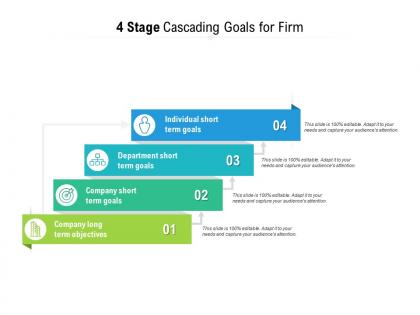
4 stage cascading goals for firm




Try Before you Buy Download Free Sample Product
 Impress Your
 Audience
 100%
100% Editable
 Save Hours
 of Time


Gain from the glocal ability of our 4 Stage Cascading Goals For Firm. Benefit from area based experience.
People who downloaded this PowerPoint presentation also viewed the following :
4 stage cascading goals for firm with all 5 slides:
Gain from the area based experience of our 4 Stage Cascading Goals For Firm. Benefit from their glocal capability.




FAQs for 4 stage cascading
Basically you take your company's big goals and break them down into smaller chunks for each team and person. Everyone needs to see how their daily work connects to the main strategy - that's where the magic happens, honestly. Transparency is everything here. People get way more motivated when they can see the whole picture, not just their tiny slice. Keep goals measurable and realistic at each level. I'd start by mapping out how your current team objectives actually tie back to what the company's trying to achieve. Once people can trace their tasks back to strategy, you'll see the difference.
Honestly, cascading goals are pretty simple - they just connect your team's daily stuff to the company's big picture. People actually care about their work when they see how it fits. Think dominoes, but the good kind where everything builds up instead of falling down. Teams naturally start working together more because they spot where their goals overlap. I've found the visual mapping thing really helps at the start - sounds nerdy but it works. Just make sure each level gets specific enough that people know what to actually do with it.
Dude, your leaders absolutely have to buy into this stuff and actually show it. Can't just announce goals and disappear, you know? They need to explain WHY each level matters - not just throw objectives at people. I've watched so many of these things crash because leadership treated it like checking a box. The ones that work? Leaders jump into goal conversations at every level instead of just barking orders from their corner office. Oh, and they've gotta check in regularly and pivot when stuff isn't clicking. Sounds obvious but you'd be amazed how rare it is.
Honestly, I'd start by just mapping everything out on paper first - way easier to see the big picture. Then grab a platform like Lattice, 15Five, or Weekdone if you've got budget. They're pretty solid for showing how leadership goals trickle down to individual stuff and tracking progress. Spreadsheets work too but they get annoying real quick (trust me on this one). Focus on leading indicators at each level, not just final results. Monthly check-ins are clutch for catching things early when they go sideways. Pick whatever tool matches your team size - no point overcomplicating it.
You need to bake in review cycles - like quarterly check-ins where you can actually pivot based on what's going down. Build some flexibility into your metrics instead of making them crazy rigid from the start. Honestly, I've watched way too many teams cling to dead targets because "we decided this in January" - super frustrating to watch. Create quick escalation paths so team leads can raise flags when stuff shifts. The whole cascading thing should keep everyone aligned, not trap you in something that doesn't work anymore. Oh and set those calendar reminders now or you'll totally forget.
Honestly, the worst part is when people can't figure out how their daily stuff connects to the big company goals. Super frustrating. Managers also love to pile on like 10 different objectives - which totally misses the point, right? Departments get weird about following the framework too, acting like their goals are somehow different. Oh, and communication falls apart constantly when priorities change mid-quarter. Start with maybe 2-3 goals max per level. Train your managers properly so they can actually translate things down. Regular check-ins help catch problems before they snowball.
So cascading goals are basically the opposite of that mess where executives set targets and pray they somehow make sense to everyone else. You start with the big company objectives, then departments break those down into their own goals, and individual people do the same thing for their specific roles. Way better than the usual chaos where people are just doing... whatever, honestly. The cool part is everyone can actually see how their daily stuff connects to the bigger picture. Quick test - try tracing your current goals back to what the company's trying to achieve. Bet you'll find some weird gaps.
Honestly, tech makes this so much simpler than doing it manually. Real-time dashboards are a game changer – no more waiting around for those quarterly check-ins that drag on forever. You can set up tools like Asana or Monday to link everything hierarchically, so when you tweak something at the top, it flows down automatically. OKR platforms work great too, though even a well-organized spreadsheet does the trick if you're just starting out. My advice? Pick one tool and actually get your team to use it consistently before you go crazy with features. Otherwise you'll just end up with another abandoned system.
So here's the thing - when you cascade goals down through your company, everyone suddenly knows what they own. No more hiding behind "that's not my job" BS. Break those big company targets into department chunks, then team pieces, then individual stuff. Each person gets specific metrics they're accountable for. If things blow up, you'll know exactly where the problem started. People actually care more because they can see how their work matters. Plus your managers finally have real ways to track who's performing. Just start by figuring out who should own which pieces of your bigger goals.
Yeah, cascading goals definitely work for motivation. People get way more engaged when they can actually see how their daily stuff connects to the company's big wins. It's not just about linking individual goals to team objectives - though that helps. The real magic happens when you're transparent about it, not just pushing it down from management. Honestly, I've watched this fail spectacularly when the connections feel forced or confusing. But when it clicks? Your team starts tracing their small victories back to real business results. Makes everything feel less like busywork, you know?
Make those cascading goals the actual backbone of your performance reviews. So instead of those pointless 1-5 rating scales, you're discussing whether they hit their specific goals that connect to bigger team stuff. Way more productive honestly. During the review, talk through their progress, what roadblocks they ran into, and how their work helped the team succeed overall. Then you set fresh goals for next time that still tie back to company priorities. I've seen this work so much better than generic performance metrics - actually gives people something concrete to work toward.
Honestly, get your leadership team on the same page first - nothing kills momentum like mixed messages from the top. I'd announce the big picture goals, let people digest it, then break down how each department fits in. Hit them from multiple angles too: all-hands meetings, team huddles, written stuff, whatever clicks with your people. Repetition is huge here. Don't just say it once and walk away. Check in regularly to see how teams are actually using these goals day-to-day, then tweak your approach based on what's working (or what isn't).
So cascading goals are basically how you connect the big company vision to what people actually do every day. When it works, nobody's sitting there wondering why their job matters - they can literally see how their stuff rolls up to team goals, then company strategy. Game changer for getting everyone rowing in the same direction instead of doing random busy work. Honestly, most companies are terrible at this part. Start by working backwards from your main strategy and map out where individual goals should connect. You'll probably find some weird gaps or goals that don't make sense anymore. Short version: it's how you turn strategy into action that actually matters.
Honestly, collaborative planning sessions work really well - get teams together to brainstorm their own departmental goals. One-on-ones are solid too for aligning individual stuff with company targets. Town halls? People actually love those, way more than I expected. Surveys before finalizing anything help gather input, or you could do cross-functional workshops so departments can see how their goals connect. The whole thing needs to feel like an actual conversation, not some decree from above. Just pick whatever feels right for how your team operates - you know them best.
Track how well goals actually connect up and down - like, can people clearly see how their stuff ties to bigger company objectives? Goal completion rates are obvious. Milestone tracking too. But honestly, employee engagement scores might be your best bet since cascaded goals are pretty useless if nobody cares about them. Cross-functional collaboration is worth watching - good cascading usually gets teams talking to each other more. Oh, and don't try measuring everything at once. Pick 2-3 things that make sense for your specific mess.
No Reviews