


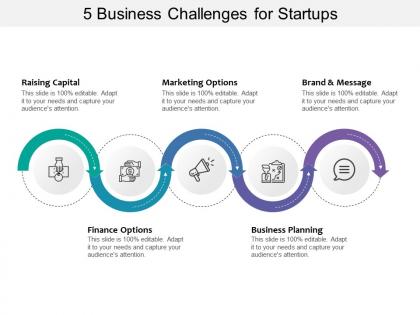
5 business challenges for startups




Try Before you Buy Download Free Sample Product
 Impress Your
 Audience
 100%
100% Editable
 Save Hours
 of Time


Our 5 Business Challenges For Startups are the essential beat of your lilting melody. Adorn them with your tuneful thoughts and top the charts.
People who downloaded this PowerPoint presentation also viewed the following :
5 business challenges for startups with all 5 slides:
Appreciate conscientious attempts with our 5 Business Challenges For Startups. Ensure it gets the acknowledgement it deserves.




FAQs for 5 business
Limited brand recognition and customer trust represent startups' biggest market presence challenges, requiring strategic marketing, consistent quality delivery, and differentiated value propositions to compete against established players. Many emerging companies find that building credibility through partnerships, customer testimonials, and targeted digital marketing campaigns enables faster market penetration, ultimately delivering sustainable growth and competitive positioning in increasingly crowded industries.
Startups can manage limited resources through strategic budgeting, prioritizing revenue-generating activities, leveraging cost-effective digital tools, and maintaining lean operational structures. By focusing on essential expenditures, bootstrapping where possible, and seeking alternative funding sources like grants or angel investors, many startups find they can extend runway while building sustainable growth foundations that ultimately deliver competitive positioning.
Effective startup branding strategies include developing a clear value proposition, creating consistent visual identity across all touchpoints, leveraging authentic storytelling, engaging directly with target audiences through social media, and establishing thought leadership within their industry. These approaches enable startups to differentiate themselves in competitive markets, build customer trust, and create memorable experiences that drive loyalty, with many successful companies finding that authentic, consistent messaging ultimately delivers stronger market positioning and sustainable growth.
Startups handle competition from established players through strategic differentiation, agile innovation, niche market focus, and leveraging their flexibility advantages. While larger competitors have resources and market presence, startups can pivot quickly, offer personalized customer experiences, and target underserved segments, with many finding that their speed and adaptability ultimately deliver competitive positioning.
Technology enables startups to overcome resource constraints, market barriers, and operational inefficiencies through cloud computing, automation tools, digital marketing platforms, and data analytics solutions. These technologies streamline operations, reduce costs, and accelerate market entry, with many startups finding that strategic technology adoption delivers competitive advantages, enhanced customer experiences, and scalable growth in an increasingly digital marketplace.
Startups can attract talent through equity compensation, flexible work arrangements, professional development opportunities, meaningful work culture, and clear growth pathways within the organization. Many emerging companies find that offering stock options, remote work flexibility, and direct access to leadership often outweighs traditional salary limitations, ultimately building dedicated teams who are invested in long-term success.
Common pitfalls in customer acquisition for new enterprises include targeting too broad an audience, underestimating acquisition costs, neglecting customer retention, and relying heavily on single channels. These missteps often result from insufficient market research and unrealistic growth expectations, with many startups finding that sustainable acquisition requires strategic focus, diversified approaches, and balanced investment in both acquisition and retention efforts.
Market research is crucial for startups, helping validate assumptions, identify target customers, assess market size, and understand competitive landscapes before significant investment. Through surveys, focus groups, and prototype testing, startups can refine their value propositions, reduce launch risks, and pivot strategies based on real customer feedback, ultimately minimizing costly mistakes while maximizing market entry success.
Startups face resource constraints, talent acquisition difficulties, market competition, operational inefficiencies, and maintaining quality standards while expanding rapidly. These challenges require strategic planning, with many successful companies finding that streamlined processes, scalable technology infrastructure, and phased growth approaches enable sustainable expansion while preserving company culture and delivering consistent customer experiences.
Startups can navigate regulatory hurdles by conducting thorough compliance research, engaging legal experts early, building relationships with regulatory bodies, and implementing robust documentation systems. Many emerging companies in healthcare, fintech, and food services find that proactive regulatory planning, strategic partnerships with established players, and phased market entry ultimately streamline approval processes while minimizing costly delays and penalties.
Startups can leverage partnerships to overcome challenges through shared resources, market access, technical expertise, risk distribution, and accelerated growth opportunities. Strategic alliances with established companies, suppliers, or complementary startups enable cost reduction, faster market entry, and enhanced capabilities, while many emerging businesses finding that collaborative approaches deliver competitive advantages they couldn't achieve independently.
Relying heavily on a single revenue stream creates significant vulnerability to market fluctuations, customer loss, and economic downturns that can threaten startup survival. This concentration risk limits growth potential and investor appeal, with many successful startups finding that diversifying revenue streams through multiple product lines, subscription models, or strategic partnerships ultimately delivers greater financial stability and competitive resilience.
Startups can leverage customer feedback to refine products, identify market gaps, prioritize feature development, and enhance user experiences through surveys, reviews, and direct engagement. This strategic approach enables rapid iteration cycles, reduces development costs, and builds stronger customer loyalty, with many successful startups finding that feedback-driven pivots often lead to breakthrough market positioning and sustainable competitive advantages.
Startups can maintain cash flow through invoice factoring, securing lines of credit, offering early payment discounts to customers, extending supplier payment terms, and implementing subscription-based revenue models. These strategies enable consistent cash circulation by accelerating receivables, smoothing payment cycles, and creating predictable income streams, with many early-stage companies finding that diversifying cash flow sources ultimately delivers greater financial stability and operational flexibility.
Startups can balance innovation with practicality by conducting regular market validation, implementing iterative development cycles, and maintaining close customer feedback loops throughout product development. This strategic combination enables companies to pursue breakthrough solutions while ensuring commercial viability, with many successful startups finding that measured experimentation and data-driven decision making ultimately delivers both competitive advantage and sustainable growth.
No Reviews