

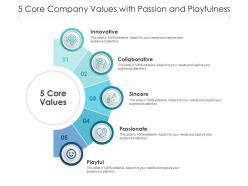
5 core company values with passion and playfulness





Try Before you Buy Download Free Sample Product
 Impress Your
 Audience
 100%
100% Editable
 Save Hours
 of Time


Our 5 Core Company Values With Passion And Playfulness are topically designed to provide an attractive backdrop to any subject. Use them to look like a presentation pro.
People who downloaded this PowerPoint presentation also viewed the following :
5 core company values with passion and playfulness with all 2 slides:
Use our 5 Core Company Values With Passion And Playfulness to effectively help you save your valuable time. They are readymade to fit into any presentation structure.

FAQs for 5 core company values with
Your company's core values are basically the beliefs that drive everything you do - like your moral compass when making decisions. They're super important because without them, everyone just makes stuff up as they go along and chaos ensues (trust me on this one). Good values help you hire the right people and keep them around too. The tricky part? Actually living by them instead of just posting them on your website and calling it a day. When things get complicated or you're stuck between tough choices, that's when they really matter. Don't just make them sound pretty - make them real.
Think of core values as your company's GPS for behavior. They help people figure out what to do when things get messy or complicated. Like when someone's deciding how to handle a difficult customer or whether to cut corners on a project. The trick is actually walking the walk though - I've seen too many companies with beautiful value statements that leadership completely ignores. When your values are real and consistent, they become this unspoken guide for everything. Hiring decisions, conflict resolution, daily interactions. People just know "this is how we roll here." But if leadership doesn't model them? Total waste of time.
Your values are basically your decision-making filter - they help you pick the right path when you're stuck between options. I always tell people to literally ask themselves which choice matches what their company actually stands for. They're like guardrails that stop you from making dumb short-term moves that'll bite you later. Honestly though? They only work if people actually use them in real conversations, not just when they're gathering dust on some poster. Most of the time when you're torn between choices, checking against your stated values makes the answer pretty obvious.
Don't just slap your values on a poster and call it a day. Weave them into hiring, reviews, conflict resolution - basically everything that matters. Stories work way better than boring bullet points, so share real examples of employees living those values. Leadership has to walk the walk daily or people see right through it. Town halls are fine I guess, but the real test? How you treat people when things get messy. That's when values actually count for something, not when everything's running smoothly.
Honestly, most successful companies end up with pretty similar values no matter what they do. Integrity, customer focus, innovation - you see these everywhere. Teamwork's huge too. Companies that actually treat people well just crush it compared to the ones that don't. Quality and adaptability matter since everything changes so damn fast now. Oh, and accountability - can't forget that one. The real trick though? Your values need to actually drive decisions, not just look nice on some poster. I've seen too many places where the wall art means nothing and it shows.
Honestly, most companies totally mess this up - their mission, vision, and values feel like three random documents someone threw together. Start with your core values first. Then check: does your mission statement actually reflect how you'll live those values while helping customers? Your vision should paint what success looks like when you consistently stick to those values over time. The mission is your daily "what," vision is your future "where," but values are the "how" that connects everything. If they don't reinforce each other, something's gotta change until they do.
Honestly, your values are everything when it comes to customer interactions. People can smell fake from a mile away - they want to deal with businesses that actually stick to what they say they believe in. It's kinda like having that reliable friend who never flakes on plans. When your team lives those values day-to-day (not just during some boring training session), customers start trusting your brand. They know what to expect. That consistency builds real loyalty over time. Don't just throw random buzzwords on your website and call it a day.
Your team's core values are like having a referee when things get messy. When people start arguing, you can just redirect back to what everyone already agreed on. Say collaboration is one of your values - frame fights as "how do we figure this out together?" instead of taking sides. People can't really push back on values they helped create, which is kinda genius. Oh, and actually USE them when things get heated - don't just let them collect dust. We literally stuck ours on the wall so nobody could pretend they forgot.
Honestly? Most company values are just expensive wall decorations. Build them into your actual hiring process and reviews - like, actually score people on them. Get your team talking about how values connect to real decisions you're making right now. I've watched so many places where nobody even remembers what their values are lol. Managers need to bring them up during feedback sessions and tough calls. Leadership has to walk the walk consistently - your team will copy what they see you doing. Make values part of daily work, not some separate thing you discuss once a quarter.
Look, most companies do this backwards - they write values once then never touch them again. Big mistake. I'd say revisit them every 3-5 years, or when something major happens like rapid growth or leadership shakeups. Maybe a pivot too. Here's the thing though: don't change them just because it's been a while. If they still fit your actual day-to-day culture and where you're going, leave them alone. But if they feel stale or totally disconnected from reality? Time for a proper review session with your leadership team and key people.
Honestly, most companies mess this up in two ways. First, they pick super vague values like "integrity" and "teamwork" that don't actually help when you're dealing with real problems. Like, what does that even mean when you're deciding whether to fire someone? Second issue is way more common though - leadership just doesn't walk the walk. You'll have these gorgeous values posted everywhere, but then managers ignore them completely during hiring or when they're under pressure. My advice? Make your values specific enough that you could actually use them to solve an argument between coworkers. Otherwise you're just putting fancy words on the wall.
Ask your people straight up if the values actually make sense in their daily work - anonymous surveys work great for this. Focus groups are solid too since you'll get real stories about when values helped or totally failed them. Yeah, the feedback might hurt a little, but that's honestly where you find the good stuff. Look for patterns in what they're saying is confusing or missing. Then actually fix your values based on what you heard. Don't forget to circle back and show them how their input changed things - people need to see their voices mattered.
Your core values are basically who you are - like the stuff that doesn't budge even when everything else changes. Goals are totally different though. They're concrete things you're chasing that shift around as you grow. So integrity might be a core value, but hitting that 20% revenue bump? That's a goal. Here's what I've learned the hard way - values should drive how you go after your goals. If there's a mismatch between what your team says it believes and what you're actually pushing for, people notice that weird tension immediately. Makes everything feel off.
Honestly, good values work like a filter for candidates - people who vibe with what you're about will actually want to work there. Think of it like dating but less awkward. When someone sees values they connect with, they're way more likely to stick around long-term too. Oh, and here's the thing - when your team hits a rough patch or needs to make hard calls, shared values give everyone something to anchor on. Just don't be one of those companies that posts pretty values online then totally ignores them. People see right through that.
Look, your core values are like a roadmap for picking CSR stuff that doesn't seem fake. When what you actually believe in matches the causes you support, everything just clicks better with employees and customers. Without that connection? People can tell you're just throwing darts at a board of trendy causes. Start by figuring out what your company genuinely cares about - and I mean really cares about, not what sounds good on paper. Then build your social responsibility around those things. It's honestly way less stressful than trying to guess what'll make you look good.
-
Graphics are very appealing to eyes.
-
Great quality product.
-
Very well designed and informative templates.
-
Wonderful templates design to use in business meetings.
-
Excellent template with unique design.
-
Much better than the original! Thanks for the quick turnaround.