


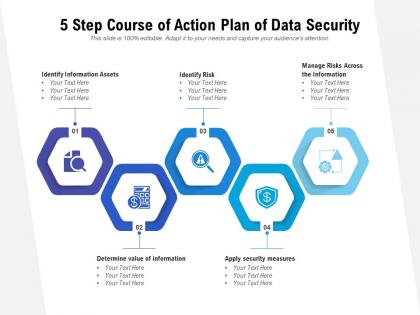
5 step course of action plan of data security




Try Before you Buy Download Free Sample Product
 Impress Your
 Audience
 100%
100% Editable
 Save Hours
 of Time


Our 5 Step Course Of Action Plan Of Data Security are very adaptable. They have a high flexibility quotient.
People who downloaded this PowerPoint presentation also viewed the following :
5 step course of action plan of data security with all 2 slides:
You have a clear understanding of the situation. Demonstrate your mastery with our 5 Step Course Of Action Plan Of Data Security.

FAQs for 5 step course of action plan
Effective data security plans include access controls, encryption protocols, regular security audits, incident response procedures, and employee training programs. These components work together by limiting unauthorized access, protecting sensitive information, and ensuring rapid threat detection, with many organizations finding that comprehensive plans significantly reduce breach risks while maintaining operational efficiency and regulatory compliance.
Organizations can assess their current data security posture through comprehensive security audits, vulnerability assessments, penetration testing, compliance evaluations, and risk analysis across all systems and processes. These assessments enable businesses to identify gaps, prioritize remediation efforts, and establish baseline metrics, with many financial institutions and healthcare organizations finding that thorough posture evaluations ultimately streamline implementation and enhance regulatory compliance.
Employee training plays a critical role in data security plan success by educating staff on threat recognition, secure practices, password management, and incident response protocols. Well-trained employees become the first line of defense against cyberattacks, with many organizations finding that comprehensive training programs significantly reduce security breaches while enhancing overall organizational resilience and compliance.
Data encryption serves as a foundational layer in comprehensive security strategies by converting sensitive information into unreadable code, protecting data both at rest and in transit across networks and storage systems. Financial institutions and healthcare organizations particularly benefit from encryption's ability to safeguard customer records and transactions, ensuring compliance while maintaining operational efficiency and competitive trust advantages.
Data backup and recovery best practices include automated regular backups, multiple storage locations, encryption of backup data, regular testing of recovery procedures, and comprehensive documentation of recovery processes. These strategies streamline business continuity by minimizing downtime, ensuring data integrity, and enabling rapid restoration, with many organizations finding that robust backup systems ultimately deliver competitive advantage through enhanced operational resilience.
Organizations ensure regulatory compliance by conducting thorough data audits, implementing role-based access controls, establishing data retention policies, and creating incident response procedures aligned with GDPR, HIPAA, or industry-specific requirements. Through regular compliance assessments and employee training, companies streamline audit processes while minimizing regulatory risks, ultimately delivering enhanced customer trust and competitive advantage in increasingly regulated markets.
Essential data security monitoring tools include SIEM systems, intrusion detection platforms, endpoint protection software, vulnerability scanners, and threat intelligence feeds. These technologies streamline threat identification by analyzing network traffic, monitoring user behavior, and detecting anomalies in real-time, with many organizations finding that integrated security platforms ultimately deliver faster incident response and enhanced operational resilience.
Organizations should handle third-party vendor risk through comprehensive due diligence assessments, contractual security requirements, regular audits, and continuous monitoring of vendor compliance. These strategic approaches enable businesses to evaluate vendor security postures, establish clear data protection standards, and maintain oversight throughout partnerships, with many financial services and healthcare organizations finding that proactive vendor risk management ultimately delivers enhanced data protection and regulatory compliance.
Developing an incident response strategy involves establishing detection protocols, creating response teams with defined roles, implementing containment procedures, and developing recovery workflows. These components work together by enabling rapid threat identification, coordinating cross-functional teams during breaches, and minimizing operational disruption, with many organizations finding that structured incident planning significantly reduces response times and protects customer trust.
A data security plan should be reviewed quarterly and updated immediately following security incidents, regulatory changes, or significant business modifications. This regular assessment enables organizations to address emerging threats, incorporate new technologies, and maintain compliance standards, while many enterprises find that proactive quarterly reviews significantly reduce vulnerabilities and enhance overall operational security.
Common pitfalls include inadequate risk assessment, insufficient employee training, overlooking third-party vendor vulnerabilities, neglecting regular updates, and failing to establish clear incident response procedures. These oversights significantly compromise organizational security, with many companies finding that comprehensive planning, regular audits, and employee education ultimately deliver stronger protection and regulatory compliance in an increasingly complex threat landscape.
Organizations can leverage cloud security measures by implementing multi-factor authentication, encryption protocols, automated threat detection, access controls, and regular security audits within their comprehensive data security frameworks. These cloud-based protections enhance operational efficiency by providing scalable monitoring, reducing infrastructure costs, and delivering real-time threat responses, with many financial services and healthcare institutions finding that integrated cloud security ultimately strengthens their overall data protection while enabling business agility.
Risk assessment forms the foundation of effective data security plans by identifying vulnerabilities, evaluating potential threats, and prioritizing protection measures based on business impact and likelihood. Through comprehensive risk analysis, organizations can allocate resources strategically, implement targeted security controls, and ensure compliance requirements are met, ultimately delivering cost-effective protection while minimizing operational disruptions and regulatory exposure.
Data classification enhances security strategy effectiveness by enabling targeted protection levels, streamlined compliance management, and optimized resource allocation based on information sensitivity and business value. Through systematic categorization, organizations can implement precise access controls, automated monitoring protocols, and risk-appropriate encryption measures, ultimately delivering stronger protection while reducing operational complexity and security management costs.
Organizations should track metrics including incident response time, data breach frequency, compliance audit scores, employee security training completion rates, and system vulnerability remediation speed. These measurements enable businesses to assess their security posture effectiveness while identifying improvement areas, with many financial institutions and healthcare organizations finding that regular metric monitoring significantly reduces risk exposure and enhances regulatory compliance.
No Reviews