


5 ways to run wholesale distribution business successfully




Try Before you Buy Download Free Sample Product
 Impress Your
 Audience
 100%
100% Editable
 Save Hours
 of Time


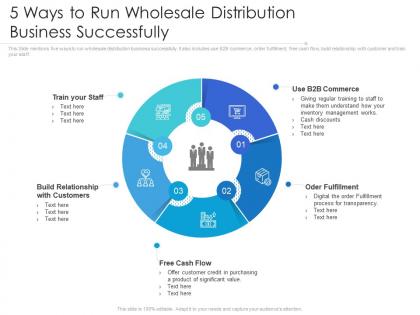
This Slide mentions five ways to run wholesale distribution business successfully. It also includes use B2B commerce, order fulfillment, free cash flow, build relationship with customer and train your staff.
People who downloaded this PowerPoint presentation also viewed the following :
5 ways to run wholesale distribution business successfully with all 2 slides:
Use our 5 Ways To Run Wholesale Distribution Business Successfully to effectively help you save your valuable time. They are readymade to fit into any presentation structure.

FAQs for 5 ways to run wholesale
Essential wholesale distribution strategies include efficient inventory management, strong supplier relationships, competitive pricing models, robust logistics networks, and strategic market positioning. These approaches streamline operations by reducing carrying costs, ensuring product availability, and accelerating delivery times, with many distributors finding that technology integration and data-driven decision making ultimately deliver enhanced customer satisfaction and sustainable competitive advantage.
Technology streamlines wholesale distribution through automated inventory management, real-time order processing, predictive analytics, integrated supply chain systems, and cloud-based platforms. These solutions enhance operational efficiency by reducing manual errors, accelerating fulfillment cycles, and optimizing stock levels, with many distributors finding that automation ultimately delivers faster customer service and significantly lower operational costs.
Customer relationship management streamlines wholesale distribution by centralizing client data, automating order processes, tracking purchase histories, and personalizing communication strategies. Through CRM systems, distributors enhance inventory forecasting, reduce order fulfillment times, and strengthen partnerships with retailers and suppliers, ultimately delivering improved operational efficiency and competitive advantage in an increasingly complex supply chain environment.
Wholesalers maximize profits through demand forecasting, automated reorder systems, ABC analysis for priority classification, and strategic safety stock levels. These approaches streamline operations by reducing carrying costs, minimizing stockouts, and optimizing cash flow, with many distribution companies finding that data-driven inventory management delivers 15-30% profit improvements while enhancing customer satisfaction.
Best practices for selecting reliable suppliers include evaluating financial stability, production capacity, quality certifications, delivery track records, and communication responsiveness. Through comprehensive supplier audits and pilot partnerships, wholesale distributors can assess reliability across multiple criteria, while establishing backup supplier relationships ensures continuity, ultimately delivering consistent product availability and maintaining competitive advantage in increasingly demanding markets.
Market trends significantly influence wholesale purchasing decisions by determining product demand forecasts, pricing strategies, inventory allocation priorities, and supplier selection criteria. Through trend analysis, distributors anticipate consumer preferences, adjust order volumes accordingly, and negotiate better terms with manufacturers, while seasonal patterns and emerging market shifts enable more strategic inventory management, ultimately delivering competitive advantage and reduced carrying costs.
Wholesalers should track inventory turnover rates, order fulfillment accuracy, customer acquisition costs, gross profit margins, and supply chain efficiency metrics. These measurements enable distributors to optimize warehouse operations, reduce carrying costs, and enhance customer satisfaction, with many wholesale organizations finding that consistent monitoring of these KPIs ultimately delivers improved cash flow and stronger competitive positioning.
Wholesalers leverage data analytics to improve decision-making by analyzing inventory patterns, customer purchasing behaviors, seasonal trends, and supplier performance metrics. Through predictive analytics and real-time dashboards, distributors can optimize stock levels, identify profitable customer segments, and streamline supply chain operations, ultimately reducing costs while enhancing service delivery and competitive positioning.
Wholesale distributors commonly face inventory management inefficiencies, supply chain disruptions, pricing pressures from both suppliers and retailers, technology integration gaps, and cash flow constraints. These challenges can be overcome through advanced inventory systems, diversified supplier networks, and strategic pricing models, with many distributors finding that digital transformation and data analytics ultimately deliver improved operational efficiency and stronger competitive positioning.
Branding is increasingly critical for wholesalers, enabling differentiation through reliability, specialized expertise, superior service quality, and strategic partnerships with manufacturers. In competitive markets, strong branding helps wholesale distributors secure better supplier relationships, attract quality retailers, and command premium pricing, while building trust that translates into long-term customer loyalty and sustained business growth.
Omnichannel wholesale distribution delivers enhanced customer experiences, streamlined inventory management, improved order accuracy, increased sales opportunities, and better data visibility across all touchpoints. This strategic approach enables distributors to serve retail partners through multiple channels seamlessly, with many finding that integrated systems reduce operational costs while accelerating order fulfillment and strengthening competitive positioning.
Wholesalers build strong retail partnerships through reliable inventory management, competitive pricing structures, flexible payment terms, and responsive customer service. By offering value-added services like marketing support, product training, and data analytics, distributors enhance retailer success while strengthening relationships, ultimately creating mutual growth opportunities and sustained competitive advantage in increasingly dynamic markets.
Sustainable sourcing enhances wholesale distribution through improved supplier relationships, reduced environmental risks, cost optimization, and stronger brand reputation. These practices streamline operations by ensuring supply chain transparency, minimizing regulatory compliance issues, and meeting increasingly demanding customer expectations, with many distributors finding that sustainability initiatives ultimately deliver competitive advantage and long-term profitability.
Effective negotiation techniques significantly impact wholesale distribution success by securing better pricing terms, establishing favorable payment schedules, and building stronger supplier relationships. Through strategic negotiation, distributors achieve improved profit margins, reduced operational costs, and enhanced inventory flexibility, while suppliers gain reliable long-term partnerships, ultimately delivering competitive advantage in increasingly dynamic markets.
Innovations shaping wholesale distribution include AI-powered demand forecasting, automated warehouse systems, blockchain supply chain transparency, IoT inventory tracking, and digital B2B marketplaces. These technologies streamline operations by reducing manual processes, enhancing accuracy, and enabling real-time visibility, with many distributors finding that strategic automation delivers faster fulfillment and competitive advantage.
-
Very unique, user-friendly presentation interface.