


5 Year Marketing Plan Financial Portfolio




Try Before you Buy Download Free Sample Product
 Impress Your
 Audience
 100%
100% Editable
 Save Hours
 of Time


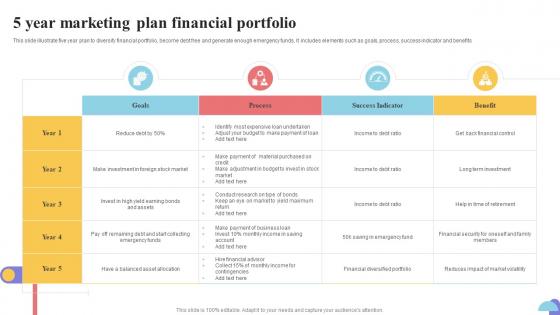
This slide illustrate five year plan to diversify financial portfolio, become debt free and generate enough emergency funds. It includes elements such as goals, process, success indicator and benefits
People who downloaded this PowerPoint presentation also viewed the following :
5 Year Marketing Plan Financial Portfolio with all 6 slides:
Use our 5 Year Marketing Plan Financial Portfolio to effectively help you save your valuable time. They are readymade to fit into any presentation structure.





FAQs for 5 Year Marketing
Key components of a successful marketing strategy include clear target audience identification, competitive positioning, multi-channel campaign development, measurable objectives, and consistent brand messaging. These elements work together by aligning resources with market opportunities, optimizing customer acquisition costs, and driving engagement across touchpoints, with many organizations finding that integrated approaches deliver stronger ROI and sustainable competitive advantage.
Businesses effectively identify their target audience through comprehensive market research, demographic analysis, psychographic profiling, competitor analysis, and customer data examination. These strategic approaches enable organizations to understand consumer behaviors, preferences, and pain points across various sectors like retail, healthcare, and financial services, ultimately delivering more personalized marketing campaigns and improved customer acquisition rates.
Digital marketing serves as the backbone of modern marketing strategy, encompassing social media engagement, search engine optimization, content marketing, email campaigns, and data-driven advertising. These channels enable businesses to reach targeted audiences more precisely, track campaign performance in real-time, and optimize customer experiences across multiple touchpoints, ultimately delivering higher ROI and competitive advantage in an increasingly digital marketplace.
Companies leverage social media to enhance marketing through targeted advertising, influencer partnerships, community building, real-time customer engagement, and data-driven content strategies. These platforms enable businesses to reach specific demographics cost-effectively, build brand loyalty through authentic interactions, and measure campaign performance instantly, with many organizations finding that strategic social media integration delivers higher conversion rates and stronger customer relationships.
Marketing strategy success can be measured through key performance indicators (KPIs), return on investment (ROI) analysis, customer acquisition costs, conversion rates, and brand awareness metrics. These measurement methods enable organizations to track campaign effectiveness, optimize resource allocation, and demonstrate tangible business outcomes, with many companies finding that comprehensive analytics ultimately deliver competitive advantage and sustained growth.
Market research is crucial for developing effective marketing strategies, as it provides insights into customer preferences, competitive landscapes, market trends, and demographic behaviors. Through comprehensive research, companies can identify target audiences more precisely, optimize resource allocation, and minimize campaign risks, with organizations in retail, technology, and financial services finding that data-driven strategies deliver significantly higher ROI and customer engagement rates.
Brand differentiation strategies include developing unique value propositions, creating distinctive brand personalities, focusing on niche market segments, emphasizing superior customer experience, and leveraging innovative product features or services. These approaches enable companies to stand out by delivering targeted messaging, building emotional connections with consumers, and establishing competitive advantages, with many organizations finding that strategic differentiation ultimately drives customer loyalty and premium pricing opportunities.
Businesses can engage audiences through content marketing by creating valuable blog posts, interactive videos, informative infographics, educational webinars, and targeted social media campaigns. These strategies build meaningful connections by addressing customer pain points, sharing industry insights, and demonstrating expertise, with many organizations finding that consistent, authentic content ultimately drives higher engagement rates and stronger brand loyalty.
Key marketing performance metrics include conversion rates, customer acquisition cost, lifetime value, return on ad spend, and engagement rates across channels. These metrics enable organizations to optimize resource allocation, identify high-performing campaigns, and demonstrate ROI, with many companies finding that tracking these indicators delivers improved targeting, enhanced budget efficiency, and ultimately stronger competitive positioning in increasingly data-driven markets.
Aligning marketing strategy with business goals ensures cohesive resource allocation, consistent messaging, and measurable outcomes that directly support organizational growth and profitability. This strategic combination enables companies to streamline campaigns, enhance customer targeting, and maximize ROI, with many organizations finding that aligned strategies deliver faster market penetration and sustainable competitive advantage.
Customer feedback shapes marketing strategy by revealing customer preferences, identifying pain points, highlighting messaging effectiveness, and uncovering unmet needs that drive strategic adjustments. Through surveys, social media monitoring, and direct interactions, companies refine their targeting, messaging, and channel selection, with many retail and service organizations finding that feedback-driven strategies deliver higher engagement rates and improved customer retention.
Emerging marketing strategy trends include AI-powered personalization, omnichannel customer experiences, sustainability-focused messaging, voice search optimization, and social commerce integration. These approaches streamline customer engagement by delivering targeted content, seamless cross-platform interactions, and authentic brand storytelling, with many organizations finding that strategic combinations of these technologies ultimately enhance customer loyalty and competitive advantage.
Cultural differences significantly impact global marketing strategies through language adaptation, consumer behavior variations, purchasing patterns, communication preferences, and value system alignments. Companies like McDonald's customize menus for local tastes, while luxury brands adjust messaging for different cultural contexts, ultimately delivering more resonant customer experiences and competitive advantage in diverse markets.
Omnichannel marketing delivers consistent customer experiences across all touchpoints, increased engagement rates, improved customer retention, enhanced data collection, and higher conversion rates. This strategic approach enables brands to seamlessly integrate online, mobile, social media, and in-store interactions, with many retailers finding that unified messaging across channels ultimately drives 15-35% higher customer lifetime value.
SEO enhances marketing strategy by improving search visibility, driving qualified traffic, and reducing customer acquisition costs through organic reach. By targeting relevant keywords, optimizing content, and building authority, businesses streamline their digital presence while delivering measurable ROI, with many organizations finding that strategic SEO integration ultimately accelerates lead generation and competitive positioning.
-
Thank you SlideTeam for such an excellent service.
-
“The presentation template I got from you was a very useful one.My presentation went very well and the comments were positive.Thank you for the support. Kudos to the team!”