


5s Of Lean Stock Management System




Try Before you Buy Download Free Sample Product
 Impress Your
 Audience
 100%
100% Editable
 Save Hours
 of Time


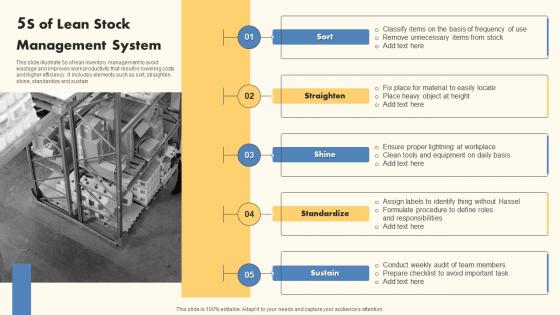
This slide illustrate 5s of lean inventory management to avoid wastage and improves work productivity that result in lowering costs and higher efficiency. It includes elements such as sort, straighten, shine, standardize and sustain.
People who downloaded this PowerPoint presentation also viewed the following :
5s Of Lean Stock Management System with all 6 slides:
Use our 5s Of Lean Stock Management System to effectively help you save your valuable time. They are readymade to fit into any presentation structure.





FAQs for 5s Of Lean
The main principles of 5S Lean Management are Sort (removing unnecessary items), Set in Order (organizing essential items), Shine (cleaning and maintaining), Standardize (establishing consistent procedures), and Sustain (maintaining improvements long-term). These principles streamline operations by reducing waste, improving efficiency, and enhancing workplace safety, with many manufacturing companies, hospitals, and offices finding that systematic implementation delivers faster processes, lower costs, and significantly improved productivity across their operations.
Implementing 5S improves workplace efficiency by eliminating waste, reducing search time for tools and materials, standardizing work processes, and creating visual management systems that identify problems quickly. Through systematic organization and cleanliness protocols, organizations streamline operations, minimize downtime, and enhance employee productivity, with many manufacturing and healthcare facilities finding significant reductions in processing times and operational costs.
Companies typically face resistance to change from employees accustomed to existing workflows, inconsistent implementation across departments, and difficulty sustaining new organizational habits long-term. While manufacturing and healthcare organizations often struggle with initial training costs and time investments, those maintaining consistent 5S practices ultimately achieve improved efficiency, reduced waste, and enhanced workplace safety, with many finding that systematic approach delivers measurable operational improvements.
5S contributes to workplace safety by creating organized, clutter-free environments where hazards are immediately visible, standardizing procedures to reduce human error, and establishing systematic maintenance routines that prevent equipment failures. Through proper implementation, organizations streamline safety protocols, minimize accident risks, and enhance employee awareness, with many manufacturing and healthcare facilities finding that structured 5S programs ultimately deliver improved compliance and reduced workplace incidents.
5S can be highly effective in non-manufacturing environments, including healthcare facilities, offices, retail spaces, warehouses, and service organizations. These principles streamline workflows by organizing workspaces, standardizing procedures, and eliminating waste, with many hospitals, banks, and administrative departments finding that 5S implementation reduces search time, enhances productivity, and ultimately delivers improved customer service and operational efficiency.
Employee training plays a crucial role in 5S implementation by ensuring proper understanding of sorting, organizing, cleaning, standardizing, and sustaining practices across all organizational levels. Comprehensive training programs enable employees to identify waste, maintain workplace organization standards, and develop continuous improvement mindsets, with many manufacturing and healthcare organizations finding that well-trained teams sustain 5S practices more effectively, ultimately delivering enhanced productivity and operational efficiency.
Organizations can measure 5S success through visual management metrics, workplace audits, efficiency indicators, safety incident tracking, and employee engagement scores. Through regular assessments, companies streamline operations by reducing waste, improving productivity, and enhancing workplace organization, with many manufacturing and healthcare facilities finding that consistent measurement ultimately delivers sustained operational improvements and competitive advantage.
5S focuses specifically on workplace organization through Sort, Set in order, Shine, Standardize, and Sustain, while other Lean methodologies like Kaizen target continuous improvement, Six Sigma emphasizes defect reduction, and Value Stream Mapping analyzes entire processes. While 5S creates the foundational workspace discipline, these complementary approaches address broader operational challenges, with many manufacturing and healthcare organizations finding that 5S enables more effective implementation of advanced Lean techniques.
Organizations should conduct 5S audits monthly for initial implementation phases, transitioning to quarterly evaluations once systems mature, with annual comprehensive reviews to assess overall effectiveness. Many manufacturing facilities, hospitals, and service centers find that regular weekly spot-checks combined with formal quarterly assessments maintain momentum while enabling continuous improvement, ultimately delivering sustained workplace efficiency and operational excellence.
Successful 5S implementation requires visual management tools like shadow boards and color-coded labels, standardized checklists and audit forms, employee training programs, and digital tracking systems for monitoring compliance. These resources streamline workplace organization by establishing clear protocols, enhancing accountability, and maintaining consistency, with many manufacturing and healthcare organizations finding that systematic tool deployment accelerates adoption and delivers sustained operational efficiency.
Technology enhances 5S effectiveness by enabling digital visual management systems, automated monitoring through IoT sensors, and mobile applications for audits and documentation. These tools streamline workplace organization by providing real-time data tracking, predictive maintenance alerts, and standardized checklists, ultimately delivering improved compliance rates and operational efficiency across manufacturing and service environments.
Common misconceptions about 5S Lean Management include believing it's only about cleanliness, viewing it as a one-time event rather than continuous practice, thinking it applies solely to manufacturing, and assuming it's just common sense without requiring training. Many organizations find that successful 5S implementation requires sustained commitment, comprehensive training, and cultural change, ultimately delivering improved safety, efficiency, and employee engagement across diverse sectors like healthcare, offices, and retail environments.
5S fosters continuous improvement by establishing systematic workplace organization that makes problems visible, encourages employee ownership, and creates standardized processes for identifying inefficiencies. Through sustained daily practices like visual management and regular audits, organizations develop habits of questioning current methods, suggesting improvements, and maintaining higher standards, ultimately building a foundation where continuous enhancement becomes part of everyday operations.
Sustaining 5S practices requires regular audits, continuous employee training, leadership commitment, visual management systems, and integration with performance metrics. These strategies work by maintaining accountability, reinforcing behaviors, and embedding 5S into daily operations, with many manufacturing and healthcare organizations finding that consistent monitoring and recognition programs ultimately deliver long-term operational excellence and cultural transformation.
Leadership involvement significantly influences 5S success by providing visible commitment, allocating necessary resources, and establishing accountability frameworks throughout the organization. When executives actively participate in 5S audits, communicate expectations clearly, and recognize achievements, they create cultural momentum that drives sustained implementation, with many manufacturing and service organizations finding that leadership engagement directly correlates with long-term workplace organization success.
-
Visually stunning presentation, love the content.
-
Colors used are bright and distinctive.