


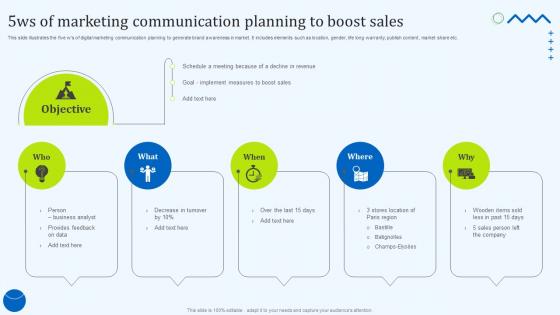
5ws Of Marketing Communication Planning To Boost Sales




Try Before you Buy Download Free Sample Product
 Impress Your
 Audience
 100%
100% Editable
 Save Hours
 of Time


This slide illustrates the five ws of digital marketing communication planning to generate brand awareness in market. It includes elements such as location, gender, life long warranty, publish content , market share etc.
People who downloaded this PowerPoint presentation also viewed the following :
5ws Of Marketing Communication Planning To Boost Sales with all 6 slides:
Use our 5ws Of Marketing Communication Planning To Boost Sales to effectively help you save your valuable time. They are readymade to fit into any presentation structure.





FAQs for 5ws Of Marketing Communication Planning
Key components include target audience analysis, clear messaging strategy, channel selection, budget allocation, timeline development, and performance metrics. These elements work together by ensuring consistent brand messaging across touchpoints, optimizing resource distribution, and enabling measurable results, with many organizations finding that strategic integration ultimately delivers enhanced customer engagement and improved ROI.
Defining your target audience involves analyzing demographics, psychographics, behavioral patterns, geographic location, and purchasing preferences through market research, customer surveys, and data analytics. This strategic segmentation enables businesses to create personalized messaging, select appropriate communication channels, and optimize resource allocation, with companies in retail, healthcare, and financial services finding that precise audience targeting significantly enhances campaign effectiveness and ROI.
Branding serves as the foundational framework for marketing communication planning, ensuring consistent messaging, visual identity, and value proposition across all channels and touchpoints. It guides content creation, channel selection, and audience targeting strategies, while establishing emotional connections with consumers, differentiating from competitors, and ultimately driving brand recognition, customer loyalty, and measurable business growth.
Businesses can measure marketing communication effectiveness through key performance indicators like conversion rates, brand awareness metrics, customer acquisition costs, engagement levels, and return on investment tracking. Through analytics platforms and attribution modeling, organizations streamline performance evaluation, optimize resource allocation, and enhance campaign targeting, with many companies finding that integrated measurement approaches ultimately deliver deeper customer insights and improved competitive advantage.
Common marketing communication planning challenges include misaligned messaging across channels, insufficient budget allocation, unclear target audience definition, poor timing coordination, and inadequate performance measurement systems. These obstacles often stem from siloed departments, competing priorities, and rapidly changing market conditions, with many organizations finding that strategic integration and cross-functional collaboration ultimately streamline workflows and enhance campaign effectiveness.
Digital channels revolutionize marketing communication strategies by enabling real-time engagement, personalized messaging, precise audience targeting, and comprehensive performance analytics across multiple touchpoints. Through social media, email automation, and mobile platforms, companies streamline customer interactions, reduce acquisition costs, and deliver seamless omnichannel experiences, ultimately enhancing brand visibility and competitive positioning.
**INPUT**: What tools or software can assist in creating a comprehensive marketing communication plan? **OUTPUT**: Marketing communication planning tools include HubSpot, Hootsuite, Asana, CoSchedule, and Salesforce Marketing Cloud, alongside analytics platforms like Google Analytics and social listening tools. These technologies streamline campaign management, content scheduling, and performance tracking across multiple channels, with many organizations finding that integrated platforms ultimately deliver better coordination, enhanced audience targeting, and measurable ROI improvements. [Word count: 58 words]
A marketing communication plan should evolve through continuous market monitoring, performance analysis, audience feedback integration, and competitive landscape assessment, while maintaining strategic flexibility for rapid pivots. Successful organizations regularly update their messaging, channels, and tactics based on consumer behavior shifts, emerging platforms, and campaign data insights, ultimately delivering enhanced engagement and sustained competitive advantage in increasingly dynamic markets.
Marketing communication consistency strategies include developing comprehensive brand guidelines, creating centralized content calendars, establishing unified voice and tone standards, implementing cross-platform approval processes, and maintaining regular message audits. These approaches streamline brand representation by ensuring coordinated messaging, standardized visual elements, and cohesive customer experiences, with many organizations finding that strategic consistency ultimately delivers stronger brand recognition and competitive market positioning.
Cultural differences significantly impact marketing communication through varying values, languages, consumer behaviors, religious beliefs, and social norms across global markets. These variations require brands to adapt messaging, imagery, and channels strategically, with companies like McDonald's and Coca-Cola localizing campaigns while maintaining brand consistency, ultimately delivering more authentic customer connections and competitive advantage internationally.
Storytelling in marketing communication creates emotional connections, builds brand identity, enhances message retention, and differentiates companies from competitors through compelling narratives. It can be leveraged through customer success stories, brand origin tales, and product journey narratives, with many organizations finding that authentic storytelling significantly improves engagement rates, strengthens customer loyalty, and ultimately drives conversion rates across digital and traditional channels.
Organizations ensure marketing communication aligns with business objectives by establishing clear KPIs, conducting regular strategy audits, maintaining cross-departmental collaboration, and implementing integrated planning processes. Through strategic alignment frameworks, companies like retail chains and financial services firms streamline messaging consistency, enhance brand coherence, and optimize resource allocation, ultimately delivering measurable ROI and sustainable competitive advantage.
Ethical considerations in marketing communication planning include truthful advertising, transparent data usage, responsible targeting practices, cultural sensitivity, and authentic brand representation. These principles help organizations build sustainable customer relationships while avoiding misleading claims or manipulative tactics, with many companies finding that ethical marketing ultimately delivers stronger brand loyalty, reduced legal risks, and competitive advantage in increasingly conscious markets.
Customer feedback can be integrated through social media monitoring, survey analysis, review assessment, focus group insights, and customer service data evaluation. These approaches enable marketers to refine messaging, adjust channel strategies, and personalize campaigns, with many retail and hospitality brands finding that feedback-driven communication delivers improved engagement rates and stronger customer relationships.
Innovative approaches include interactive storytelling, augmented reality experiences, personalized video content, gamification elements, and user-generated content campaigns. These strategies enhance engagement by creating immersive brand interactions, fostering emotional connections, and encouraging active participation, with companies across retail, technology, and entertainment sectors finding that personalized, interactive experiences significantly boost customer loyalty and conversion rates.
-
This design is not only aesthetically pleasing but it has many uses making the cost worthwhile. The graphics look stunning, and you can edit them as per your needs.
-
“As you have innovative ideas and they are all customizable, this saves a huge chunk of your time to prepare well-read presentations.”