


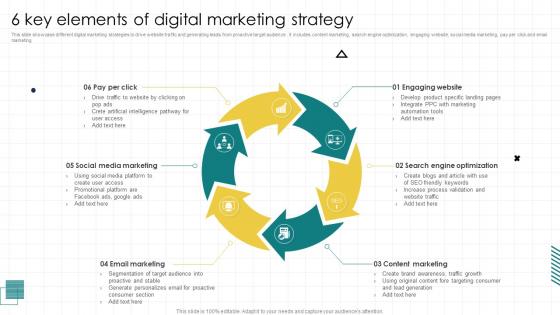
6 Key Elements Of Digital Marketing Strategy




Try Before you Buy Download Free Sample Product
 Impress Your
 Audience
 100%
100% Editable
 Save Hours
 of Time


This slide showcase different digital marketing strategies to drive website traffic and generating leads from proactive target audience. It includes content marketing, search engine optimization, engaging website, social media marketing, pay per click and email marketing.
People who downloaded this PowerPoint presentation also viewed the following :
6 Key Elements Of Digital Marketing Strategy with all 6 slides:
Use our 6 Key Elements Of Digital Marketing Strategy to effectively help you save your valuable time. They are readymade to fit into any presentation structure.





FAQs for 6 Key Elements Of
Key components of an effective digital marketing strategy include audience targeting, content marketing, SEO optimization, social media engagement, email campaigns, and performance analytics. These elements work together by identifying customer segments, delivering relevant messaging across multiple touchpoints, and measuring conversion rates, with many organizations finding that integrated approaches ultimately deliver higher ROI and stronger customer relationships.
Small businesses can leverage social media through targeted content creation, community engagement, influencer partnerships, cost-effective advertising, and customer service integration. These platforms enable businesses to reach specific demographics, build brand awareness, and drive sales with minimal investment, with many retail stores, local restaurants, and service providers finding that consistent social media presence significantly increases customer acquisition and retention rates.
Key metrics include conversion rates, customer acquisition cost, return on ad spend, website traffic, engagement rates, and customer lifetime value. These measurements enable organizations to optimize campaign performance, allocate resources strategically, and demonstrate ROI across channels, with many businesses finding that comprehensive tracking ultimately delivers improved marketing efficiency and sustainable competitive advantage.
SEO practices contribute to digital marketing strategy by enhancing organic visibility, driving qualified traffic, and reducing customer acquisition costs through sustainable search rankings. These optimization techniques integrate seamlessly with content marketing, social media, and paid advertising campaigns, with many businesses finding that strong SEO foundations amplify overall digital performance and deliver measurable ROI.
Content marketing establishes brand authority, builds customer relationships, addresses audience pain points, drives organic traffic, and nurtures leads through valuable information delivery. By creating targeted blogs, videos, and social content, businesses enhance customer engagement, improve search rankings, and foster long-term loyalty, ultimately delivering higher conversion rates and sustainable competitive advantage.
Email marketing integrates into broader digital strategies by supporting content distribution, lead nurturing, customer retention, and cross-channel messaging alignment. Through automated workflows and segmentation, businesses enhance social media campaigns, drive website traffic, and deliver personalized experiences, while many organizations finding that coordinated email efforts significantly amplify overall campaign effectiveness and customer engagement rates.
Latest digital advertising trends include programmatic advertising, connected TV advertising, voice search optimization, privacy-first targeting, and AI-powered personalization. These technologies streamline campaign management, enhance audience targeting, and deliver personalized experiences across multiple touchpoints, with many organizations finding that strategic combination of these approaches ultimately drives higher engagement rates and improved ROI in an increasingly competitive marketplace.
Businesses can effectively use data analytics to refine digital marketing strategies by tracking customer behavior patterns, measuring campaign performance across channels, identifying high-value audience segments, and optimizing content engagement metrics. Through predictive analytics and real-time monitoring, companies streamline targeting accuracy, enhance conversion rates, and allocate resources more strategically, ultimately delivering improved ROI and competitive advantage.
Strategies to enhance customer engagement through digital channels include personalized email campaigns, interactive social media content, targeted advertising, omnichannel experiences, and data-driven content optimization. These approaches streamline customer interactions by delivering relevant messaging, fostering two-way communication, and creating seamless touchpoints across platforms, with many organizations finding that personalized, multi-channel strategies significantly increase conversion rates and customer loyalty.
Businesses can align their digital marketing strategy with overall goals by establishing clear KPIs that directly connect to revenue targets, customer acquisition costs, and brand awareness metrics. Through regular cross-departmental collaboration between marketing, sales, and executive teams, companies in retail, SaaS, and financial services streamline campaign focus, optimize resource allocation, and ultimately deliver measurable ROI while maintaining strategic consistency across all channels.
Audience segmentation enables marketers to deliver personalized content, optimize ad spend, and increase conversion rates by dividing customers into distinct groups based on demographics, behaviors, and preferences. This strategic approach allows retail brands, financial services, and healthcare organizations to create highly relevant campaigns that resonate with specific audiences, ultimately delivering higher engagement rates and improved ROI.
Marketers can effectively leverage influencers by selecting partners whose audiences align with target demographics, establishing authentic long-term relationships rather than one-off campaigns, and integrating influencer content across multiple channels. Through strategic collaborations, brands achieve enhanced credibility, expanded reach, and higher engagement rates, with many companies finding that micro-influencers deliver better ROI than celebrity partnerships.
Mobile optimization significantly impacts digital marketing strategy by enhancing user experience, improving search engine rankings, increasing conversion rates, and enabling location-based targeting capabilities. With mobile traffic accounting for over half of web visits, businesses across retail, healthcare, and financial services find that mobile-responsive designs deliver faster load times, lower bounce rates, and ultimately higher customer engagement and revenue growth.
A/B testing enhances digital marketing effectiveness by comparing different campaign elements, optimizing conversion rates, and delivering data-driven insights that eliminate guesswork from marketing decisions. Through systematic testing of headlines, visuals, and calls-to-action, organizations across retail, financial services, and healthcare streamline their marketing spend while maximizing engagement, ultimately achieving significantly higher ROI.
Alignment challenges include inconsistent messaging across platforms, fragmented customer data, conflicting campaign objectives, budget allocation disputes, and varying performance metrics. These obstacles can be overcome by implementing unified brand guidelines, integrating customer data platforms, establishing cross-channel KPIs, and creating collaborative workflows, with many organizations finding that centralized strategy oversight ultimately delivers consistent customer experiences and improved ROI.
-
Their designing team is so expert in making tailored templates. They craft the exact thing I have in my mind…..really happy.
-
SlideTeam’s pool of 2Million+ PPTs has really benefited my team, everyone from the IT department to HR. We are lucky to have crossed ways with them.