


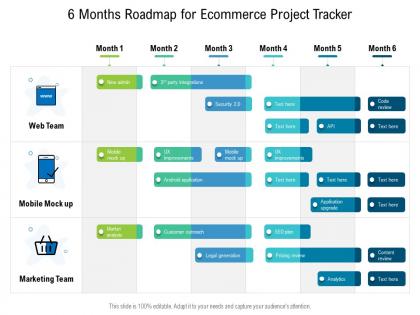
6 months roadmap for ecommerce project tracker




Try Before you Buy Download Free Sample Product
 Impress Your
 Audience
 100%
100% Editable
 Save Hours
 of Time


Utilize our pre build 6 Months Roadmap For Ecommerce Project Tracker to present your plan of action in the most effective way. Reduce the paperwork and showcase how different activities are linked to each other by incorporating this attention grabbing PowerPoint theme. This completely editable roadmap PPT layout is suitable to fit all your needs and to have a structured outline of the entire process flow using color coding. Provide guidelines to your teammates about the progression process by employing our PPT theme. Team members can easily be designated into teams by accessing the work milestones to be accomplished within the timeframe. You can easily modify the PowerPoint slide according to real time situations. Download our stunning 6 Months Roadmap For Ecommerce Project Tracker, and you are good to go to prove your expertise in strategic planning.
People who downloaded this PowerPoint presentation also viewed the following :
6 months roadmap for ecommerce project tracker with all 2 slides:
Give your audience a fulfilling experience. They will find our 6 Months Roadmap For Ecommerce Project Tracker elevating.
FAQs for 6 months roadmap for
Key eCommerce project tracker milestones include platform selection, design mockups, payment gateway integration, inventory management setup, testing phases, and launch preparation. These milestones streamline project delivery by establishing clear checkpoints, enabling stakeholder alignment, and minimizing deployment risks, with many organizations finding that structured roadmaps reduce time-to-market significantly.
Project tracking tools integrate into eCommerce workflows through inventory management systems, order processing platforms, customer service dashboards, and automated reporting mechanisms. These integrations streamline operations by connecting product development timelines with launch schedules, synchronizing marketing campaigns with inventory levels, and enabling real-time visibility across departments, ultimately delivering faster product launches and enhanced customer experiences.
**Key metrics include conversion rates, average order value, customer acquisition cost, cart abandonment rates, and customer lifetime value.** These indicators enable businesses to assess user experience effectiveness, revenue optimization, and marketing efficiency across their digital platforms, with many eCommerce organizations finding that tracking these metrics together delivers comprehensive insights into both immediate performance and long-term growth potential.
Task prioritization in eCommerce project trackers involves evaluating impact on revenue generation, customer experience enhancement, technical dependencies, and resource availability. Many retail organizations streamline this process by categorizing tasks as revenue-critical, customer-facing, or infrastructure-supporting, while considering launch deadlines and seasonal demands, ultimately delivering faster time-to-market and improved operational efficiency.
Common eCommerce project tracking challenges include scope creep, misaligned stakeholder expectations, integration complexities, resource allocation issues, and timeline disruptions across multiple platforms. These challenges can be mitigated through detailed roadmaps, regular stakeholder communication, phased implementation approaches, and dedicated project management tools, with many retailers finding that structured tracking ultimately delivers improved launch timelines and enhanced customer experiences.
Project progress in eCommerce should be reviewed weekly for ongoing initiatives and daily during critical phases like product launches, seasonal campaigns, or system integrations. This frequency enables teams to quickly address inventory issues, website performance problems, and customer experience challenges, while maintaining agility in an increasingly competitive digital marketplace where rapid adjustments drive customer satisfaction.
Customer feedback serves as a critical input for prioritizing features, identifying pain points, refining user experience improvements, and validating product decisions throughout the eCommerce roadmap development process. This feedback helps teams streamline development cycles, enhance customer satisfaction metrics, and ultimately deliver more targeted solutions, with many retailers finding that customer-driven roadmaps significantly boost conversion rates and competitive advantage.
Effectively communicating eCommerce project timelines requires visual roadmaps, regular milestone updates, stakeholder-specific dashboards, and clear dependency mapping between development phases, testing cycles, and launch preparations. Through interactive timeline tools and structured progress reports, project managers enable stakeholders to track critical deliverables like payment integration, inventory management, and user experience optimization, ultimately ensuring alignment and minimizing delays across complex eCommerce implementations.
Best practices for assigning roles and responsibilities in eCommerce projects include defining clear project ownership, establishing cross-functional team structures, creating detailed RACI matrices, setting communication protocols, and implementing regular accountability checkpoints. These approaches streamline project execution by eliminating role confusion, enhancing team coordination, and ensuring timely deliverables, with many organizations finding that strategic role clarity ultimately delivers faster launches and improved project outcomes.
Risks in eCommerce project trackers should be identified through systematic assessment of technical vulnerabilities, integration challenges, security threats, timeline dependencies, and resource constraints. Organizations can manage these risks by implementing continuous monitoring protocols, establishing contingency plans for critical functions like payment processing, and maintaining regular stakeholder communication, ultimately delivering more resilient project outcomes and competitive advantage.
Essential eCommerce project management features include inventory integration, multi-channel campaign coordination, customer journey mapping, automated workflow triggers, and real-time analytics dashboards. These capabilities streamline product launches, seasonal promotions, and cross-platform operations, with many retail organizations finding that integrated tools reduce time-to-market significantly while enhancing team coordination and customer experience delivery.
An eCommerce project tracker adapts to market trends by incorporating flexible milestone adjustments, real-time analytics integration, and dynamic resource reallocation capabilities that respond to shifting consumer behaviors and competitive landscapes. Through agile framework integration and automated trend monitoring, retail businesses can pivot product launches, adjust marketing campaigns, and reallocate development resources, ultimately maintaining competitive advantage while delivering faster time-to-market responsiveness.
Incorporating SEO strategies in ecommerce project roadmaps ensures organic visibility, sustainable traffic growth, and competitive positioning by aligning technical development with search optimization requirements from project inception. This strategic integration enables businesses to build SEO-friendly architecture, optimize user experience pathways, and coordinate content launches with technical milestones, ultimately delivering higher search rankings and reduced customer acquisition costs.
Ensuring eCommerce platform scalability requires incorporating cloud-based infrastructure, microservices architecture, automated scaling protocols, performance monitoring systems, and modular design principles into your project roadmap. These strategic approaches enable platforms to handle increased traffic, expand product catalogs, and support growing customer bases seamlessly, with many retailers finding that proactive scalability planning reduces operational costs while delivering faster user experiences and competitive market advantages.
Effective eCommerce project collaboration techniques include regular stand-up meetings, shared project management platforms, cross-functional team integration, real-time communication tools, and collaborative documentation systems. These approaches streamline coordination by ensuring transparency across development, marketing, and operations teams, while enabling faster decision-making and issue resolution, ultimately delivering more cohesive customer experiences and accelerated project timelines.
No Reviews