


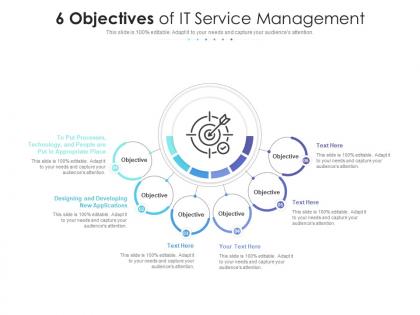
6 objectives of it service management




Try Before you Buy Download Free Sample Product
 Impress Your
 Audience
 100%
100% Editable
 Save Hours
 of Time


Our 6 Objectives Of IT Service Management are topically designed to provide an attractive backdrop to any subject. Use them to look like a presentation pro.
People who downloaded this PowerPoint presentation also viewed the following :
6 objectives of it service management with all 2 slides:
Use our 6 Objectives Of IT Service Management to effectively help you save your valuable time. They are readymade to fit into any presentation structure.
FAQs for 6 objectives of
IT Service Management objectives include aligning IT services with business needs, optimizing operational efficiency, enhancing customer satisfaction, ensuring compliance, and minimizing service disruptions. These strategic approaches streamline service delivery by standardizing processes, automating workflows, and improving resource allocation, with many organizations finding that effective ITSM ultimately delivers faster resolution times and competitive advantage.
Organizations can measure ITSM success through key performance indicators including service availability rates, incident resolution times, customer satisfaction scores, cost per service delivery, and mean time to recovery metrics. These measurements enable businesses to track operational efficiency, optimize resource allocation, and demonstrate value to stakeholders, with many enterprises finding that comprehensive ITSM metrics ultimately deliver improved service quality and reduced operational costs.
Customer satisfaction serves as a central objective in IT Service Management, driving service quality improvements, user experience optimization, and business value delivery through responsive support and reliable technology solutions. By prioritizing customer satisfaction, organizations enhance operational efficiency, reduce service disruptions, and strengthen stakeholder relationships, with many IT departments finding that satisfied users become advocates for technology initiatives, ultimately delivering competitive advantage and organizational success.
ITSM objectives align with business goals by enhancing operational efficiency, reducing costs, and improving service delivery across organizational functions. Through strategic integration of IT services with business processes, companies streamline workflows, minimize downtime, and accelerate decision-making, with many enterprises finding that aligned ITSM ultimately delivers competitive advantage and measurable ROI.
Key ITSM performance indicators include incident resolution time, first-call resolution rates, service availability percentages, customer satisfaction scores, and mean time to recovery (MTTR). These metrics enable organizations to streamline service delivery, enhance user experiences, and optimize operational efficiency, with many IT departments finding that comprehensive KPI tracking ultimately delivers improved service quality and strategic business alignment.
ITSM improves operational efficiency by automating routine tasks, standardizing service delivery processes, and implementing proactive monitoring systems that minimize downtime. Through centralized incident management and self-service portals, organizations streamline resource allocation, reduce response times, and enhance productivity, with many enterprises finding that strategic ITSM implementation delivers significant cost reductions and improved customer experiences.
ITSM enhances incident management by implementing structured workflows, automated ticketing systems, and priority-based escalation processes that minimize response times and service disruptions. Through centralized monitoring and standardized resolution procedures, organizations streamline troubleshooting, reduce downtime significantly, and maintain consistent service levels, with many enterprises finding that systematic incident management ultimately delivers improved customer satisfaction and operational reliability.
Service level agreements (SLAs) serve as the foundation for ITSM objectives by establishing measurable performance standards, defining service expectations, accountability frameworks, and resolution timeframes that align IT services with business requirements. These agreements enable organizations to monitor service quality, ensure consistent delivery across departments, and maintain transparency between IT teams and stakeholders, ultimately delivering improved operational efficiency and stronger business-IT alignment.
Continuous improvement practices integrate into IT Service Management through regular service reviews, performance monitoring, feedback collection, root cause analysis, and process optimization initiatives. These approaches streamline operations by identifying inefficiencies, reducing incident recurrence, and enhancing service delivery, with many organizations finding that systematic improvement cycles ultimately deliver faster resolution times and improved customer satisfaction.
Organizations face challenges including inadequate resource allocation, resistance to process changes, lack of executive support, siloed departmental operations, and insufficient staff training on ITSM frameworks. These obstacles often result in delayed implementations, inconsistent service delivery, and reduced customer satisfaction, with many companies finding that strategic change management and cross-functional collaboration ultimately streamline adoption and enhance operational efficiency.
Effective communication contributes to IT Service Management success by establishing clear expectations, facilitating stakeholder alignment, and ensuring seamless incident resolution across teams. Through transparent reporting and regular updates, organizations enhance user satisfaction, minimize service disruptions, and accelerate problem-solving processes, with many enterprises finding that structured communication frameworks ultimately deliver improved operational efficiency and stronger business relationships.
Automation streamlines IT Service Management by reducing manual tasks, minimizing human errors, and accelerating service delivery across incident management, change processes, and routine maintenance activities. Through automated workflows and AI-driven solutions, organizations enhance operational efficiency, achieve faster resolution times, and deliver consistent customer experiences, while enabling IT teams to focus on strategic initiatives that drive competitive advantage.
ITSM frameworks like ITIL guide organizations by providing structured methodologies for service strategy, design, transition, operation, and continual improvement, establishing clear governance and performance metrics. These frameworks enable companies to align IT services with business objectives, streamline incident management, and enhance customer satisfaction, with many enterprises finding that systematic ITSM implementation delivers reduced operational costs and improved service reliability.
ITIL 4's co-creation approach enhances ITSM objectives by fostering collaborative partnerships between IT teams and business stakeholders, improving service alignment, and accelerating solution development through shared accountability. This methodology streamlines communication workflows, reduces deployment timelines, and enhances customer satisfaction, with many organizations finding that co-created services deliver superior user experiences and stronger competitive advantage.
Organizations leverage feedback loops to refine IT Service Management objectives through continuous monitoring, stakeholder surveys, performance analytics, incident analysis, and regular service reviews. These mechanisms enable companies to identify gaps, adjust service levels, and optimize resource allocation based on real user experiences, with many enterprises finding that systematic feedback collection ultimately delivers enhanced service quality, reduced downtime, and improved alignment between IT capabilities and evolving business needs.
-
Great quality slides in rapid time.
-
Great designs, Easily Editable.
-
Illustrative design with editable content. Exceptional value for money. Highly pleased with the product.