


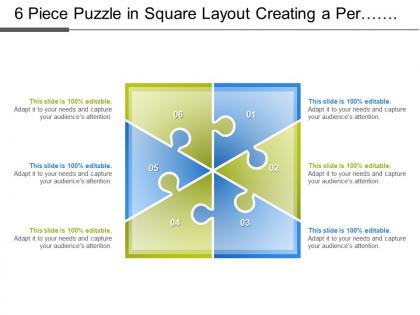
6 piece puzzle in square layout creating a perplexity of process
You must be logged in to download this presentation.




Try Before you Buy Download Free Sample Product
 Impress Your
 Audience
 100%
100% Editable
 Save Hours
 of Time


Achievements get better by the day with our 6 Piece Puzzle In Square Layout Creating A Perplexity Of Process. You will evolve brilliantly.
People who downloaded this PowerPoint presentation also viewed the following :
6 piece puzzle in square layout creating a perplexity of process with all 5 slides:
Everything gets done flawlessly due to our 6 Piece Puzzle In Square Layout Creating A Perplexity Of Process. It enables an exemplary display.

FAQs for 6 piece puzzle in square layout creating a
Hey! So puzzle design really comes down to three things. First, make the rules super clear - players should instantly get what they're supposed to do. The tricky part is figuring out *how* to do it. Build difficulty slowly too. Like, don't crush people on level 2 because they'll just quit (learned that the hard way lol). Best puzzles make you feel like a genius when you crack them, not like you just got lucky with random button mashing. Try to create multiple ways to solve things if you can. Oh, and definitely test with people who haven't seen it before - you'll be shocked what you missed.
So puzzles actually hit different parts of your brain - kind of wild when you think about it. Sudoku builds up your working memory and logic skills. Jigsaws are all about spatial stuff and spotting patterns. Crosswords make you better with words and pulling random facts from memory (honestly my favorite type). Math puzzles don't just work your number skills - they teach you problem-solving tricks you'll use everywhere else. The key is mixing it up instead of doing the same puzzle every day. You get way better brain training that way.
So like, players get way more hooked when puzzles have actual stories behind them. Instead of just "move these blocks," they're helping someone escape or discovering hidden lore. Context makes everything click better, you know? Plus narrative gives you natural breaks to teach new mechanics without people getting frustrated during the hard parts. I swear, some of my favorite puzzle games barely had complex mechanics but the story kept me glued to the screen. Try wrapping your next puzzle in some kind of plot - even something simple works. You'll see engagement shoot up immediately.
Honestly, tech totally changes the puzzle game. Real-time hints are a lifesaver when you're stuck, and I'm weirdly obsessed with tracking my solve times - it's like having a personal scoreboard. The adaptive difficulty thing is cool too since it actually learns how good you are. AR stuff can be hit or miss though, sometimes it's just gimmicky. My advice? Start with hybrid puzzles that mix physical pieces with digital elements. They don't overwhelm you with features but still give you that enhanced experience. Way better than going full digital right away.
Oh man, there's actually a bunch of stuff that messes with puzzle-solving! Working memory is huge - like how much info you can hold in your head at once. Then there's how flexible your thinking is when you need to try different approaches. Stress totally kills your ability though - makes you tunnel vision and miss the obvious stuff (happens to me every time in escape rooms lol). Your confidence matters too, plus whether you've done similar puzzles before. But honestly? Most of this gets better with practice, and just being in the right headspace helps a ton.
Puzzles are perfect because everyone naturally finds their thing - some people go straight for edges, others sort by color or weird patterns. The chatting gets pretty crazy too, everyone's like "has anyone seen this piece??" You're all working toward the same goal so nobody feels left out. When that final piece goes in, everyone cheers and it's honestly such a good feeling. Oh and definitely let different people lead sections - keeps it interesting and everyone stays involved. Short bursts work better than marathon sessions in my experience.
Oh, puzzles are amazing for getting kids actually engaged! They're sneakily learning problem-solving and critical thinking without realizing it. I use math puzzles for number work, word games for vocab, even timeline puzzles in social studies. The collaboration is what really gets me though - they'll debate strategies and help each other way more than during regular lessons. Just match the difficulty to where your kids are at, and don't go overboard with them. I started with basic jigsaws and logic games last year. Now they literally beg for puzzle time! Way better than another worksheet, honestly.
Honestly, the biggest trap is making puzzles way too hard or stupidly easy. New designers always think harder equals better - which is totally wrong btw. You want that perfect middle ground where people feel smart solving it, not like they want to throw their phone. Don't add fake clues that go nowhere, that's just annoying. Your solution needs to make sense, even if it takes some thinking. Oh and definitely test it on people who've never seen it! You'll miss obvious problems because you already know the answer. Fresh eyes catch everything you can't see.
Dude, culture totally changes how people think about puzzles. What makes perfect sense to you might confuse the hell out of someone else. Western games usually focus on solo problem-solving and step-by-step logic, but Eastern cultures often prefer working together and spotting patterns. Colors mean different things too - red's lucky in China but screams danger here. I've watched puzzle games completely bomb overseas because the basic mechanics just didn't click culturally. If you're making something for a global audience, test it with different groups early on. Don't just translate the words - you might need to rethink the whole visual approach and puzzle logic.
Puzzle apps are getting crazy social lately. They adjust difficulty based on how you solve stuff, which is honestly pretty smart. Multiplayer ones are huge now - you can compete or work together live. AR puzzles are wild too, like your phone puts pieces right onto your table or whatever. Short daily challenges are the real hook though. People love those streak counters and sharing their scores. Oh, and if you're thinking about making something in this space, definitely focus on community stuff. Kids these days don't really want to solve puzzles alone anymore.
Honestly, player feedback is like your north star for tweaking puzzle mechanics. If someone says a level's too annoying or boring, you can mess with the difficulty curve or timing to fix it. The best part? You're not just solving problems - you're figuring out what actually hooks people. Sure, analytics are helpful, but nothing beats hearing directly from players about how your puzzles made them feel. I always tell people to start gathering feedback super early, even when your prototype looks like garbage. Trust me, it saves so much headache later.
Keep your main mechanic dead simple at first, then add layers bit by bit. It's like learning to ride a bike before attempting wheelies, you know? Test it on non-puzzle people first - they'll spot the confusing parts you totally missed. Give players multiple ways to solve things when you can. Honestly, the best feeling is when someone goes "oh I'm so smart!" instead of "well that was random." Visual hints help too. I do this thing where if my mom could get through level one, I know I'm headed in the right direction.
Puzzles are surprisingly good for getting people to actually engage instead of just mindlessly scrolling. Hide clues across your social media or do riddles about your products - honestly, people get weirdly competitive about this stuff. Scavenger hunts work great too, especially if there's a discount at the end. The trick is finding that sweet spot where it's challenging but not impossible. I'd start small though - maybe just throw a brain teaser in your weekly newsletter and watch your open rates spike. People love feeling clever when they solve something.
Honestly, rewards are what keep people grinding through tough puzzles instead of rage-quitting. You need those little dopamine hits - points, new levels unlocked, whatever. I made this mistake before where I had solid puzzles but crappy rewards, and players just... bounced. Timing matters too. Drop rewards too often and they're meaningless. Wait too long between them and people get frustrated and leave. You're aiming for that "okay just one more" feeling where small wins stack up to bigger ones. Oh, and definitely put rewards right before your hardest sections - gives players something to look forward to when they're struggling.
Honestly, visuals are everything with puzzles. People judge by the box art before they even think about difficulty level. Blurry or boring images? Hard pass. You need crisp, high-res photos that'll look amazing both on the shelf and when it's all put together. The tricky part is getting the complexity right - enough detail so people can actually sort pieces without losing their minds, but not so chaotic it becomes a nightmare. I learned this the hard way with a puzzle that was basically all blue sky. Match your image complexity to who's solving it. Good artwork isn't cheap, but it's worth every penny.
-
Content of slide is easy to understand and edit.
-
Design layout is very impressive.