


6 Week Roadmap For Employee Training And Development Social Media Marketing




Try Before you Buy Download Free Sample Product
 Impress Your
 Audience
 100%
100% Editable
 Save Hours
 of Time


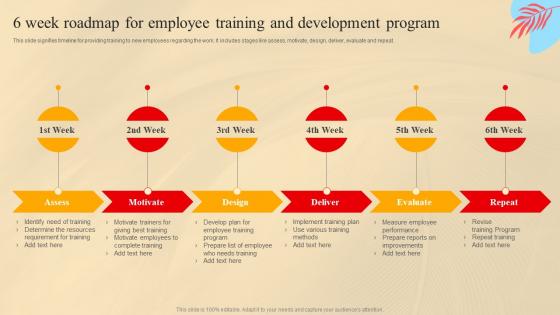
This slide signifies timeline for providing training to new employees regarding the work. It includes stages like assess, motivate, design, deliver, evaluate and repeat.
People who downloaded this PowerPoint presentation also viewed the following :
6 Week Roadmap For Employee Training And Development Social Media Marketing with all 6 slides:
Use our 6 Week Roadmap For Employee Training And Development Social Media Marketing to effectively help you save your valuable time. They are readymade to fit into any presentation structure.





FAQs for 6 Week Roadmap For Employee Training And Development
LinkedIn stands out as the primary platform for employee training promotion, alongside Twitter for industry insights, YouTube for video tutorials, Facebook for community building, and Instagram for visual content showcasing training success stories. These platforms enhance program visibility by connecting with professional networks, sharing educational content, and demonstrating real-world applications across industries like healthcare, finance, and technology, ultimately delivering broader talent acquisition and employee engagement advantages.
Organizations measure social media marketing impact on training through engagement analytics, completion rates, knowledge retention assessments, and behavioral change tracking. By analyzing metrics like post interactions, video watch times, and course enrollments alongside pre-and-post training evaluations, companies can determine ROI while identifying which social platforms most effectively drive learning outcomes and employee skill development.
Content creation serves as the foundation for engaging employee training programs on social media by transforming traditional learning materials into interactive posts, videos, infographics, polls, and discussion prompts that encourage participation. Through compelling visual storytelling and bite-sized educational content, organizations streamline knowledge retention, foster peer-to-peer learning, and create community-driven training environments, ultimately delivering higher completion rates and enhanced skill development across teams.
Employee testimonials on social media create authentic recruitment tools by showcasing real learning experiences, career advancement stories, and skill development outcomes through LinkedIn posts, video testimonials, and success stories. These genuine endorsements build trust with potential candidates, demonstrate program value and company culture, while highlighting tangible career progression, ultimately attracting quality talent who see credible evidence of professional growth opportunities.
Companies can encourage employee learning sharing through recognition programs, branded hashtag campaigns, internal content creation contests, and dedicated social media training sessions that build confidence and skills. These strategies work particularly well when organizations provide content templates, showcase employee spotlights, and integrate social sharing into professional development goals, ultimately enhancing employer branding while building employee advocacy networks.
Visual storytelling in employee training social media campaigns can include infographic skill progressions, behind-the-scenes learning moments, employee success story videos, interactive timeline posts, and before-and-after transformation content. These approaches enhance engagement by creating relatable narratives, showcasing real career journeys, and building community connection, with many organizations finding that visual stories significantly increase training program participation and knowledge retention.
**INPUT**: What are the best practices for developing a social media marketing calendar focused on employee training content? **OUTPUT**: Best practices include establishing consistent posting schedules, aligning content with business objectives, incorporating diverse formats like videos and infographics, and tracking engagement metrics. This strategic approach enables organizations to streamline knowledge sharing, enhance employee skill development, and ultimately deliver improved performance outcomes while building stronger internal communities.
Organizations can align social media messaging with corporate training goals by integrating consistent brand values, learning objectives, and key competencies across all platforms and communications. Through strategic content planning, many companies showcase employee development stories, share industry insights that reinforce training themes, and create social campaigns that highlight skills being developed internally, ultimately strengthening both their employer brand and learning culture.
Organizations must consider employee consent for image/video use, protection of proprietary training content, compliance with data privacy regulations like GDPR, and safeguarding sensitive business information from competitors. While social media showcases enhance employer branding and talent attraction, many companies find that implementing clear consent protocols and content guidelines ultimately delivers stronger recruitment outcomes while maintaining employee trust and regulatory compliance.
Social media influencers can promote corporate training programs by creating authentic testimonials, developing educational content series, and showcasing real transformation stories from program participants. Through strategic partnerships, influencers help organizations reach broader talent pools, enhance program credibility, and demonstrate tangible career advancement outcomes, with many companies finding that influencer endorsements significantly boost enrollment rates and employee engagement levels.
Organizations should track engagement metrics like shares, comments, and click-through rates, knowledge retention through assessments and completion rates, behavioral changes in employee posting frequency and quality, and business outcomes including lead generation and brand sentiment. These comprehensive metrics enable companies to measure both immediate learning impact and long-term strategic value, with many finding that tracking employee advocacy reach and content quality scores ultimately delivers enhanced brand visibility and stronger customer engagement across platforms.
User-generated content enhances training program visibility by showcasing authentic employee experiences, creating peer testimonials, and demonstrating real skill applications across social platforms. Through employee posts about certifications, learning milestones, and professional growth stories, organizations amplify their development initiatives organically, while building credibility and attracting top talent who value continuous learning opportunities.
Organizations face challenges including keeping pace with rapidly evolving platforms, measuring training ROI effectively, ensuring consistent brand messaging across teams, and bridging generational gaps in social media proficiency. These obstacles present both operational and strategic considerations, with many companies finding that structured programs combining hands-on practice, platform-specific training, and clear guidelines ultimately deliver enhanced employee confidence and measurable marketing outcomes.
Organizations tailor social media content by incorporating visual infographics for visual learners, interactive polls and quizzes for kinesthetic learners, podcast-style videos for auditory learners, and step-by-step carousels for sequential learners. This multi-format approach enhances engagement across diverse learning preferences, with companies like IBM and Microsoft finding that personalized content delivery significantly improves training completion rates and knowledge retention.
Innovative social media trends for promoting employee training include micro-learning videos, interactive live sessions, gamified challenges with leaderboards, user-generated content showcasing success stories, and AI-powered personalized learning paths. These approaches enhance engagement by creating community-driven learning experiences, peer-to-peer knowledge sharing, and real-time feedback mechanisms, ultimately delivering higher participation rates and improved skill retention across organizations.
-
It’s really cool, and you can find pretty much everything you could need for your work or school.
-
They helped us design the pamphlets for our church’s food drive! The people loved the design, and I’m happy to say it was successful. Thank you, SlideTeam!