


6R Approach For Cloud Software Migration




Try Before you Buy Download Free Sample Product
 Impress Your
 Audience
 100%
100% Editable
 Save Hours
 of Time


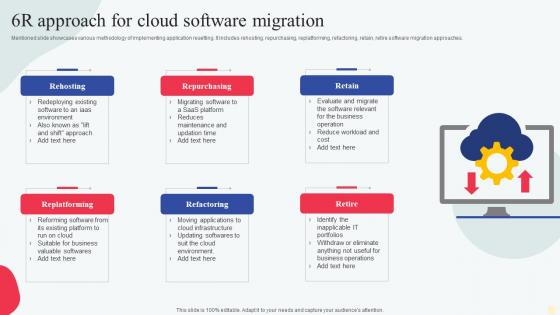
Mentioned slide showcases various methodology of implementing application resetting. It includes rehosting, repurchasing, replatforming, refactoring, retain, retire software migration approaches.
People who downloaded this PowerPoint presentation also viewed the following :
6R Approach For Cloud Software Migration with all 6 slides:
Use our 6R Approach For Cloud Software Migration to effectively help you save your valuable time. They are readymade to fit into any presentation structure.





FAQs for 6R Approach For
The 6R Approach encompasses six core principles: Reframe (shifting perspectives), Restructure (organizational redesign), Revitalize (energy renewal), Retool (skill development), Relate (relationship building), and Renew (continuous improvement). These principles enable organizations to systematically navigate change by addressing mindset shifts, operational efficiency, and workforce adaptation, with many companies finding that this comprehensive framework delivers sustainable transformation and enhanced competitive advantage.
The 6R Approach integrates into project management by establishing systematic checkpoints for Reuse, Reduce, Recycle, Recover, Redesign, and Refuse across project phases, ensuring resource optimization and waste minimization. This framework enables project managers to streamline workflows, reduce costs, and enhance sustainability metrics, with many organizations finding that systematic 6R implementation delivers improved efficiency and competitive advantage.
The 6R Approach enhances stakeholder engagement through structured communication, clear role definition, regular feedback loops, and transparent progress tracking throughout transition phases. By systematically addressing readiness, resistance, resources, reinforcement, results, and relationships, organizations create multiple touchpoints for stakeholder involvement, ultimately delivering stronger buy-in and smoother implementation across all organizational levels.
The 6R Approach can be strategically adapted for digital transformation by applying its principles to technology migration, system modernization, and process digitization. Organizations use this framework to rehost legacy systems to cloud platforms, refactor outdated applications for mobile compatibility, and rearchitect entire digital infrastructures, ultimately delivering enhanced operational efficiency and competitive advantage in increasingly digital markets.
Effectiveness metrics for the 6R Approach include cost reduction percentages, resource efficiency ratios, waste elimination rates, process cycle time improvements, and sustainability compliance scores. These measurements enable organizations to track operational streamlining across manufacturing, retail, and service sectors, with many companies finding that comprehensive 6R implementation delivers measurable competitive advantages and enhanced resource allocation.
The 6R Approach addresses sustainability by systematically reducing environmental impact through refuse, reduce, reuse, recycle, rot, and rethink strategies. Organizations implementing these principles streamline waste management, minimize resource consumption, and enhance operational efficiency, with manufacturing companies and retail chains finding that comprehensive 6R integration delivers significant cost savings while strengthening their environmental stewardship credentials.
Leadership drives successful 6R Approach implementation by establishing clear vision, allocating necessary resources, and fostering organizational buy-in across all operational levels. Effective leaders champion each R—Reduce, Reuse, Recycle, Recover, Redesign, and Rethink—through strategic decision-making, employee engagement initiatives, and performance accountability, ultimately delivering sustainable competitive advantage and operational excellence.
Effective communication of the 6R Approach requires multi-channel strategies including executive briefings, department-specific workshops, visual dashboards, and regular progress updates tailored to each organizational level. Through cascading communication frameworks, leadership teams can ensure consistent messaging while middle management translates strategic objectives into operational tasks, ultimately creating organization-wide alignment and measurable adoption across all departments.
The 6R Approach has achieved significant success in manufacturing, healthcare, retail, and logistics industries due to their resource-intensive operations and sustainability pressures. These sectors benefit from the framework's systematic waste reduction, cost optimization, and circular economy principles, with manufacturing companies finding substantial material savings and healthcare organizations streamlining supply chains while enhancing environmental compliance and operational efficiency.
The 6R Approach facilitates risk management by providing a structured framework for Risk identification, Risk assessment, Risk response, Risk monitoring, Risk communication, and Risk review throughout project lifecycles. This systematic methodology enables project managers to proactively address uncertainties, streamline decision-making processes, and maintain stakeholder alignment, with organizations in construction, IT, and manufacturing finding that comprehensive risk oversight ultimately delivers improved project outcomes and reduced financial exposure.
Common challenges when adopting the 6R Approach include resistance to change, lack of stakeholder alignment, insufficient data tracking systems, resource constraints, and inconsistent implementation across departments. These obstacles can be overcome by establishing clear communication strategies, investing in comprehensive training programs, implementing robust monitoring systems, and securing leadership commitment, with many organizations finding that phased rollouts and cross-functional teams ultimately deliver sustainable transformation and measurable results.
The 6R Approach emphasizes comprehensive assessment through its six criteria (reasons, resources, risks, returns, responsibility, and relationships), while frameworks like Kotter's 8-Step Process focus more on sequential implementation stages. This strategic combination delivers more thorough upfront analysis and stakeholder alignment compared to linear models, with many organizations finding that the 6R framework ultimately enhances project success rates through better risk mitigation.
Small businesses can significantly benefit from the 6R Approach by systematically addressing resource optimization, waste reduction, operational efficiency, and sustainable practices across their limited but focused operations. This framework enables smaller organizations to streamline processes, reduce costs, enhance customer experiences, and improve environmental impact, with many finding that strategic implementation of reduce, reuse, recycle, rethink, refuse, and repair principles delivers competitive advantages while building stronger community relationships and long-term viability.
Case studies showcasing the 6R Approach include Walmart's supply chain optimization reducing waste by 20%, Toyota's manufacturing processes eliminating redundancies while enhancing quality, and Amazon's logistics network redesigning distribution for faster delivery. These organizations demonstrate how systematically applying reduce, reuse, recycle, redesign, remanufacture, and refuse principles streamlines operations, minimizes costs, and delivers competitive advantage across retail, manufacturing, and e-commerce sectors.
**INPUT**: How do we ensure the continuous improvement aspect of the 6R Approach remains a priority post-implementation? **OUTPUT**: Continuous improvement in the 6R Approach requires establishing regular review cycles, performance monitoring systems, and dedicated feedback loops that track effectiveness across all six dimensions. Organizations maintain momentum by scheduling quarterly assessments, assigning improvement champions, and integrating 6R metrics into operational dashboards, with many companies finding that linking continuous improvement to performance incentives and strategic planning processes ultimately delivers sustained optimization and competitive advantage. [Word count: 60 words]
-
I'm happy to discover your PowerPoint presentations and templates. They met my expectations precisely. Very innovative!
-
Easily Understandable slides.