


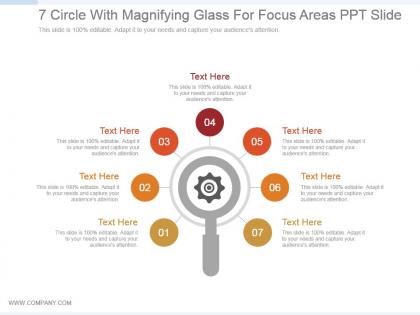
7 circle with magnifying glass for focus areas ppt slide




Try Before you Buy Download Free Sample Product
 Impress Your
 Audience
 100%
100% Editable
 Save Hours
 of Time


Doubt is never a factor with our 7 Circle With Magnifying Glass For Focus Areas Ppt Slide. Face challenges with complete certainty.
People who downloaded this PowerPoint presentation also viewed the following :
7 circle with magnifying glass for focus areas ppt slide with all 5 slides:
Fix your gaze ahead with our 7 Circle With Magnifying Glass For Focus Areas Ppt Slide. Focus fully on future events.
FAQs for 7 circle with magnifying glass for focus
Key elements include audience needs and expertise level, presentation objectives and desired outcomes, time constraints and content prioritization, available supporting data and evidence, and alignment with organizational goals. These components work together by ensuring message relevance, maintaining audience engagement, and delivering actionable insights, with many presenters finding that strategic focus areas ultimately enhance communication effectiveness and drive better business results.
Focus areas enhance presentation clarity by organizing content around core themes, eliminating distracting tangents, and creating logical narrative flow that guides audiences through key insights. This strategic approach enables presenters to deliver more compelling messages, reduce cognitive overload for viewers, and ultimately achieve stronger audience engagement and retention, with many organizations finding that focused presentations drive better decision-making outcomes.
Techniques for selecting relevant focus areas include audience research and surveys, data analytics to identify engagement patterns, competitor analysis, stakeholder feedback sessions, and social listening tools. These methods help organizations understand their target demographic's preferences, pain points, and interests, with many companies finding that combining quantitative data with qualitative insights delivers more precise audience alignment and stronger engagement outcomes.
Focus areas vary significantly across industries based on unique operational demands and regulatory requirements. Healthcare prioritizes patient safety, compliance, and care quality, while technology companies emphasize innovation, scalability, and user experience, and education focuses on learning outcomes, accessibility, and institutional effectiveness, with many organizations finding that industry-specific priorities ultimately drive strategic resource allocation and competitive positioning.
Visual aids emphasize focus areas through strategic color contrasts, enlarged text or graphics, animation sequences, directional arrows, and highlighted sections that guide audience attention. These techniques streamline information delivery by creating visual hierarchy, reducing cognitive load, and ensuring key messages resonate, with many presenters finding that strategic emphasis ultimately enhances audience retention and engagement.
Maintain audience engagement by crafting focus areas with compelling storytelling, interactive elements like polls or Q&A segments, and relevant real-world examples from their industry. Structure each focus area with clear value propositions, visual variety through dynamic slides and multimedia, and strategic pacing that alternates between information delivery and audience participation, ultimately creating memorable experiences that drive action.
Audience analysis serves as the foundation for selecting focus areas by revealing demographic preferences, pain points, communication styles, and decision-making factors that guide content strategy. Through surveys, analytics, and behavioral data, organizations identify which topics resonate most effectively with their target segments, ultimately ensuring focused messaging delivers higher engagement rates and conversion outcomes across diverse audience segments.
Effective transitions between focus areas involve clear verbal signposts, strategic pauses, and visual cues like slide transitions or gesture changes that signal topic shifts. Successful presenters use bridging phrases such as "building on this foundation" or "shifting our focus to," while incorporating brief summaries of previous points before introducing new sections, ultimately maintaining audience engagement and ensuring seamless narrative flow throughout complex presentations.
Common pitfalls include selecting too many focus areas, choosing overly broad topics, misaligning areas with audience needs, lacking supporting data, and creating disconnected segments. These issues dilute message impact by confusing audiences, reducing retention, and weakening persuasive power, with many presenters finding that three well-defined, interconnected focus areas deliver significantly better engagement and actionable outcomes.
Storytelling techniques integrate with focus areas by creating narrative arcs around key themes, using compelling characters to represent stakeholder perspectives, and structuring content with clear conflict-resolution patterns that guide audience attention. Through strategic storytelling frameworks, presentations seamlessly weave data points into memorable narratives, transforming complex information into engaging experiences that resonate emotionally while maintaining focus, ultimately delivering enhanced audience retention and persuasive impact.
Best practices for prioritizing focus areas include impact assessment, resource availability analysis, strategic alignment evaluation, time-to-completion estimates, and stakeholder input integration. These approaches streamline decision-making by identifying high-impact, achievable objectives first, balancing quick wins with long-term strategic goals, and ensuring resource allocation matches organizational capacity, ultimately delivering measurable progress while maintaining momentum toward broader business objectives.
Feedback from past presentations reveals audience engagement patterns, content clarity issues, and topic relevance gaps that directly inform your focus area refinement strategy. By analyzing which segments generated the most questions, where attention dropped, and what topics resonated across different audience types, speakers can strategically narrow their focus to high-impact areas, ultimately delivering more targeted content and enhanced audience value.
Measuring focus area effectiveness involves tracking audience engagement metrics, feedback scores, achievement of presentation objectives, follow-up actions taken, and behavioral changes observed. Post-presentation surveys, conversion rates, decision-making outcomes, and stakeholder responses provide quantifiable data, with many organizations finding that combining immediate feedback with long-term impact assessment delivers comprehensive insights into strategic communication success.
Focus areas establish logical progression and narrative coherence by organizing content into distinct themes, creating smooth transitions between related topics, and ensuring each section builds toward the presentation's main objectives. This strategic structure enables presenters to maintain audience engagement through clear signposting, reduces cognitive load by grouping related information, and ultimately delivers more persuasive messaging, with many organizations finding that well-defined focus areas significantly improve information retention and decision-making outcomes.
Strategies include consistent visual themes, repeated key messaging, strategic slide transitions, focused storytelling, and deliberate pacing that emphasizes core points. These approaches reinforce focus by creating memorable anchors, maintaining audience attention, and ensuring critical messages resonate, with many presenters finding that structured repetition and visual consistency ultimately deliver stronger audience retention and clearer takeaways.
-
Topic best represented with attractive design.
-
Excellent Designs.