

8 types of digital marketing channels




Try Before you Buy Download Free Sample Product
 Impress Your
 Audience
 100%
100% Editable
 Save Hours
 of Time


Making your presentations memorable can help keep you ahead of the game. We want to help by offering high quality 8 Types Of Digital Marketing Channels.
People who downloaded this PowerPoint presentation also viewed the following :
Content of this Powerpoint Presentation
Description:
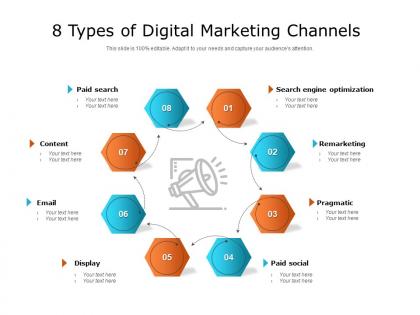
The image presented is a PowerPoint slide, titled "8 Types of Digital Marketing Channels." It illustrates a central hub-and-spoke model with a megaphone icon in the center, symbolizing the amplification and dissemination of marketing messages. Eight numbered shapes are arranged in a circular fashion around the central icon, representing different digital marketing channels. Each shape corresponds to one of the eight digital marketing channels, and is accompanied by bullet points where specific details or strategies can be inserted.
The slide outlines the following digital marketing channels:
1. Search engine optimization - Space for text on strategies or insights.
2. Remarketing - Space for text on strategies or insights.
3. Pragmatic - Typically, this might refer to 'Pragmatic Marketing' which entails practical aspects of marketing, but in this context, it seems to be a placeholder for another digital marketing channel.
4. Paid social - Space for text on strategies or insights.
5. Display - Space for text on strategies or insights.
6. Email - Space for text on strategies or insights.
7. Content - Space for text on strategies or insights.
8. Paid search - Space for text on strategies or insights.
Use Cases:
This slide can be utilized across various industries for different purposes:
1. Digital Marketing:
Use: To educate on different digital marketing strategies.
Presenter: Digital marketing strategist.
Audience: Marketing team members.
2. E-commerce:
Use: To outline the marketing mix for online sales.
Presenter: E-commerce manager.
Audience: E-commerce team and stakeholders.
3. Education & Training:
Use: For teaching modern marketing techniques.
Presenter: Instructor or Professor.
Audience: Students specializing in marketing or business.
4. Software & Technology:
Use: To discuss marketing strategies for software products.
Presenter: Product marketing manager.
Audience: Software development and marketing teams.
5. Retail:
Use: To strategize and optimize online retail marketing efforts.
Presenter: Retail marketing specialist.
Audience: Retail management and marketing staff.
6. Healthcare:
Use: To showcase digital marketing tactics for healthcare services.
Presenter: Healthcare marketing consultant.
Audience: Hospital administrators and marketing professionals.
7. Automotive:
Use: To plan digital advertising campaigns for automotive sales.
Presenter: Automotive marketing director.
Audience: Sales and marketing teams in the automotive industry.
8 types of digital marketing channels with all 2 slides:
Offering designs geared for ever presentation; our 8 Types Of Digital Marketing Channels are ready to make your project shine. Browse thousands of styles.
FAQs for 8 types of
Honestly? Start with Facebook and Instagram - they're cheap and you can see what's actually working. Google Ads are solid too. Email marketing has insane ROI if you don't mess it up. Content/blogging is great but takes forever (I'm talking months). Pick maybe 2-3 things max or you'll burn out trying to do everything. I'd master one channel first, then add another. Oh, and don't sleep on email - people think it's dead but it's not. Way better than posting into the void on social media hoping someone sees it.
Honestly, it depends on who you're trying to reach. Facebook and Instagram let you get crazy specific with targeting - like, scary specific sometimes. LinkedIn's obviously the move for B2B stuff. TikTok and Snapchat own the younger crowd, but you need solid video content. YouTube's great if you can do longer videos and want that search traffic. Twitter's... well, X now I guess? Good for jumping on trends. My take: figure out where your people actually hang out first, then worry about the creative. Don't spread yourself too thin trying to be everywhere at once.
Look, SEO is your best bet for long-term visibility. People searching for your stuff will actually find you. Paid ads? They work until you stop paying - then nothing. Good SEO keeps bringing traffic even while you sleep, which is pretty sweet. Takes patience though, like 3-6 months to really see results. I know that sounds forever but it's worth it. The whole thing builds on itself over time too. Start with figuring out what keywords your industry uses, then tweak your existing content. Even small changes can bump up your rankings quite a bit.
Honestly, start with your subject lines - they're everything. Keep them short and interesting without being those annoying clickbait ones we all hate. Test when you send stuff too, like different days and times make a huge difference. I used to think segmentation was overrated but it actually works - split people up by what they've bought or how they act on your site. Oh and definitely check how your emails look on phones since that's where most people read them anyway. Try A/B testing but just change one thing at a time or you'll go crazy trying to figure out what worked.
Interactive stuff and short videos are crushing it right now. Honestly, user-generated content is where it's at - people trust real customers way more than fancy ads. Behind-the-scenes content performs so much better than that polished stuff brands used to push. Oh, and get your employees posting too, that's been working really well lately. Video podcasts are everywhere now (kinda wish there weren't so many tbh). Most people are using AI for brainstorming and rough drafts. Just look at what formats your audience actually clicks on, then do more of that while trying one new thing each quarter.
So influencer partnerships are actually pretty solid for getting your name out there. You're tapping into audiences that already trust whoever they follow. Just make sure their followers actually match who you're trying to reach - I wasted money on that mistake before lol. Micro-influencers are honestly where I'd start. Way better engagement than those massive accounts and you won't drain your budget immediately. When it works, you'll see more people talking about you online, hitting your website, following your socials. The whole borrowing-credibility thing really does pay off if you pick the right people.
Honestly, just pick metrics that match what you're actually trying to do. Awareness campaigns? Look at reach, impressions, and how people are talking about your brand. Lead gen is all about click-through rates, conversions, and cost per lead - plus whether those leads are any good. Sales campaigns need revenue tracking, customer acquisition cost, and ROAS. Oh, and don't sleep on engagement stuff like time on page and bounce rates - that's where you'll really see what's working. But seriously, stick to maybe 3-5 metrics that actually matter. There's nothing worse than drowning in a bunch of vanity metrics that just make you feel good but don't help you make real decisions.
Honestly, I'd run ads for keywords where you're stuck on page 2-3 organically - gives you that instant visibility while SEO does its slow thing. During busy seasons, bid on your best organic terms too. Competitors get aggressive and you don't want to lose ground. Plus there's something intimidating about owning both the paid and organic spots, you know? Test different ad copy and see what converts - that stuff often works great for your meta descriptions later. Your organic research will help with paid targeting too. The whole thing just works better when you're pulling data from both sides instead of treating them like separate projects.
Dude, video marketing is absolutely crushing it right now. People share videos 1200% more than text posts - that's insane. Plus Google eats this stuff up for SEO. Honestly, I'm guilty of this too, but most of us just skim text these days rather than actually reading it. Videos grab attention way better. There's something about seeing actual faces and hearing voices that makes brands feel real, you know? Oh, and the conversion numbers are nuts - landing pages with video convert 80% better. I'd start simple with some explainer videos or show what happens behind the scenes. See what clicks with your audience first.
Honestly, I'm obsessed with checking my Instagram Insights - probably too much lol. But seriously, dig into your analytics to see what's actually hitting with your audience. Engagement rates and click-throughs don't lie. The demographic stuff is super helpful too, like when your people are scrolling and what formats they're into. I always look at my hashtag performance and story completion rates since those tell you a lot. Oh, and track which CTAs send the most traffic back to your site! Try doing weekly check-ins on your top posts and just copy whatever made them work.
Honestly, the worst thing you can do is jump on every new platform just because it's buzzing. Pick where your people actually are - I've watched teams burn months on TikTok while their B2B customers were all scrolling LinkedIn instead. Pretty painful to watch. Also think about what your team can realistically handle. YouTube sounds great until you realize nobody wants to edit videos every week. Don't go for the trendy option if it doesn't match your skills or audience. Start with maybe 2-3 channels you can actually do well instead of half-assing everything.
Honestly, mobile is just way more in-your-face than regular online stuff. People carry their phones everywhere, so you can hit them with push notifications or texts instantly - no waiting around for them to check your website. The whole vibe is different too. Smaller screens mean you gotta be super visual and punchy with your ads. Plus people are scrolling crazy fast and buying random stuff on impulse way more. Oh, and location targeting is where mobile gets really cool since you actually know where someone is. I'd start by making your current campaigns mobile-first, then play around with the geo stuff.
Okay so customer segmentation is just grouping your audience instead of sending the same stuff to literally everyone. You look at their demographics, what they actually do on your site, interests - that kind of thing. Then you tailor your messaging to each group. Way better than generic "hey everyone" emails that nobody opens. Your click rates and conversions will actually improve when people get content that speaks to them specifically. I'd start by digging into whatever customer data you've got already - find maybe 3 or 4 clear groups, then build campaigns around each one. It's honestly not as complicated as it sounds.
Honestly, user-generated content is gold - you can sprinkle it everywhere. Grab customer photos and reviews, then toss them on social, your website homepage, email newsletters, whatever. Creating a branded hashtag works crazy well for collecting more stuff. Just make sure you ask permission first (learned that one the hard way lol). Always credit whoever made it too. Start with people who've already tagged you - they're usually stoked to be featured. Oh, and don't sleep on testimonials for your homepage. That social proof hits different than anything you write yourself.
Data privacy is huge right now - you can't just track people without asking first. GDPR made everything so much more complicated, honestly. Don't use those sketchy dark patterns that trick users into subscriptions either. Your messaging needs to be genuine too, not some manipulative garbage designed to mess with people's emotions. Oh, and misinformation is obviously a no-go. I'd start by looking at what you're doing now and fixing your consent process. Most companies are still doing it wrong. Being transparent about data collection isn't optional anymore.
No Reviews