


8 types of advertising





Try Before you Buy Download Free Sample Product
 Impress Your
 Audience
 100%
100% Editable
 Save Hours
 of Time


Achieve cross functional co-operation with our 8 Types Of Advertising. Get action focused on a common goal.
People who downloaded this PowerPoint presentation also viewed the following :
Content of this Powerpoint Presentation
An average person is exposed to between 4,000 and 10,000 advertisements a day. Businesses, large or small, employ social media, billboards, television, radio, and print to influence people and turn them into customers.
Research has shown that Google AdWords generated more than 80% of the company’s income in 2021. As a result, businesses must study and employ many advertising methods to expand their customer base and improve sales.
Showcase how your Digital Advertising benefits your clients. Check out this pre-designed PPT Template.
This blog covers eight forms of advertisements that businesses can use to market their products and services. Use this as a guide to select advertising types that are within your budget and make sense for your business plan.
Let’s get started.
Enhance your marketing designs with SlideTeam’s Paid Advertising Agency Proposal, and produce the greatest proposal for your clients.
Template 1: 8 Types of Advertising Template
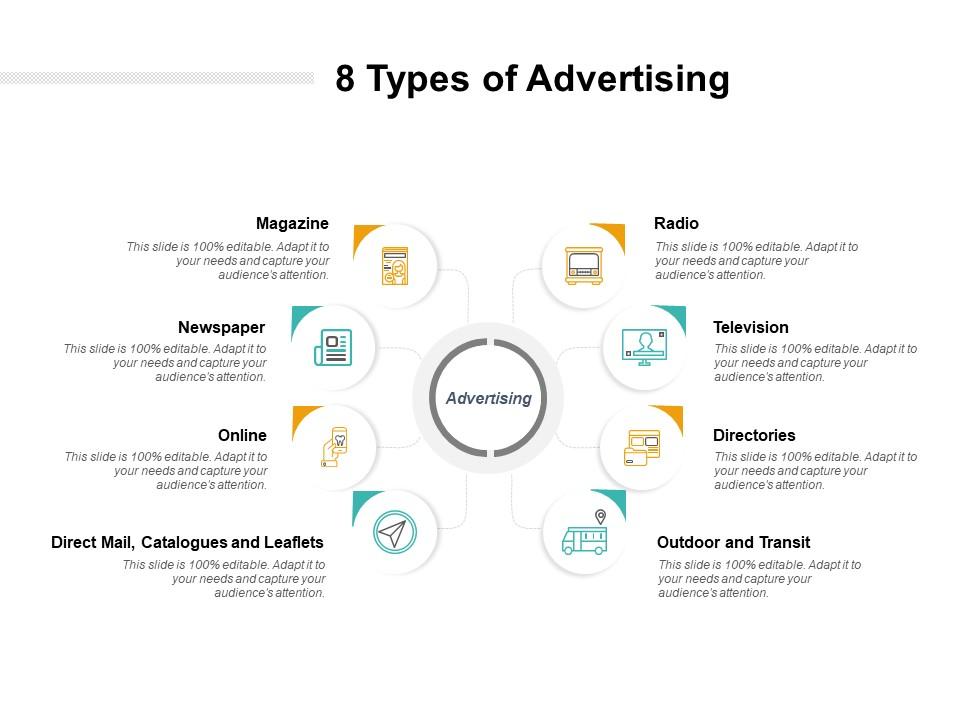
Advertising helps maintain a brand in customers’ minds. Use this PPT Template to discuss the methods of advertising that work in promoting goods or services to the right demographic. This presentation shows eight types of advertising, including magazines, newspapers, online, radio, television, directories, radio, outdoor and transit, catalogues, and more. Knowing the types of ads will help in selecting the best options for your business based on target market, budget, and purpose.
The most effective paid promotional tool
It is imperative that you use advertising well, and in all its permutations and combinations to ensure optimal use. There is no doubt that despite its limitations, in specific cases, you can easily consider to be the most effective paid promotional tool.
P.S. Need to deliver a cost-effective analysis of ad campaigns to support your messaging and vision? Check out this PPT Design.
8 types of advertising with all 5 slides:
Our 8 Types Of Advertising focus action on a common goal. They achieve cross functional co-operation.

FAQs for 8
Honestly, I'd go with digital stuff and local marketing if I were you. Facebook and Instagram ads are clutch because you can target exactly who you want without spending a fortune. Google Ads are solid too, but only if people are actually searching for your product. Don't sleep on email marketing though - super cheap and it actually works if you've built up a decent list. Oh, and local partnerships with other businesses? That's where you can really make some magic happen. Start with just one thing, see what sticks, then branch out. No point spreading yourself too thin right off the bat.
Honestly, digital crushes traditional for ROI because you can actually see what's happening. Like, you know exactly which clicks turned into sales instead of just throwing money at a billboard and crossing your fingers. Real-time tracking is huge - if something's not working, you pivot immediately rather than waiting months to figure it out. The targeting gets crazy specific too, which traditional can't touch. Don't get me wrong, TV and radio still work for getting your name out there, but good luck proving they drove that sale. I'd go digital first if you want measurable results that you can actually bank on.
Dude, honestly? Social media is where it's at for advertising now. Your customers are scrolling Instagram and TikTok all day anyway, so meet them there. The targeting is insane - you can literally find people based on what they bought last week or what videos they liked. Traditional ads just feel... old? Like shouting into the void. What I'd do is pick maybe two platforms max where your people actually are. Don't spread yourself thin trying to be on everything. Test stuff fast and cheap, see what hits, then throw more money at whatever's working. The feedback is instant too, which is pretty wild compared to old-school advertising.
Honestly, TikTok and Instagram Reels are where it's at for Gen Z - that's basically their entire world right now. YouTube Shorts too. They hate anything that feels too corporate or fake, so user-generated content crushes those polished ads every time. If you do influencer collabs, just make sure the creator actually fits your vibe. Interactive stuff works great - polls, AR filters, those gamified things they love. Oh and anything shareable is gold. Keep it visual and real. They'll scroll past anything that screams "hello fellow kids" energy, you know?
Honestly, ads that hit you in the feels are way stickier than ones just listing features. People remember stories that make them feel something - whether that's nostalgia, excitement, or even a little FOMO. You know those Nike commercials that somehow convince couch potatoes they're athletes? Pure emotional manipulation, but it works. The trick is figuring out what emotion fits your brand. Like, a coffee shop might go for cozy morning vibes while a fitness brand pushes that "you got this" energy. Once you nail down the feeling, build your whole story around it. Works every time.
Online ads are way better for targeting - you can get super specific with who sees your stuff based on their interests and behavior. Traditional stuff like TV and billboards just blasts everyone. Plus online tracking is actually useful, unlike trying to figure out if your radio ad worked (good luck with that). You can tweak online campaigns instantly too. Offline costs more and you're kinda shooting in the dark with results. I'd definitely start online if money's tight. Once you've got some momentum going, then maybe throw in some offline for brand recognition.
Oh man, seasonal campaigns are genius! People's brains literally shift gears - like you automatically think "back to school" in August or get into gift mode after Halloween. Timing is everything though. You want to hit them right when that seasonal mindset kicks in, not after everyone's already shopped. The scarcity thing works too - those "limited holiday offer" emails make people panic-buy instead of waiting around. Plus they don't feel as pushy since they match what's actually happening in people's lives. Way better than random sales in March, you know?
Honestly, it's all about that trust factor - influencers have already built relationships with their followers, so when they recommend something it doesn't feel like an ad being shoved down your throat. You're getting access to people who genuinely care about what this person has to say. Engagement rates blow traditional advertising out of the water too. Plus you can track everything super easily and see exactly what's working. Just don't get caught up in follower counts - I've seen brands waste money on huge accounts where the audience was totally wrong for their product. Match matters way more than numbers.
Honestly, it depends what you're trying to do. Brand awareness? Track reach and impressions, maybe throw in some surveys to see if people actually remember your ad. Direct response is easier - just watch your click-through rates and conversions. ROI's the real winner though - revenue divided by what you spent. Social platforms basically do the math for you, which is nice. Traditional stuff like radio or print gets weird... you'll need promo codes or special landing pages to figure out what's working. Oh, and don't track everything - pick 2-3 metrics that actually matter for your goal or you'll go crazy.
Honestly, start with just getting people to know your product exists - social media ads and some PR buzz work great for this. Video's your best friend since folks need to actually see what you're selling. Don't ignore your email list either, that's pure gold right there. Influencers can help too if you find the right ones (though half of them are kinda overpriced these days). Search ads come later once you've got some momentum going. Pick like 2-3 channels max so you can figure out what's actually moving the needle before you spread yourself too thin.
Honestly, I'd start by figuring out your hard no's first - like what you absolutely won't do. Then get weird within those boundaries! It's kinda like improv where the funniest bits happen when there are actual rules. Put your energy into stories that show off what your product actually does instead of trying to manipulate people or oversell. I always do this test: would I be pissed if my competitor pulled this exact move? The goal is making something people remember but also respect you for. Not trying to trick anyone - that backfires anyway.
Honestly, programmatic ads have totally flipped the game. TV and radio are scrambling to offer data-driven targeting because clients won't settle for the old "spray and pray" approach anymore. Print's struggling too. Super Bowl commercials still somehow cost millions though - wild, right? The traditional outlets that figured out programmatic buying are holding their own. But anyone still stuck on "here's our prime time slot" is bleeding budget to digital fast. Your clients are gonna want that real-time optimization no matter what channel you're pitching them.
Video ads crush it engagement-wise - moving content just stops people mid-scroll, you know? They can pack a whole story into like 10 seconds. Static ads need absolutely killer visuals to compete, but they're perfect for simple messages. Native ads are weirdly effective because they don't scream "THIS IS AN AD!" People scroll right past without realizing. Some folks get annoyed when they figure it out though. Honestly, it comes down to where your audience lives online. I'd test the same message across different formats and see what actually converts for your specific crowd.
Dude, interactive video ads are taking off big time. AR/VR stuff too - though honestly I'm still not sold on whether people actually want to wear those headsets for ads lol. Voice search is everywhere now, and programmatic buying keeps getting creepier with how well it targets you. Since cookies are basically dead, everyone's scrambling for first-party data. Location-based marketing is insane these days with all the geofencing tech. Oh and social commerce is clutch - people buy straight from Instagram without even leaving the app. Short-form video content is still king. Just make sure your mobile site doesn't suck because nobody has patience anymore.
Okay so basically you want to be everywhere your customers are hanging out, not just picking one platform and hoping for the best. Think Facebook + email + maybe some Google ads, whatever makes sense for your people. The repetition is what really works - someone sees your brand 3-4 times across different places and suddenly you're not some random company anymore, you know? I'd probably avoid going crazy with like 8 different channels right away though. Figure out where your audience actually spends time first, then pick maybe 3-4 solid ones. Way better to do fewer channels well than spread yourself too thin. Plus you're just more likely to catch people who live on Instagram vs the ones who are all about email.
No Reviews