


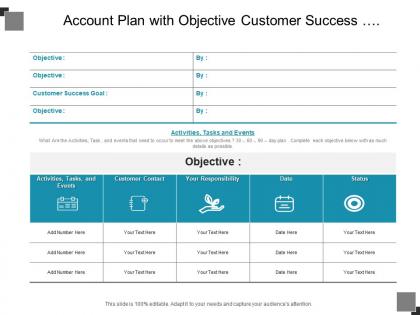
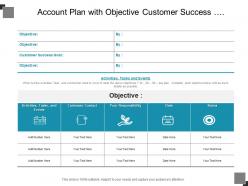
Account plan with objective customer success activities tasks and status




Try Before you Buy Download Free Sample Product
 Impress Your
 Audience
 100%
100% Editable
 Save Hours
 of Time


Encourage integration with our Account Plan With Objective Customer Success Activities Tasks And Status. Expose the harm caused by divisive forces.
People who downloaded this PowerPoint presentation also viewed the following :
Account plan with objective customer success activities tasks and status with all 5 slides:
Astute dealings is your forte. Let the depth of your ability emerge with our Account Plan With Objective Customer Success Activities Tasks And Status.



FAQs for Account plan with objective customer success activities
A comprehensive account plan should include client background and business objectives, relationship mapping and key stakeholders, current service portfolio and usage analysis, growth opportunities and expansion strategies, competitive landscape assessment, and risk mitigation plans. These components work together to deliver strategic account management, enhanced client relationships, and sustainable revenue growth, with many organizations finding that structured planning significantly improves client retention rates.
Client segmentation enhances account plans by enabling targeted strategies, personalized approaches, and resource prioritization based on customer value, needs, and growth potential. Through strategic segmentation, sales teams can allocate efforts more efficiently, customize messaging and solutions for each segment, and ultimately deliver higher conversion rates and stronger client relationships across diverse portfolio requirements.
Account plans adapt to changing client needs and market conditions through regular client feedback sessions, quarterly business reviews, flexible goal adjustments, and continuous market analysis. These adaptive strategies enable account managers to pivot service offerings, reallocate resources, and modify engagement approaches in response to evolving priorities, ultimately maintaining strong client relationships and competitive positioning in dynamic business environments.
Competitive analysis provides critical insights into market positioning, competitor strategies, pricing models, and service gaps that directly inform account planning decisions. Through systematic competitor evaluation, sales teams identify unique value propositions, anticipate client objections, and develop strategic approaches that differentiate their offerings, ultimately enabling more targeted account strategies and higher win rates.
Technology and CRM tools enhance account plan execution by centralizing customer data, automating follow-up processes, and providing real-time analytics on engagement patterns. These platforms streamline communication tracking, enable personalized outreach at scale, and deliver predictive insights about account health, with many sales organizations finding that integrated CRM systems ultimately improve client retention rates and accelerate revenue growth.
Essential account plan metrics include revenue growth, customer retention rates, expansion opportunities captured, relationship depth scores, and strategic milestone achievement. These measurements enable organizations to track performance by monitoring quarterly revenue increases, contract renewals, and cross-selling success, ultimately delivering enhanced customer satisfaction and competitive advantage in long-term partnerships.
Account plans should be reviewed quarterly for major updates, with monthly check-ins for progress tracking and market changes. This frequency enables account managers to adapt to evolving client needs, competitive shifts, and new opportunities, while many organizations find that regular reviews strengthen client relationships, improve strategic alignment, and ultimately deliver higher retention rates and revenue growth.
**INPUT**: What strategies can be implemented to deepen client relationships within an account plan? **OUTPUT**: Effective relationship-deepening strategies include regular executive touchpoints, cross-functional team integration, value-based consultations, proactive issue resolution, and strategic business reviews. These approaches streamline communication across organizational levels while enhancing trust through consistent delivery, with many enterprises finding that structured engagement frameworks ultimately deliver increased client retention and expanded partnership opportunities. [Word count: 54 words]
Account plans facilitate cross-selling and upselling by mapping client needs, identifying service gaps, and tracking relationship touchpoints across departments and decision-makers. Through comprehensive customer analysis, sales teams can strategically position complementary solutions, enhance client value propositions, and ultimately deliver expanded revenue streams while strengthening long-term partnerships.
Stakeholder feedback informs account plan refinement by revealing unmet needs, shifting priorities, competitive insights, operational constraints, and emerging opportunities that weren't initially apparent. Through regular feedback sessions, account managers can adjust strategies, reallocate resources, and modify timelines, with many organizations finding that continuous stakeholder input significantly enhances plan accuracy and ultimately delivers stronger client relationships.
Collaboration among teams contributes to a robust account plan by integrating diverse perspectives, aligning strategic objectives, and leveraging specialized expertise across departments. When sales, marketing, customer success, and product teams collaborate effectively, organizations develop comprehensive strategies that address client needs holistically, ultimately delivering enhanced customer experiences and stronger account relationships.
Aligning account plans with business goals requires strategic mapping of client objectives to organizational priorities, regular cross-departmental collaboration, and performance metrics that reflect both relationship health and revenue targets. This strategic combination enables sales teams to prioritize high-value opportunities, streamline resource allocation, and deliver measurable outcomes that support company-wide growth initiatives, ultimately creating sustainable competitive advantage.
Account plans help identify potential risks by systematically analyzing client health metrics, relationship mapping, competitive threats, contract renewal timelines, and stakeholder changes. Through regular assessment of these factors, account managers can proactively address issues like budget constraints, leadership transitions, or shifting priorities, ultimately strengthening client partnerships and minimizing churn risks.
Establishing clear roles and responsibilities within an account team prevents task overlap, ensures accountability, and streamlines client communication by designating specific contact points for different service areas. This strategic approach enhances operational efficiency, reduces internal confusion, and delivers seamless customer experiences, with many organizations finding that well-defined team structures ultimately accelerate decision-making and strengthen client relationships.
Account plans can be tailored by customizing value propositions, sales approaches, compliance requirements, and stakeholder engagement strategies specific to each sector's operational realities. Healthcare organizations require HIPAA compliance focus while financial services emphasize regulatory adherence and risk management, with manufacturing clients prioritizing efficiency metrics and supply chain integration, ultimately delivering more relevant solutions and stronger client relationships.
-
Out of the box and creative design.
-
Amazing product with appealing content and design.