


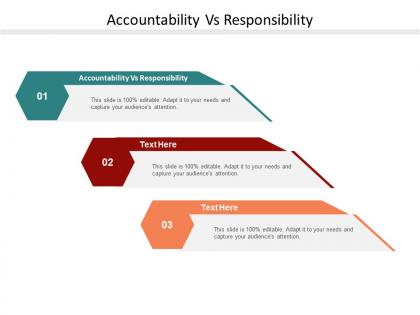
Accountability vs responsibility ppt powerpoint presentation inspiration design ideas cpb




Try Before you Buy Download Free Sample Product
 Impress Your
 Audience
 100%
100% Editable
 Save Hours
 of Time


Our Accountability Vs Responsibility Ppt Powerpoint Presentation Inspiration Design Ideas Cpb are topically designed to provide an attractive backdrop to any subject. Use them to look like a presentation pro.
People who downloaded this PowerPoint presentation also viewed the following :
Accountability vs responsibility ppt powerpoint presentation inspiration design ideas cpb with all 2 slides:
Use our Accountability Vs Responsibility Ppt Powerpoint Presentation Inspiration Design Ideas Cpb to effectively help you save your valuable time. They are readymade to fit into any presentation structure.
FAQs for Accountability vs responsibility ppt powerpoint presentation inspiration
Accountability involves answering for outcomes and facing consequences, while responsibility focuses on ownership of tasks and duties assigned to individuals. In workplace settings, employees are responsible for completing their assigned projects, but managers are accountable for team performance, with accountability requiring transparency, measurability, and ultimately delivering organizational success through clear ownership structures.
Clear definitions of accountability and responsibility enhance team dynamics by eliminating role confusion, reducing conflict over ownership, and establishing transparent expectations for deliverables and decision-making authority. This clarity streamlines collaboration, minimizes duplicated efforts, and accelerates project completion, with many organizations finding that defined accountability frameworks ultimately deliver improved communication, stronger trust between team members, and measurable increases in overall productivity.
Accountability in project management drives successful outcomes by establishing clear ownership of deliverables, creating transparent progress tracking, and ensuring team members take responsibility for their commitments. Through defined accountability frameworks, project managers streamline decision-making, minimize delays, and enhance stakeholder communication, with many organizations finding that structured accountability processes ultimately deliver improved project completion rates and stronger team performance.
Organizations foster accountability through clear goal-setting, regular performance feedback, transparent communication channels, and recognition systems that reward ownership of outcomes. By implementing structured check-ins, peer accountability partnerships, and leadership modeling, companies create environments where employees take initiative, with many finding that these approaches enhance team collaboration, reduce blame culture, and ultimately deliver improved performance and employee engagement.
Leadership styles significantly shape team perceptions by modeling expectations, communication approaches, and decision-making frameworks that either encourage shared ownership or create dependency cultures. Transformational leaders typically foster collaborative accountability through empowerment and trust-building, while micromanagers often blur responsibility lines, with many organizations finding that participative leadership styles ultimately deliver stronger team ownership and improved performance outcomes.
Common misconceptions include treating accountability and responsibility as identical concepts, believing accountability only applies when things go wrong, and assuming responsibility means working alone without collaboration. Many organizations find that effective accountability requires shared ownership and proactive communication, while responsibility involves both individual contributions and team coordination, ultimately delivering clearer expectations and stronger performance outcomes.
Individuals can effectively communicate responsibilities through clear documentation, regular progress updates, defined metrics, transparent reporting channels, and proactive stakeholder engagement. These communication strategies enhance accountability by establishing measurable expectations, creating visibility into performance outcomes, and building trust across teams, with many organizations finding that structured communication frameworks ultimately deliver improved project success rates and stronger collaborative relationships.
Effective accountability strategies include regular check-ins with progress updates, clear deadline expectations with milestone tracking, peer review systems, performance dashboards that provide transparency, and structured feedback sessions. These approaches streamline task management by establishing consistent monitoring, encouraging collaborative oversight, and creating visible progress indicators, with many organizations finding that combining multiple accountability methods ultimately delivers improved project completion rates and enhanced team performance.
Absence of accountability significantly diminishes team performance by creating unclear expectations, reducing quality standards, and enabling repeated mistakes without consequences. This breakdown erodes trust among team members, decreases motivation, and fosters a culture where high performers become frustrated while underperformers continue unchecked, ultimately undermining collective productivity and workplace satisfaction.
Tools that clarify team roles include RACI matrices, responsibility assignment matrices, organizational charts, job description templates, and role clarity workshops. These frameworks streamline accountability by defining decision-makers, contributors, and stakeholders for each task, with many organizations finding that clear role delineation reduces conflicts, enhances productivity, and ultimately delivers faster project completion.
Accountability can be measured through performance indicators, outcome tracking, goal achievement rates, feedback scores, and compliance metrics. These measurements enhance organizational transparency and individual growth by establishing clear expectations, enabling regular progress reviews, and creating data-driven improvement cycles, with many companies finding that structured accountability systems ultimately deliver stronger team performance and strategic results.
Accountability directly builds trust within teams by creating transparency, predictability, and reliability among members, while consistent follow-through on commitments reinforces psychological safety. When team members consistently deliver on their promises and own their outcomes, it establishes a foundation of mutual confidence, ultimately enabling stronger collaboration and higher performance across organizations.
Remote work environments often blur accountability and responsibility boundaries, as physical oversight decreases while digital tracking and outcome-based measurements increase. While in-person settings rely on direct supervision and immediate feedback, remote teams typically establish clearer accountability metrics through project management tools, regular check-ins, and deliverable-focused frameworks, ultimately enhancing individual ownership and transparent performance evaluation across distributed organizations.
Blurring accountability and responsibility lines creates confusion in decision-making, delayed project outcomes, finger-pointing during failures, and weakened team performance across organizations. This ambiguity undermines operational efficiency by reducing ownership clarity, slowing problem resolution, and creating workplace tensions, with many companies finding that unclear role definitions ultimately compromise strategic execution and competitive advantage.
Feedback mechanisms enhance accountability and responsibility by establishing clear performance expectations, providing regular progress updates, and creating transparent communication channels between team members and leadership. Through structured feedback systems, teams can identify areas for improvement, address issues promptly, and maintain consistent standards, with many organizations finding that regular feedback loops ultimately strengthen individual ownership and collective performance outcomes.
-
Good research work and creative work done on every template.
-
Excellent template with unique design.
-
The Designed Graphic are very professional and classic.
-
Thanks for all your great templates they have saved me lots of time and accelerate my presentations. Great product, keep them up!
-
Informative presentations that are easily editable.