


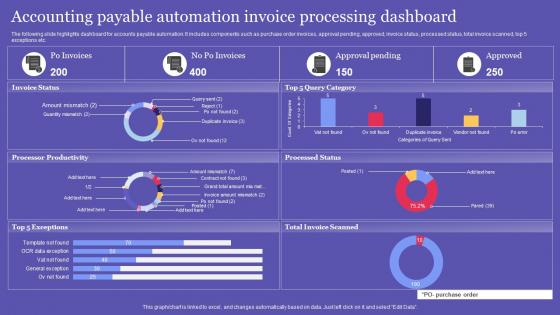
Accounting Payable Automation Invoice Processing Dashboard




Try Before you Buy Download Free Sample Product
 Impress Your
 Audience
 100%
100% Editable
 Save Hours
 of Time


The following slide highlights dashboard for accounts payable automation. It includes components such as purchase order invoices, approval pending, approved, invoice status, processed status, total invoice scanned, top 5 exceptions etc.
People who downloaded this PowerPoint presentation also viewed the following :
Accounting Payable Automation Invoice Processing Dashboard with all 7 slides:
Use our Accounting Payable Automation Invoice Processing Dashboard to effectively help you save your valuable time. They are readymade to fit into any presentation structure.






FAQs for Accounting Payable Automation
Key benefits include enhanced accuracy through reduced manual errors, accelerated payment cycles, improved cash flow management, strengthened vendor relationships, and significant cost savings through streamlined operations. These automation technologies enable businesses to process invoices faster, minimize late payment penalties, and allocate resources more strategically, with many organizations finding competitive advantages through improved financial transparency and operational efficiency.
Automation improves invoice processing by eliminating manual data entry, implementing automated approval workflows, and using optical character recognition for instant data capture. Through these technologies, organizations reduce processing time from weeks to days while minimizing human errors, with many financial departments finding that automated systems deliver 90% faster invoice cycles and significantly enhanced accuracy rates.
Cloud-based solutions enable accounts payable automation by providing scalable infrastructure, real-time data access, seamless integration with existing systems, and enhanced security protocols. These platforms streamline invoice processing, approval workflows, and payment execution across multiple locations, with many organizations finding that cloud deployment reduces IT costs while delivering faster processing times and improved vendor relationships.
Machine learning enhances accounts payable automation by improving invoice data extraction accuracy, detecting duplicate payments, and identifying potential fraud patterns through predictive analytics. These AI-driven capabilities streamline vendor management, accelerate approval workflows, and minimize processing errors, with many financial departments finding that automated systems reduce manual intervention by up to 80% while delivering faster payment cycles.
Common implementation challenges include resistance to change, data migration complexities, integration difficulties with existing systems, staff training requirements, and initial setup costs. While these obstacles can seem daunting, many organizations find that phased rollouts, comprehensive training programs, and partnering with experienced vendors significantly streamline the transition, ultimately delivering enhanced efficiency and cost savings.
Accounts payable automation enhances cash flow management by providing real-time visibility into payment obligations, optimizing payment timing through early payment discounts, and reducing processing delays that can disrupt financial planning. Through automated workflows and analytics, organizations streamline vendor relationships, minimize late payment penalties, and strategically manage working capital, ultimately delivering improved cash flow predictability and enhanced financial control.
Essential security measures for accounts payable automation include multi-factor authentication, role-based access controls, encrypted data transmission, audit trails, and vendor verification protocols. These safeguards protect against fraud, unauthorized access, and data breaches by ensuring proper authorization workflows, maintaining detailed transaction logs, and enabling real-time monitoring, with many organizations finding that comprehensive security frameworks ultimately enhance both financial transparency and operational efficiency.
Accounts payable automation supports compliance by creating detailed audit trails, enforcing approval workflows, and maintaining comprehensive documentation for every transaction. Through automated controls, organizations streamline regulatory reporting, minimize human errors that could trigger compliance issues, and ensure consistent adherence to financial regulations, with many financial institutions finding that automated systems significantly reduce audit preparation time while enhancing transparency.
Businesses can evaluate accounts payable automation success through metrics like processing time reduction, cost per invoice, early payment discount capture rates, vendor satisfaction scores, and error reduction percentages. These measurements enable organizations to track operational efficiency gains, with many companies finding that automated systems deliver 60-80% faster processing times and significantly lower administrative costs, ultimately providing measurable ROI and competitive advantage.
Integration with other financial systems enhances accounts payable automation by creating seamless data flow, eliminating duplicate entry, and providing real-time visibility across procurement, inventory, and general ledger systems. This strategic combination enables organizations to streamline invoice matching, accelerate approval workflows, and improve cash flow management, with many companies finding that integrated systems deliver faster month-end closes and enhanced financial reporting accuracy.
Adopting accounts payable automation typically requires initial investment in software and implementation, but delivers significant long-term cost reductions through decreased manual processing, reduced errors, and faster payment cycles. Organizations across manufacturing and retail sectors often see 60-80% reduction in processing costs, enhanced cash flow management, and improved vendor relationships, ultimately delivering competitive advantage through operational efficiency.
Organizations can train staff effectively on automated accounts payable systems through comprehensive onboarding programs, hands-on workshops with real invoice scenarios, role-specific training modules, and ongoing support systems. Financial departments, healthcare institutions, and retail companies find that combining interactive software tutorials with mentorship programs, regular refresher sessions, and clear documentation enables faster adoption while reducing errors, ultimately delivering improved processing efficiency and enhanced staff confidence in digital workflows.
Artificial intelligence analyzes historical payment data, vendor patterns, and seasonal fluctuations to predict future cash flow requirements and optimal payment timing within automated accounts payable systems. Through machine learning algorithms, organizations can anticipate liquidity needs, negotiate better payment terms with suppliers, and strategically manage working capital, ultimately delivering enhanced financial planning accuracy and competitive cash management advantages.
Small businesses benefit from accounts payable automation through reduced manual workload, faster invoice processing, improved cash flow management, and elimination of paper-based systems. While larger enterprises leverage automation for complex vendor networks, small businesses gain proportionally greater efficiency improvements, with many finding that automated workflows free up valuable staff time for strategic activities, ultimately delivering competitive advantages previously available only to larger organizations.
Future trends in accounts payable automation include advanced AI-powered invoice processing, blockchain-based payment verification, predictive analytics for cash flow management, mobile-first approval workflows, and seamless ERP integration. These technologies streamline operations by eliminating manual data entry, reducing processing times, and enhancing financial transparency, with many organizations finding that automated systems deliver significant cost savings while enabling faster, more strategic decision-making.
-
Been using SlideTeam for some time now…can’t imagine why I wasted all that time in front of the screen trying to make the perfect presentation.
-
The design is very attractive, informative, and eye-catching, with bold colors that stand out against all the basic presentation templates.