


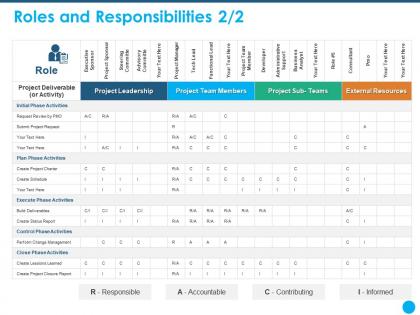
Roles and responsibilities administrative support ppt powerpoint presentation files




Try Before you Buy Download Free Sample Product
 Impress Your
 Audience
 100%
100% Editable
 Save Hours
 of Time


Our Roles And Responsibilities Administrative Support Ppt Powerpoint Presentation Files are topically designed to provide an attractive backdrop to any subject. Use them to look like a presentation pro.
People who downloaded this PowerPoint presentation also viewed the following :
Roles and responsibilities administrative support ppt powerpoint presentation files with all 2 slides:
Use our Roles And Responsibilities Administrative Support Ppt Powerpoint Presentation Files to effectively help you save your valuable time. They are readymade to fit into any presentation structure.
FAQs for Roles and responsibilities administrative support ppt
Administrative support professionals handle scheduling and calendar management, communication coordination, document preparation, meeting facilitation, and office operations oversight. These responsibilities streamline executive productivity by managing workflows, maintaining organizational systems, and ensuring seamless daily operations, with many corporations finding that skilled administrative support ultimately enhances operational efficiency and enables leadership focus on strategic priorities.
Effective communication skills enhance administrative support performance by enabling clear coordination with executives, streamlining client interactions, and facilitating seamless information flow across departments. These capabilities help administrative professionals deliver faster response times, reduce miscommunications that can delay projects, and build stronger stakeholder relationships, ultimately positioning them as strategic partners rather than task executors.
Essential software tools for administrative support roles include Microsoft Office Suite, Google Workspace, project management platforms like Asana or Trello, calendar scheduling tools, and customer relationship management systems. These technologies streamline document creation, enhance communication workflows, and automate routine tasks, with many organizations finding that integrated digital solutions significantly reduce administrative overhead while improving accuracy and response times.
Administrative support staff contribute to project management by coordinating schedules, maintaining documentation, tracking deadlines, facilitating communication between stakeholders, and managing resource allocation. Through systematic organization and process management, they enable project teams to focus on strategic deliverables while ensuring operational efficiency, ultimately streamlining workflows and enhancing project completion rates across departments.
Administrative support plays a crucial role in confidentiality and data protection by implementing secure filing systems, managing access controls, handling sensitive communications, and ensuring compliance with privacy regulations like GDPR. These professionals serve as gatekeepers for organizational information, with many companies finding that well-trained administrative staff significantly reduce data breach risks while enhancing operational security and client trust.
Administrative support roles vary significantly across industries, with healthcare requiring medical terminology knowledge and patient confidentiality management, education demanding student record coordination and academic calendar awareness, and corporate sectors emphasizing client relationship management and business process optimization. These specialized requirements enable organizations to streamline industry-specific workflows, enhance operational efficiency, and deliver targeted services, with many institutions finding that tailored administrative expertise ultimately provides competitive advantage in their respective markets.
Administrative professionals can implement time-blocking, the Eisenhower Matrix for urgency assessment, digital task management systems, and regular workload reviews to prioritize effectively. These strategies enable seamless coordination by categorizing responsibilities, allocating focused time periods, and maintaining visibility across competing demands, with many organizations finding that structured prioritization approaches ultimately deliver enhanced productivity and reduced administrative bottlenecks.
Administrative support staff streamline office procedures by implementing standardized processes, automating routine tasks, coordinating cross-departmental communications, and maintaining organized documentation systems. Through strategic workflow optimization and resource coordination, these professionals enhance operational efficiency, reduce processing times, and minimize bottlenecks, with many organizations finding that dedicated administrative support ultimately delivers faster project completion and improved team productivity.
Common administrative support challenges include managing multiple priorities, handling difficult communications, adapting to new technologies, dealing with interruptions, and maintaining accuracy under pressure. Administrative professionals can overcome these through effective time management systems, developing strong communication skills, embracing continuous learning for technology updates, setting boundaries while remaining accessible, and implementing quality control processes that ultimately enhance their value and career advancement opportunities.
Administrative support evolves from routine task management to strategic technology coordination, data analysis, and digital workflow optimization as automation handles basic functions. Modern administrative professionals increasingly manage cloud systems, coordinate virtual teams, and analyze business metrics, with many organizations finding that these enhanced roles deliver greater operational efficiency and strategic value than traditional clerical positions.
**INPUT**: What skills are most valued in administrative support roles today, and how can professionals develop them? **OUTPUT**: Most valued administrative support skills today include digital proficiency, project coordination, communication expertise, data analysis capabilities, and adaptability to remote work environments. Professionals can develop these through online certification programs, cross-departmental collaboration experiences, and hands-on practice with productivity software, ultimately delivering enhanced operational efficiency and strategic support that enables organizations to streamline workflows and maintain competitive advantage. **Word count: 58 words**
Administrative support personnel streamline employee onboarding by managing documentation, coordinating training schedules, preparing workspaces, and facilitating communication between new hires and departments. They enhance the experience by organizing orientation sessions, tracking completion of required training modules, and serving as initial points of contact, ultimately reducing HR workload while ensuring consistent, efficient integration processes that accelerate productivity.
Best practices for managing multiple schedules include using centralized digital calendars, setting up automated reminders, color-coding appointments by priority or person, and maintaining buffer time between meetings. Administrative assistants in busy organizations streamline operations by synchronizing calendars across platforms, confirming appointments 24 hours in advance, and preparing meeting materials proactively, ultimately delivering seamless coordination and enhanced productivity.
Administrative support enhances team collaboration and communication by streamlining meeting coordination, managing shared calendars, facilitating information distribution, and maintaining centralized documentation systems. These professionals serve as communication hubs across departments, enabling seamless project workflows, reducing scheduling conflicts, and ensuring consistent information sharing, ultimately delivering improved operational efficiency and stronger cross-functional teamwork.
Emotional intelligence is crucial in administrative support roles as it enables effective communication with diverse stakeholders, conflict resolution, and anticipating team needs while managing high-pressure situations. Administrative professionals can develop these skills through active listening practice, empathy training, and self-reflection exercises, with many organizations finding that emotionally intelligent support staff significantly enhance workplace productivity, reduce interpersonal conflicts, and create more positive office environments.
-
Understandable and informative presentation.
-
Excellent design and quick turnaround.