

Advantages and disadvantages of iot internet of things iot overview ppt powerpoint presentation tips




Try Before you Buy Download Free Sample Product
 Impress Your
Audience
 100%
Editable
 Save Hours
of Time


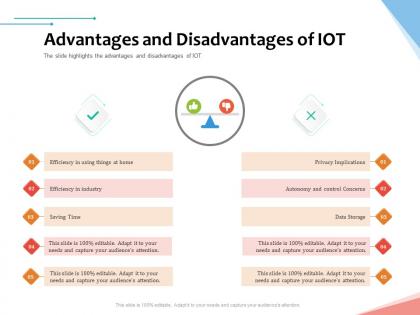
The slide highlights the advantages and disadvantages of IOT.
People who downloaded this PowerPoint presentation also viewed the following :
Advantages and disadvantages of iot internet of things iot overview ppt powerpoint presentation tips with all 2 slides:
Use our Advantages And Disadvantages Of IoT Internet Of Things IOT Overview Ppt Powerpoint Presentation Tips to effectively help you save your valuable time. They are readymade to fit into any presentation structure.


FAQs for Advantages and disadvantages of iot internet of things iot overview ppt
Dude, smart home stuff is actually pretty sweet. You can control lights, thermostat, cameras - everything from your phone which is weirdly satisfying. Energy bills drop because the thermostat learns when you're home and adjusts automatically. Security's way better too with cameras and smart doorbells that ping your phone. The whole system kinda learns your routine after a while. Honestly though, start with just a smart thermostat - super easy to install yourself and you'll notice the savings right away. Don't go crazy buying everything at once like I did.
Dude, IoT in manufacturing is a game changer. Your machines basically tell you "hey, I need maintenance" before they actually break - no more surprise downtime eating your budget. Real-time alerts catch quality problems and bottlenecks instantly. Honestly, the amount of waste you'll cut just from knowing what's happening moment-to-moment is wild. Energy costs drop when systems optimize automatically. Inventory tracks itself, materials get reordered before you run out. My advice? Start with sensors on your most critical equipment first - you'll see results fast and wonder why you waited so long.
Honestly, most IoT devices are security nightmares. Manufacturers just rush them to market with garbage default passwords and zero encryption. First thing - change those default logins immediately and turn on two-factor auth if it's available. Keep firmware updated too, though good luck getting patches from sketchy brands. Put all your smart devices on a separate network so they can't mess with your important stuff if they get hacked. I learned this the hard way with a sketchy security camera once. Only buy from companies that actually care about security updates. Start by making a list of what you've got and secure those first.
Honestly, IoT is pretty solid for environmental monitoring. You can track energy usage in real-time and have systems automatically dial back waste. Smart thermostats and lighting learn your habits, which is actually kinda cool. The predictive maintenance thing saves you from random equipment failures - like, who wants their HVAC dying in July? Real-time data shows you exactly where energy's getting wasted too. I'd start with smart meters in your biggest energy-sucking areas first. You'll see results pretty quickly, and then you can expand from there.
Dude, privacy concerns are seriously slowing down IoT adoption. Each new device you connect creates another way for hackers to get in - kinda scary when you think about it. People don't want their data harvested constantly, which makes total sense. Plus regulations like GDPR make everything more complicated for companies trying to launch products. You'll need solid encryption and security from day one, not as an afterthought. Budget way more time and money for this stuff than you think. Trust me, cutting corners on security will bite you later.
Look, IoT for small businesses is kinda tricky money-wise. Yeah, you'll get hit with upfront costs - devices, setup, training your team. That part sucks. But once it's running? The efficiency stuff is actually pretty nice. Automated inventory, maintenance alerts before things break (saved my cousin's bakery like $3k last year), better data to work with. Don't go crazy though - pick one problem area that's already costing you and start there. Maybe two max. You can always add more later once you see how it works out.
So IoT in healthcare is basically about wearables that constantly track your patients' vitals, activity, medication compliance - all that stuff. The cool part? You catch problems before they blow up into emergencies. Blood sugar crashes, irregular heartbeats, whatever - it alerts you right away. Patients don't need to come in as much (thank god, right?), and you get way better data to actually help them. These devices can bug people about taking their meds or call for help if someone falls. Honestly, just figure out which of your patients would benefit most from being monitored 24/7 and start there.
Dude, 5G is honestly a total game-changer for IoT stuff. The latency drops to like milliseconds, so your smart devices actually respond instantly instead of that annoying delay we're used to. It can handle thousands more connected devices per area than 4G too - which is nuts when you think about it. The crazy bandwidth means you can finally do real-time video analytics on security cameras or get industrial automation that's actually responsive. If you're planning any serious IoT setup, you'd be crazy not to work 5G into your plans. Trust me on this one.
Honestly, the main pain is that every brand speaks its own language - your Samsung fridge can't chat with Philips lights at all. Companies want you stuck in their world, so forget easy mixing and matching. Security's a mess too since there's no standard way devices prove they're legit. I'd go with stuff that uses Zigbee or Matter if you can find it. Otherwise grab a hub that translates between systems - though that's another thing to manage. Short answer: it's still pretty fragmented out there.
Dude, IoT is basically like having eyes everywhere in your supply chain. Track inventory, see where shipments are, get pinged when stuff goes sideways. Everything becomes a data source - trucks, warehouses, even individual products. You'll spot delays way before they wreck your day, routes get optimized automatically, and way less waste from spoiled goods. Temperature monitoring is clutch if you're in food or pharma. My advice? Don't go crazy right away. Pick one annoying problem like inventory tracking first, then expand. Trust me on this one.
Yeah, IoT is definitely taking jobs - manufacturing, warehouses, customer service are getting hit hard. Assembly workers, call center people, that kind of stuff. I saw this documentary about a factory that basically runs itself now, which is kinda crazy if you think about it. Repetitive work is what gets automated first since sensors can just do it better. But honestly? New jobs are popping up too. IoT specialists, data people - that whole side is growing. My advice would be learning skills that work WITH the tech instead of against it. Don't try to compete with a robot, you know?
Dude, regulatory stuff controls pretty much everything in IoT development. Privacy laws, security standards - you name it. Different regions have their own rules which is annoying but whatever. The upside? It builds market trust even though your timeline gets stretched. Compliance costs money and approval takes forever, so plan for that upfront. Oh and seriously - learn the relevant frameworks during design phase. Don't be like my last team who tried adding compliance at the end. Total nightmare.
So IoT is basically changing everything about how people shop. Smart devices are tracking all our habits now - like when Alexa randomly suggests stuff or your Fitbit makes you buy protein powder. Customers want everything personalized because of all this data floating around. But here's the thing - people are getting super paranoid about privacy (and honestly, can you blame them?). You've gotta be upfront about what you're collecting. Make it worth their while, you know? Give them something actually useful in exchange for their info. Don't just take data for the sake of it.
So basically, IoT handles data overload by processing stuff locally first - that's edge computing. Only sends the important bits to the cloud instead of everything. Real-time analytics platforms are pretty solid at managing huge data streams without killing your bandwidth. Machine learning does the heavy lifting on pattern recognition, which honestly saves tons of time. You want to set up data hierarchies so critical stuff bubbles up first. My advice? Figure out what data actually moves the needle for your business before you start hoarding everything like a digital packrat.
Look, transparency is everything with IoT stuff. Tell people exactly what data you're grabbing and why. Give them real control over privacy settings too - none of that all-or-nothing nonsense. Strong encryption is obviously a must. But here's the thing that drives me crazy - companies constantly skip regular security updates! That's where most get burned. Third-party certifications help show you're not just talking. Oh, and write your privacy policy like a human being would actually read it, not some lawyer robot.
-
Use of icon with content is very relateable, informative and appealing.