


Internet of things iot and edge computing edge computing it ppt structure




Try Before you Buy Download Free Sample Product
 Impress Your
 Audience
 100%
100% Editable
 Save Hours
 of Time


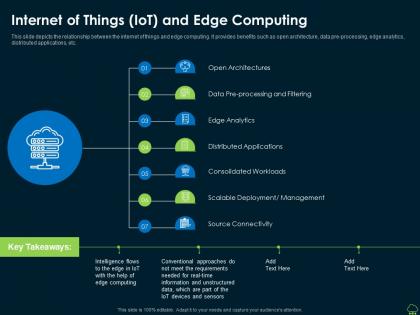
This slide depicts the relationship between the internet of things and edge computing. It provides benefits such as open architecture, data pre processing, edge analytics, distributed applications, etc.
People who downloaded this PowerPoint presentation also viewed the following :
Internet of things iot and edge computing edge computing it ppt structure with all 2 slides:
Use our Internet Of Things IOT And Edge Computing Edge Computing IT Ppt Structure to effectively help you save your valuable time. They are readymade to fit into any presentation structure.

FAQs for Internet of things iot and edge computing edge computing
Edge computing significantly enhances IoT device performance by processing data locally rather than sending it to distant cloud servers, reducing latency, minimizing bandwidth usage, and enabling real-time responses. Through edge infrastructure, manufacturing facilities achieve faster equipment monitoring, hospitals deliver immediate patient alerts, and retail stores optimize inventory tracking, while ultimately reducing operational costs and improving system reliability in increasingly connected environments.
Edge computing significantly reduces latency in IoT applications by processing data locally at or near the source, eliminating the need to transmit information to distant cloud servers. This approach enables real-time responses for critical applications like autonomous vehicles, industrial automation, and healthcare monitoring, with many organizations finding that edge processing delivers response times under 10 milliseconds compared to cloud latency of 100+ milliseconds.
Edge computing enhances IoT data security by processing information locally rather than transmitting everything to centralized servers, encrypting data at the source, and reducing attack surface exposure. Through distributed processing architectures, organizations in healthcare, manufacturing, and financial services can minimize data breaches, ensure faster threat detection, and maintain regulatory compliance, ultimately delivering stronger privacy protection and operational resilience.
Processing IoT data at the edge delivers reduced latency, enhanced security, lower bandwidth costs, improved reliability, and real-time decision-making capabilities. Manufacturing plants, autonomous vehicles, and smart retail systems leverage edge processing to minimize response times, maintain operations during connectivity issues, and reduce cloud storage expenses, ultimately enabling faster insights and more responsive customer experiences.
Organizations can effectively implement edge computing by conducting infrastructure assessments, selecting compatible edge devices, establishing secure connectivity protocols, and integrating data processing capabilities at network endpoints. Through strategic deployment in manufacturing facilities, retail locations, and smart buildings, companies streamline real-time analytics, reduce bandwidth costs, and enhance system responsiveness, while maintaining seamless integration with existing IoT networks, ultimately delivering faster decision-making and improved operational efficiency.
Smart manufacturing uses IoT sensors with edge computing for predictive maintenance, quality control, and real-time production optimization. Autonomous vehicles process sensor data locally for instant decision-making, while smart cities deploy edge-enabled traffic systems, environmental monitoring, and energy management, ultimately delivering faster response times, reduced bandwidth costs, and enhanced operational efficiency across industries.
Integrating AI and machine learning at the edge enhances IoT data analysis by enabling real-time processing, reducing latency, and minimizing bandwidth requirements through local decision-making capabilities. This strategic combination allows manufacturing plants, smart cities, and healthcare facilities to process sensor data instantly, detect anomalies immediately, and automate responses without cloud dependency, ultimately delivering faster insights and improved operational efficiency.
Key considerations include processing power, connectivity options, security features, scalability requirements, and integration capabilities with existing infrastructure. These platforms streamline IoT deployments by reducing latency, minimizing bandwidth costs, and enhancing data security, with many manufacturing and healthcare organizations finding that strategic edge placement ultimately delivers faster response times and improved operational efficiency.
Edge computing reduces bandwidth costs in IoT systems by processing data locally at device level, filtering unnecessary information, and transmitting only critical insights to central servers. Through strategic data processing at network edges, organizations minimize cloud storage expenses, reduce transmission frequencies, and optimize resource allocation, with manufacturing plants and smart cities finding significant cost reductions while maintaining real-time operational efficiency.
Potential drawbacks include increased infrastructure complexity, higher deployment costs, security vulnerabilities across distributed nodes, limited processing power for complex analytics, and challenges in maintaining consistent updates across multiple edge devices. While these present operational challenges, many organizations find that strategic edge implementation with centralized oversight delivers significant latency reductions and bandwidth savings, ultimately enhancing real-time IoT performance.
Edge computing accelerates industrial IoT decision-making by processing data locally at sensors and devices, eliminating cloud latency, and enabling instant responses to critical conditions. Manufacturing plants, oil refineries, and power grids leverage this technology to automatically adjust operations, prevent equipment failures, and optimize production workflows, ultimately delivering enhanced operational efficiency and reduced downtime costs.
Edge computing significantly enhances IoT scalability by reducing bandwidth requirements, minimizing latency, and enabling distributed processing across network endpoints. By processing data locally rather than sending everything to centralized cloud servers, organizations can deploy thousands more connected devices while maintaining performance, with manufacturing plants and smart cities finding that edge infrastructure ultimately delivers faster response times and reduced operational costs.
Edge computing enhances IoT service reliability in remote areas by reducing dependence on distant cloud servers, minimizing latency through local data processing, and maintaining functionality during network outages. Through distributed computing infrastructure, remote facilities like mining operations, agricultural sites, and offshore platforms can continue critical monitoring, automated responses, and real-time decision-making even with intermittent connectivity, ultimately delivering consistent operational efficiency.
Regulations and compliance factors significantly influence edge computing deployment by requiring data localization, privacy protection, and security standards across different jurisdictions and industries. Healthcare, financial services, and manufacturing organizations must navigate GDPR, HIPAA, and sector-specific requirements, with many finding that edge solutions actually enhance compliance through localized data processing and reduced transmission risks.
Future trends at the IoT-edge computing intersection include autonomous decision-making systems, predictive maintenance capabilities, real-time analytics processing, enhanced security frameworks, and seamless device interoperability. These advancements enable manufacturing plants to optimize production workflows, healthcare facilities to monitor patients continuously, and smart cities to manage traffic dynamically, ultimately delivering faster response times and reduced operational costs.
-
Awesome presentation, really professional and easy to edit.
-
Good research work and creative work done on every template.
-
It saves your time and decrease your efforts in half.
-
Colors used are bright and distinctive.
-
Excellent products for quick understanding.