


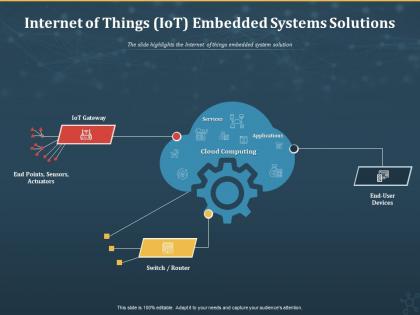
Internet of things iot embedded systems solutions ppt powerpoint presentation pictures samples




Try Before you Buy Download Free Sample Product
 Impress Your
 Audience
 100%
100% Editable
 Save Hours
 of Time


The slide highlights the Internet of things embedded system solution.
People who downloaded this PowerPoint presentation also viewed the following :
Internet of things iot embedded systems solutions ppt powerpoint presentation pictures samples with all 2 slides:
Use our Internet Of Things IoT Embedded Systems Solutions Ppt Powerpoint Presentation Pictures Samples to effectively help you save your valuable time. They are readymade to fit into any presentation structure.
FAQs for Internet of things iot embedded systems solutions ppt powerpoint
So embedded systems are what actually make IoT devices work - they're like tiny specialized computers that handle all the sensor stuff and communication. Way more efficient than regular processors for this kind of thing. They do the real-time processing, collect data, and let devices make decisions locally without always needing the cloud. Honestly, without them your smart thermostat would just be... a regular thermostat lol. If you're building something, just focus on finding a microcontroller that doesn't drain the battery but still has enough juice to do what you need.
Ugh, power management is probably the worst part - trying to squeeze months out of a single battery while keeping everything connected. Connectivity drops constantly too, which'll drive you insane during testing. Security's another huge headache since hackers love targeting IoT stuff. Plus you're working with super limited processing power and memory, so everything has to be lean. Oh, and real-time performance requirements on top of all that? Fun times. Honestly though, get your hardware sorted first, don't skimp on encryption, and test weird edge cases early or you'll hate yourself later.
So sensors are basically how your IoT device actually "sees" what's happening in the real world. Temperature, motion, humidity, accelerometers - whatever you need to monitor. Without them, your microcontroller is just sitting there doing absolutely nothing (which honestly happens more than I'd like to admit when debugging). They're the bridge between actual physical stuff and your digital processing. The trick is figuring out exactly what data you need first, then picking sensors that'll play nice with your microcontroller. Don't overthink it - just map out what you want to measure and work backwards from there.
So edge computing moves the processing right next to your IoT stuff instead of bouncing everything off distant servers. Response times drop to like milliseconds - huge difference. Your devices won't crash when the internet gets flaky (which, let's be real, happens constantly). Bandwidth costs go down too since you're not constantly uploading data. Security improves because sensitive info stays put locally. For real-time things like factory robots or self-driving cars, you literally can't function without it. The latency requirements are just too strict otherwise.
Honestly, C and C++ are still king for embedded IoT stuff - you get that low-level hardware control and crazy good memory efficiency. Python's everywhere too, super easy for prototyping on Raspberry Pi boards, but it'll eat your resources on tiny devices. Node.js for IoT is weirdly common these days (not what I expected when I first got into this). Rust's worth checking out if you want memory safety without the garbage collection headaches. I'd probably just start with C for real embedded projects, but honestly Python's perfect when you need to slap together a quick proof of concept.
Honestly, the biggest thing is IoT devices are always online now - that creates way more ways for hackers to get in compared to old embedded systems that were basically isolated. Before, you had industrial controllers that nobody could mess with remotely. Now? These IoT gadgets are like tiny computers on the internet, except most have garbage authentication and weak encryption. Network protocols, cloud stuff, remote access - all new vulnerabilities that weren't there before. Build security in from the start, not as an afterthought. Trust me on this one.
First thing - encrypt everything, both transmission and storage. Strong authentication is a must, and keep that firmware updated or you're asking for trouble. Map out what data you're actually collecting because honestly, most devices grab way more than they need. Default passwords are still everywhere which blows my mind. Set up proper access controls so users aren't stuck with whatever privacy settings you picked. Regular security audits help catch stuff you missed. Bottom line: collect only what's essential and test your defenses regularly.
Sleep modes are your best friend here - wake the device only when needed. Low-power microcontrollers help too, and honestly LoRaWAN beats WiFi for battery life every time. Dynamic voltage scaling sounds nerdy but it's actually huge for power savings. Code optimization matters more than you'd think. Oh, and edge processing cuts down data transmission which drains less battery. Start by checking where your power's going now - bet you'll spot some easy fixes right away. Zigbee's another solid protocol option if LoRaWAN doesn't fit your setup.
Dude, 5G is seriously changing everything for IoT stuff. The latency is crazy low compared to 4G, plus you get way more bandwidth. Real-time apps that couldn't work before? Now they're totally doable - autonomous cars, industrial automation, all that instant-response stuff. What blows my mind is the connection density though. We're talking a million devices per square kilometer, which honestly sounds like overkill but apparently isn't. If you're designing anything where milliseconds count or need tons of connected devices crammed together, definitely look into 5G modules. The tech's moving so fast it's hard to keep up sometimes.
Honestly, start with simple threshold monitoring first - don't overcomplicate it. You can embed lightweight processing right on your IoT devices or use nearby edge nodes. Apache Kafka's great for streaming, InfluxDB handles time-series data well. Node-RED makes data flows pretty straightforward too. The real challenge is figuring out what to process locally vs sending to the cloud. Your bandwidth costs will thank you later! ARM processors with built-in ML work well for resource-limited setups. Once you've got the basics working, then add fancier analytics.
Dude, open-source is usually the way to go for IoT stuff. No licensing costs, tons of community support, libraries everywhere - saves you so much time. But here's the catch: you're on your own for security updates, which gets messy fast when you've got devices scattered everywhere. Enterprise clients sometimes freak out about open-source too, though honestly that's more of an old-school mindset. I'd definitely start with open-source for prototypes and smaller projects. Just make sure you've got a solid plan for pushing updates before you deploy hundreds of these things. Trust me on that one.
So basically you need to get all your devices speaking the same language. MQTT and CoAP are solid choices - most stuff supports them. JSON works great for the actual data since everything can read it. Honestly? Just pick AWS IoT Core or Azure IoT Hub if you can. Makes the whole headache of managing connections way easier. I'd start by checking what protocols your devices already use, then just standardize on one. HTTP/REST is boring but reliable if you want to keep it simple. The key is picking something and sticking with it instead of trying to support everything.
Dude, the new MCUs are insane - chips like ESP32-S3 and STM32U5 can actually run AI locally without killing your battery. We're talking years of runtime here. Single chips now pack WiFi 6, Bluetooth 5, plus Matter protocol built right in. No more juggling a million external components. Security's finally decent too with hardware crypto baked into the silicon. Honestly, ARM Cortex-M33 controllers are where it's at if you're starting fresh - they'll save you so much pain down the road. The wireless integration alone makes older chips feel ancient.
Ugh, regulatory stuff controls everything from the start. FCC emissions, privacy laws, safety certs - you've gotta bake it into hardware AND software. Different countries want different things too. Europe needs CE marking, Canada wants IC certification, the list goes on. I learned this the hard way on my last project - we ignored compliance early and ended up doing a massive redesign that cost us months. Figure out which standards hit your product before you even touch a breadboard. Make a checklist and actually use it. Trust me on this one.
Honestly, agile with iterative prototyping is your best bet here. IoT projects are messy - hardware, firmware, cloud stuff all tangled together. Build basic connectivity first, then worry about the cool features later. I'm a huge fan of model-based design for embedded work since you can simulate everything before touching actual hardware (saves SO much headache). Oh, and set up automated testing for firmware early on, even if it feels like overkill. DevOps practices aren't just for web apps anymore. Pick whatever methodology clicks with you and don't stress about perfection right away.
-
Topic best represented with attractive design.
-
Easy to edit slides with easy to understand instructions.
-
Very unique, user-friendly presentation interface.