


Industrial Internet Of Things Powerpoint Presentation Slides




Try Before you Buy Download Free Sample Product
 Impress Your
 Audience
 100%
100% Editable
 Save Hours
 of Time


The manufacturing industry relies heavily on the Internet of Things IoT to streamline operations and reduce labor costs. Our meticulously crafted Industrial Internet of Things PowerPoint Presentation showcases how IoT connects machines, devices, and sensors, enabling manufacturers to gather and analyze real time data, optimize production processes, and minimize downtime. The Industrial Internet of Things IIoT section of the presentation covers various aspects, including an overview of IoT in manufacturing, industrial IoT trends, drivers of IoT adoption, and the intersection of Manufacturing Execution Systems MES and IIoT. Additionally, it delves into the impact of Industry 4.0 on manufacturing, current trends, and the benefits and challenges associated with IoT implementation. Moreover, our IoT manufacturing components PPT module highlights the integration of IoT within intelligent factories. Lastly, the template showcases exponential value creation opportunities through IoT, key challenges that impede IoT adoption and real world case studies illustrating successful IoT implementations in the manufacturing sector. Gain access to our fully editale comprehensive Internet of Things Template today.
People who downloaded this PowerPoint presentation also viewed the following :
Content of this Powerpoint Presentation
Slide 1: This slide introduces Industrial Internet of Things. State your company name and begin.
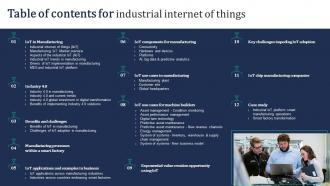
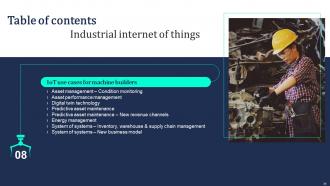
Slide 2: This slide shows Table of Content for the presentation.
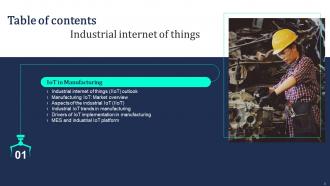
Slide 3: This slide shows title for topics that are to be covered next in the template.
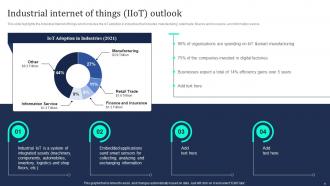
Slide 4: This slide highlights the industrial internet of things which includes the IoT adoption in industries.
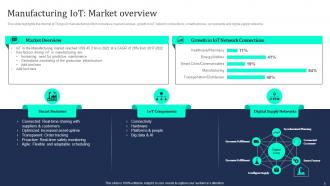
Slide 5: This slide presents the Internet of Things in manufacturing.
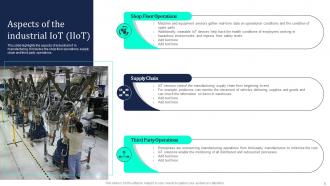
Slide 6: This slide highlights the aspects of industrial IoT in manufacturing.
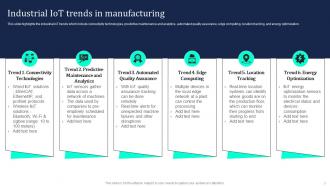
Slide 7: This slide describes the industrial IoT trends.
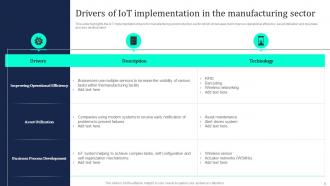
Slide 8: This slide highlights the IoT implementation drivers for manufacturing and production sector.
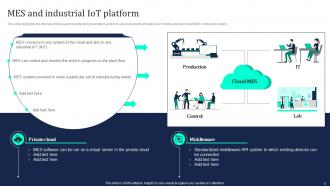
Slide 9: This slide displays the internet of things and manufacturing execution system.
Slide 10: This slide shows title for topics that are to be covered next in the template.
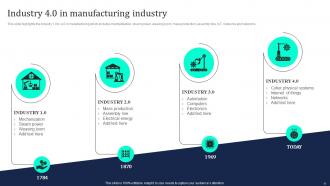
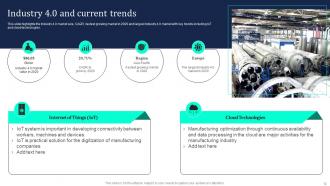
Slide 11: This slide highlights the industry 1.0 to 4.0 in manufacturing.
Slide 12: This slide presents the Industry 4.0 market size.
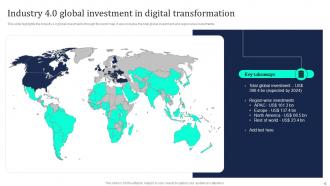
Slide 13: This slide highlights the industry 4.0 global investments through the world map.
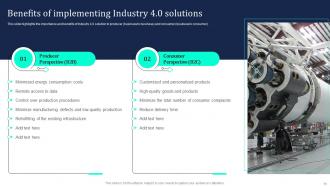
Slide 14: This slide displays the importance and benefits of Industry 4.0 solution to producer (business to business) and consumer (business to consumer).
Slide 15: This slide shows title for topics that are to be covered next in the template.
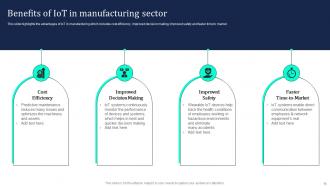
Slide 16: This slide highlights the advantages of IoT in manufacturing.
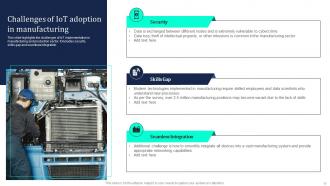
Slide 17: This slide describes the challenges of IoT implementation in manufacturing and production sector.
Slide 18: This slide shows title for topics that are to be covered next in the template.
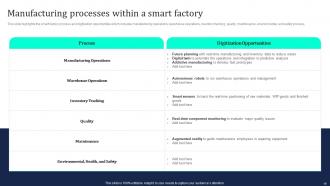
Slide 19: This slide highlights the smart factory process and digitization opportunities.
Slide 20: This slide shows title for topics that are to be covered next in the template.
Slide 21: This slide highlights the IoT component used by major players along with applications and use cases.
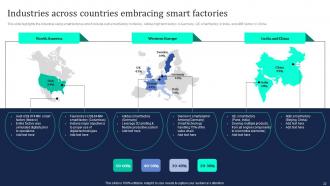
Slide 22: This slide presents the industries using smart factories which include Audi smart factory in Mexico, Adidas high tech factory in Germany, GE smart factory in India, and ABB factory in China.
Slide 23: This slide shows title for topics that are to be covered next in the template.
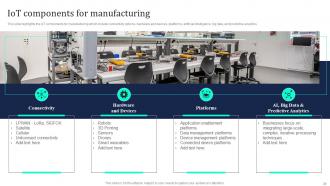
Slide 24: This slide highlights the IoT components for manufacturing.
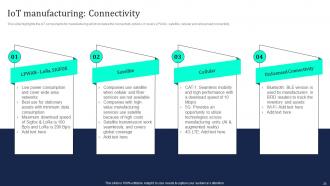
Slide 25: This slide presents the IoT components for manufacturing which includes the connectivity options.
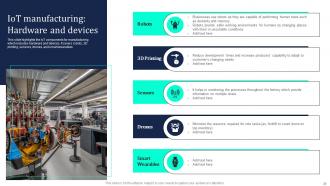
Slide 26: This slide highlights the IoT components for manufacturing which includes hardware and devices.
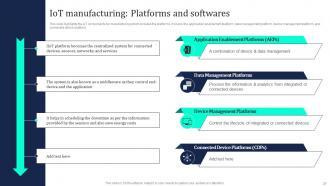
Slide 27: This slide presents the IoT components for manufacturing which includes the platforms.
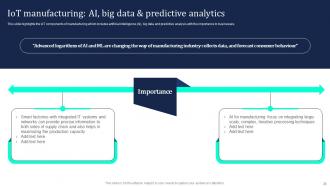
Slide 28: This slide highlights the IoT components of manufacturing which includes artificial intelligence (AI), big data and predictive analysis with the importance to businesses.
Slide 29: This slide shows title for topics that are to be covered next in the template.
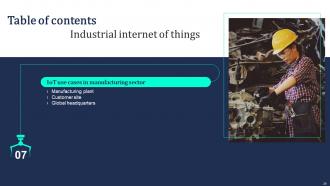
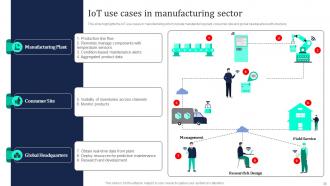
Slide 30: This slide presents the IoT use cases in manufacturing which include manufacturing plant, consumer site and global headquarters with structure.
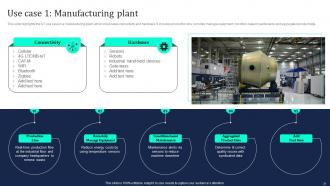
Slide 31: This slide highlights the IoT use case in a manufacturing plant, which showcases connectivity and hardware.
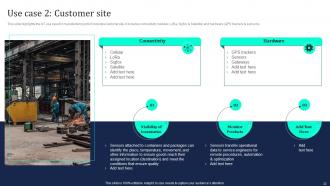
Slide 32: This slide displays the IoT use case for manufacturing which includes customer site.
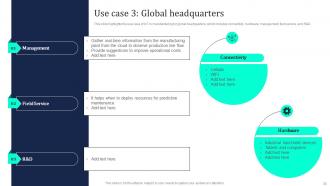
Slide 33: This slide highlights the use case of IoT in manufacturing for global headquarters.
Slide 34: This slide shows title for topics that are to be covered next in the template.
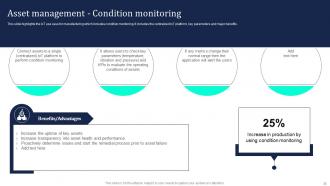
Slide 35: This slide highlights the IoT use case for manufacturing which includes condition monitoring.
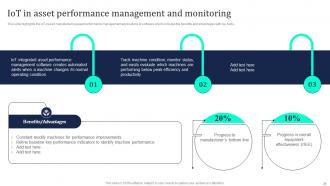
Slide 36: This slide presents the IoT-based manufacturing asset performance management applications or software.
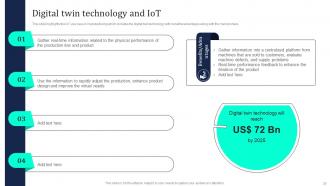
Slide 37: This slide highlights the IoT use case in manufacturing which includes the digital twin technology with benefits/advantages along with the market share.
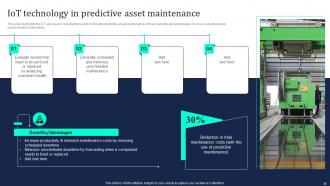
Slide 38: This slide presents the IoT use case in manufacturing which includes predictive asset maintenance with key benefits and advantages.
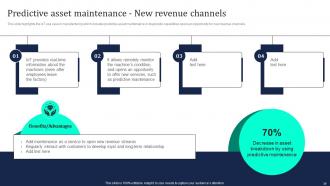
Slide 39: This slide highlights the IoT use case in manufacturing which includes predictive asset maintenance or diagnostic capabilities.
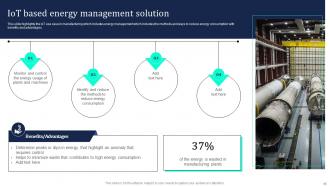
Slide 40: This slide describes the IoT use case in manufacturing which includes energy management.
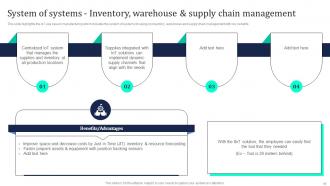
Slide 41: This slide highlights the IoT use case in manufacturing which includes the system of systems focusing on inventory.
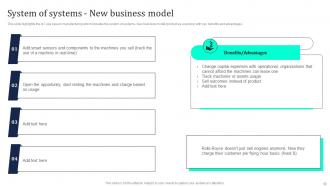
Slide 42: This slide presents the IoT use case in manufacturing which includes the system of systems- new business model (product as a service).
Slide 43: This slide shows title for topics that are to be covered next in the template.
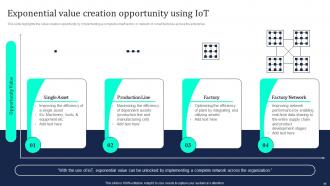
Slide 44: This slide highlights the Value creation opportunity by implementing a complete smart factory or network of smart factories across the enterprise.
Slide 45: This slide shows title for topics that are to be covered next in the template.
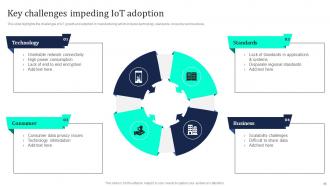
Slide 46: This slide highlights the challenges of IoT growth and adoption in manufacturing which includes technology, standards, consumer and business.
Slide 47: This slide shows title for topics that are to be covered next in the template.
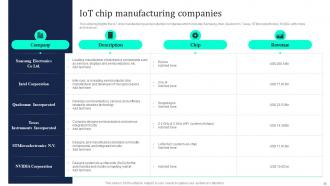
Slide 48: This slide presents the IoT chip manufacturing and production companies which includes Samsung, Intel, Qualcomm, and more.
Slide 49: This slide shows title for topics that are to be covered next in the template.
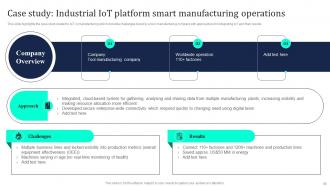
Slide 50: This slide highlights the case study related to IoT in manufacturing which includes challenges faced by a tool manufacturing company.
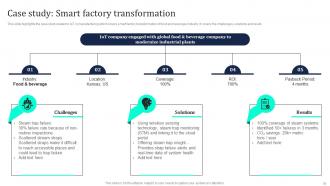
Slide 51: This slide describes the case study related to IoT in manufacturing which covers smart factory transformation of food and beverage industry.
Slide 52: This slide shows all the icons included in the presentation.
Slide 53: This slide is titled as Additional Slides for moving forward.
Slide 54: This is a Timeline slide. Show data related to time intervals here.
Slide 55: This slide shows Post It Notes for reminders and deadlines. Post your important notes here.
Slide 56: This slide provides 30 60 90 Days Plan with text boxes.
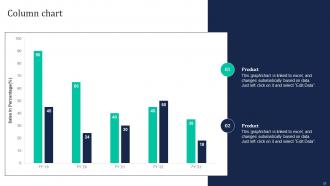
Slide 57: This slide displays Column chart with two products comparison.
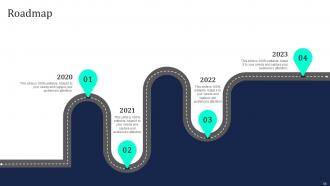
Slide 58: This slide presents Roadmap with additional textboxes.
Slide 59: This slide contains Puzzle with related icons and text.
Slide 60: This is a Thank You slide with address, contact numbers and email address.
Industrial Internet Of Things Powerpoint Presentation Slides with all 65 slides:
Use our Industrial Internet Of Things Powerpoint Presentation Slides to effectively help you save your valuable time. They are readymade to fit into any presentation structure.









FAQs for Industrial Internet Of Things
Real-time data is huge - you'll actually see what's happening instead of guessing. Those IIoT sensors track everything from machine performance to how much energy you're burning. Honestly, catching problems before they turn into expensive disasters is worth it alone. Your downtime drops, quality goes up, and workers can focus on actual work instead of babysitting equipment. Oh, and the cost savings add up fast once everything's optimized. I'd definitely start with just one production line first though - prove it works before you go crazy with sensors everywhere.
So basically these IIoT sensors watch everything - temperature, vibration, pressure, all that stuff. Real-time data gets fed into analytics that catch problems way before they blow up. No more waiting for things to actually break! You'll get heads up about worn bearings or motors running too hot. Honestly, it's pretty game-changing. Lets you schedule maintenance during slow periods instead of dealing with those nightmare emergency repairs that always happen on weekends. Way better than the old "fix it when it dies" approach we're all used to.
Think of data analytics as the thing that actually makes sense of all those sensors you're installing. Otherwise you're just hoarding spreadsheets, which honestly most places do anyway. It spots weird patterns, tells you when stuff's about to break, and catches problems before they cost you serious money. The cool part? You stop fixing things after they fail and start fixing them before they do. Just pick something simple first - maybe track vibration on a pump or whatever. You'll probably see results pretty fast and then you can expand from there.
So IIoT connects sensors and smart devices across your whole supply chain - you get real-time data on everything. Track inventory, monitor shipments, catch equipment problems before they blow up. Way better than the old days of calling around hoping someone knows what's going on, honestly. Your suppliers, manufacturers, and distributors all see the same info automatically. I'd start small though - maybe just your most important shipments first? Once you see how much time it saves, you can expand from there. The visibility is pretty incredible once you get it running.
Honestly, the biggest nightmare with IIoT is all these old devices that were never designed for security in the first place. Hackers love them because they're running ancient firmware and terrible authentication - basically sitting ducks. Plus you've got sensors everywhere creating this massive attack surface. Network segmentation is your best friend here. Isolate the critical stuff from everything else. Zero-trust helps too if you can swing it. Oh, and map out every single connected device first - sounds boring but you'd be shocked how many companies don't even know what's on their network. Keep that firmware updated religiously and audit everything regularly.
Honestly, they work great together - edge handles the instant stuff while cloud does all the heavy analysis. So your edge devices process critical data right there on-site for immediate responses (safety shutdowns, quality checks, that kind of thing). Cloud stores everything and runs those big analytics across your whole operation. Edge keeps things running smooth even when your internet's being weird. Meanwhile, cloud gives you those broader insights you need. I'd start by figuring out what processes need split-second responses versus the ones where you can wait for deeper analysis.
Temperature and pressure sensors are everywhere - total basics. Vibration ones help catch equipment issues early, which honestly saves so much headache later. Flow meters track liquids/gases, proximity sensors detect when stuff's there or not. Then you've got smart PLCs, industrial gateways, RFID for tracking assets. The selection's pretty crazy once you start looking. My advice? Figure out what you actually need to watch first. Don't get sucked into buying fancy sensors just because they exist - I've seen people do that and regret it. Match your monitoring points to the right tech, not the other way around.
So predictive analytics is pretty cool - it analyzes all that sensor data to catch problems before stuff actually breaks. Your equipment's constantly sending info about temp, vibration, all that jazz, and the system flags when things look sketchy. Way better than dealing with surprise breakdowns at 2am, trust me. You can actually plan maintenance instead of scrambling when everything goes to hell. Honestly, just start with one machine that's critical to your operation. Prove it works there first, then expand. The whole "prevent expensive emergency repairs" thing is worth it alone.
Manufacturing and energy companies are crushing it with IIoT right now. Oil & gas too. Makes sense when you think about it - these guys have insane operational costs, so saving even a tiny percentage means millions back in their pocket. Predictive maintenance is huge for manufacturing (beats scrambling when machines randomly break). Energy companies use it for grid stuff and monitoring equipment that's literally scattered everywhere. The returns are just too good to pass up. Oh, and if you're thinking about doing this yourself, definitely check out what these industries are already doing successfully.
So basically IIoT lets your machines actually talk to you through dashboards and phone alerts instead of you playing guessing games. Sensors track stuff like temperature and vibration, then ping you the second something goes wrong - no more waiting around for breakdowns or doing those tedious scheduled checks. You can even send commands back to tweak settings remotely, which is pretty cool. Honestly, it beats the old days of walking around with a clipboard hoping nothing explodes. I'd start by figuring out which machines in your place would benefit most from this kind of setup.
So basically IIoT gives you real-time data on how your equipment's actually performing energy-wise. You'll spot waste you never knew existed - seriously, some companies are shocked at how much power gets wasted on idle machines. Smart sensors catch this stuff automatically and help optimize everything. Plus you can schedule maintenance before things break down and start guzzling energy. Most places I've heard about see 10-20% savings pretty quick, usually within a year. Oh, and definitely start with whatever equipment uses the most power - that's where you'll see the biggest wins first.
So track your hard savings first - downtime reduction, energy costs, maintenance, waste. That's the easy stuff to measure. Productivity gains matter too though, like faster throughput and quality improvements. The soft benefits are honestly where you'll see the biggest wins, but good luck putting a number on those. I'd compare your implementation costs against savings over 2-3 years minimum. Monthly dashboards help you catch trends before they bite you. Oh, and don't expect immediate payoff - this stuff takes time to really show its value.
Ugh, regulations are such a headache - totally depends where you are and what industry you're in. EU's got GDPR for data stuff, CE marking, plus this new Cyber Resilience Act coming. The US is all over the place though. No single federal thing, but you might deal with FDA if it's medical, FCC for radio frequencies, or NIST cybersecurity stuff. Asia's weird too - Singapore has crazy strict data laws. My advice? Start with a compliance audit for your specific situation first. Don't go nuts trying to figure out everything at once or you'll lose your mind.
Oh man, this is huge for IIoT - you absolutely need your devices talking the same language or you're screwed. Think of it like everyone shouting in different languages at a meeting. Standards like OPC UA and MQTT basically solve this mess by letting your sensors, PLCs, and cloud stuff actually communicate. Honestly, I've seen too many projects fail because they tried building custom connections later instead of just picking proven protocols upfront. Trust me, go with established standards from the start. Makes scaling so much easier down the road.
AI and machine learning are getting baked into everything IIoT now. Edge computing's blowing up because nobody wants to deal with lag anymore. 5G is finally happening - that's gonna change real-time stuff completely. Digital twins are becoming the norm, which is actually pretty cool since you can test changes virtually first. Cybersecurity's getting way more intense too since hackers love targeting these systems. Companies are obsessed with tracking their carbon footprint in real-time now. My advice? Figure out which area fits your current work best. Getting in early usually works out well in industrial tech.
-
Excellent work done on template design and graphics.
-
SlideTeam just saved my project! Thank you so much. The variety of templates helped me showcase multiple perspectives easily.