


Introduction To Internet Of Things A World Of Connected Devices Powerpoint Presentation Slides IoT CD
Grab our insightfully designed template on the Introduction to Internet of Things A World of Connected Devices. This Introduction to IoT PPT consists of a network of interconnected physical devices connected to the Internet to improve real-time efficiency. Moreover, this IoT Devices Presentation provides an understanding of various IoT features, evolution period, emerging new technologies, key benefits, and key statistics associated with implementing IoT technology. Also, an IoT Applications presentation explains multiple parts of the IoT ecosystem, such as IoT sensors, IoT gateway, IoT security, IoT cloud, IoT networks, and IoT device monitoring Applications. Furthermore, this IoT and Artificial Intelligence PPT showcases the application of the Internet of Things in multiple industries and explores the interaction of IoT technology with emerging technologies. Lastly, this IoT and 5G Technology PPT provides practical insights by showcasing captive case studies implementing IoT technology to improve performance, work safety, and customer experience. Download our 100 percentage editable and customizable deck to know more in detail.


































































































You must be logged in to download this presentation.


Do you want to remove this product from your favourites?
 Impress your
 audience
 100%
100% Editable
 Save Hours
 of Time
PowerPoint presentation slides
Deliver an informational PPT on various topics by using this Introduction To Internet Of Things A World Of Connected Devices Powerpoint Presentation Slides IoT CD. This deck focuses and implements best industry practices, thus providing a birds-eye view of the topic. Encompassed with one hundred twenty slides, designed using high-quality visuals and graphics, this deck is a complete package to use and download. All the slides offered in this deck are subjective to innumerable alterations, thus making you a pro at delivering and educating. You can modify the color of the graphics, background, or anything else as per your needs and requirements. It suits every business vertical because of its adaptable layout.

People who downloaded this PowerPoint presentation also viewed the following :
Content of this Powerpoint Presentation
Slide 1: The slide introduces Introduction to Internet of Things A World of Connected Devices.
Slide 2: This is an Agenda slide. State your agendas here.
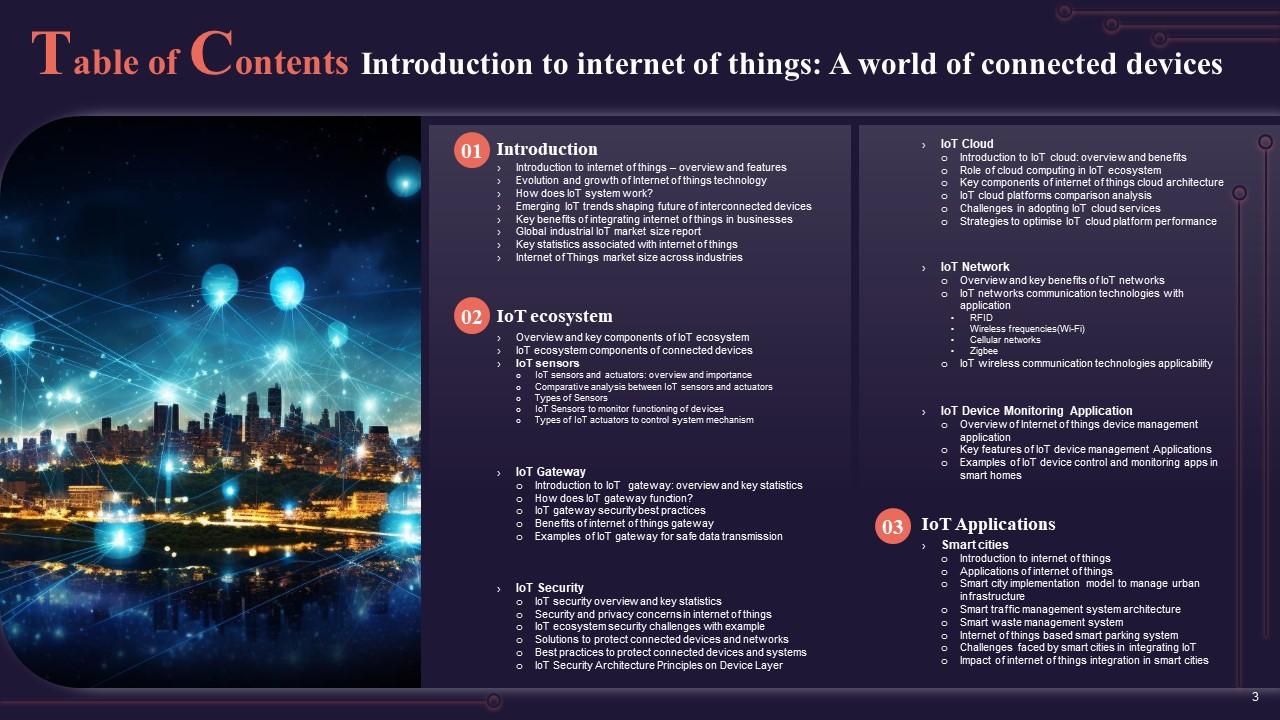
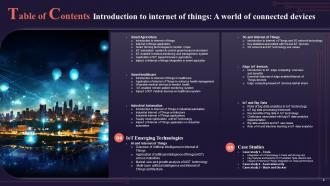
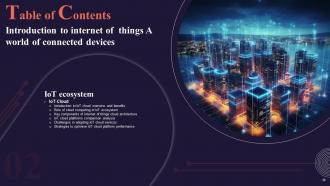
Slide 3: The slide displays Table of Contents for presentation.
Slide 4: The slide continues Table of Contents.
Slide 5: The slide again displays Table of Contents.
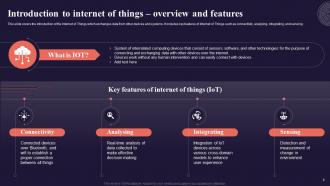
Slide 6: This slide covers the introduction of the Internet of Things which exchanges data from other devices and systems.
Slide 7: This slide showcases evolution of internet of things.
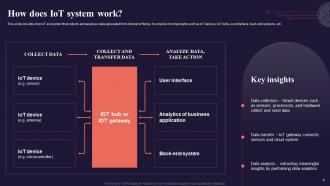
Slide 8: This slide consists of an IoT ecosystem that collects and analyses data generated from internet of things.
Slide 9: This slide exhibits IoT architecture that enables to assess, monitor and maintain the integrity of internet of things system.
Slide 10: This slide covers the latest trends of Internet of Things to improve business efficiency and unlock new opportunities.
Slide 11: This slide continues the latest trends of Internet of Things to improve business efficiency and unlock new opportunities.
Slide 12: This slide highlights the benefits of internet of things to empower businesses with improved operations.
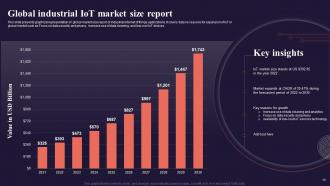
Slide 13: This slide presents graphical representation of global market size report of industrial internet of things applications.
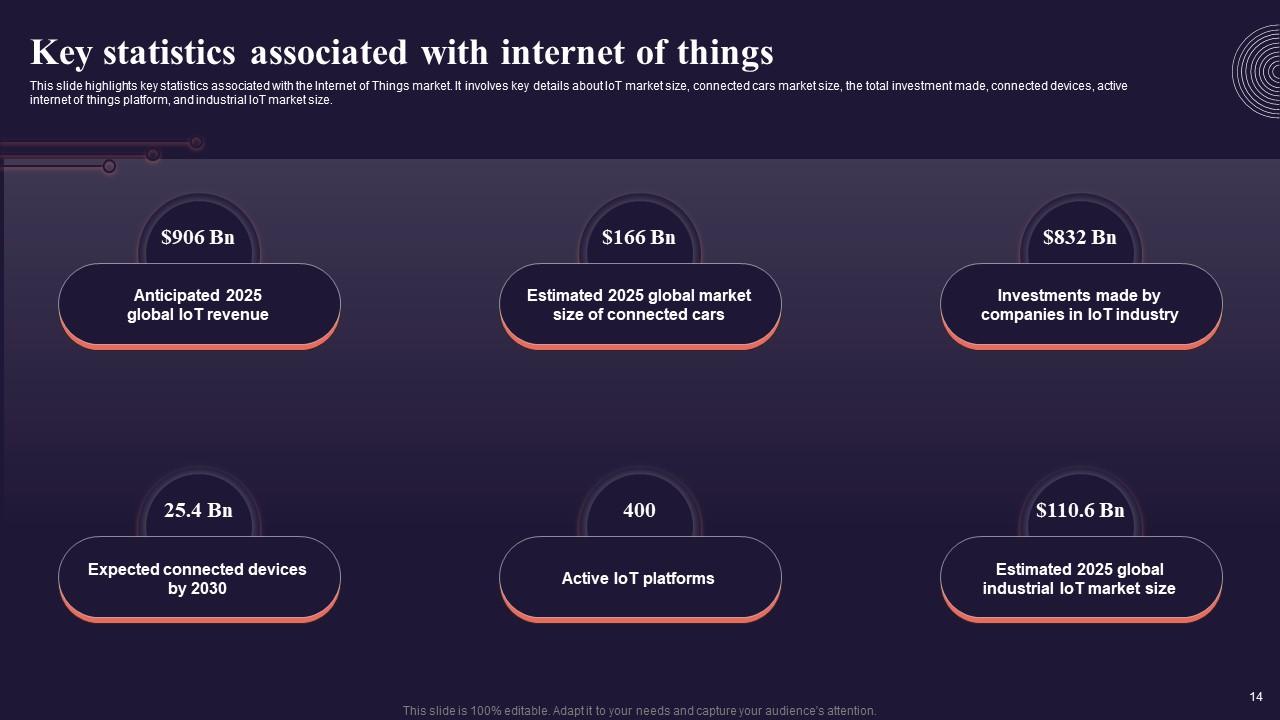
Slide 14: This slide highlights key statistics associated with the Internet of Things market.
Slide 15: This slide exhibits the market size of internet of things technology across various industries.
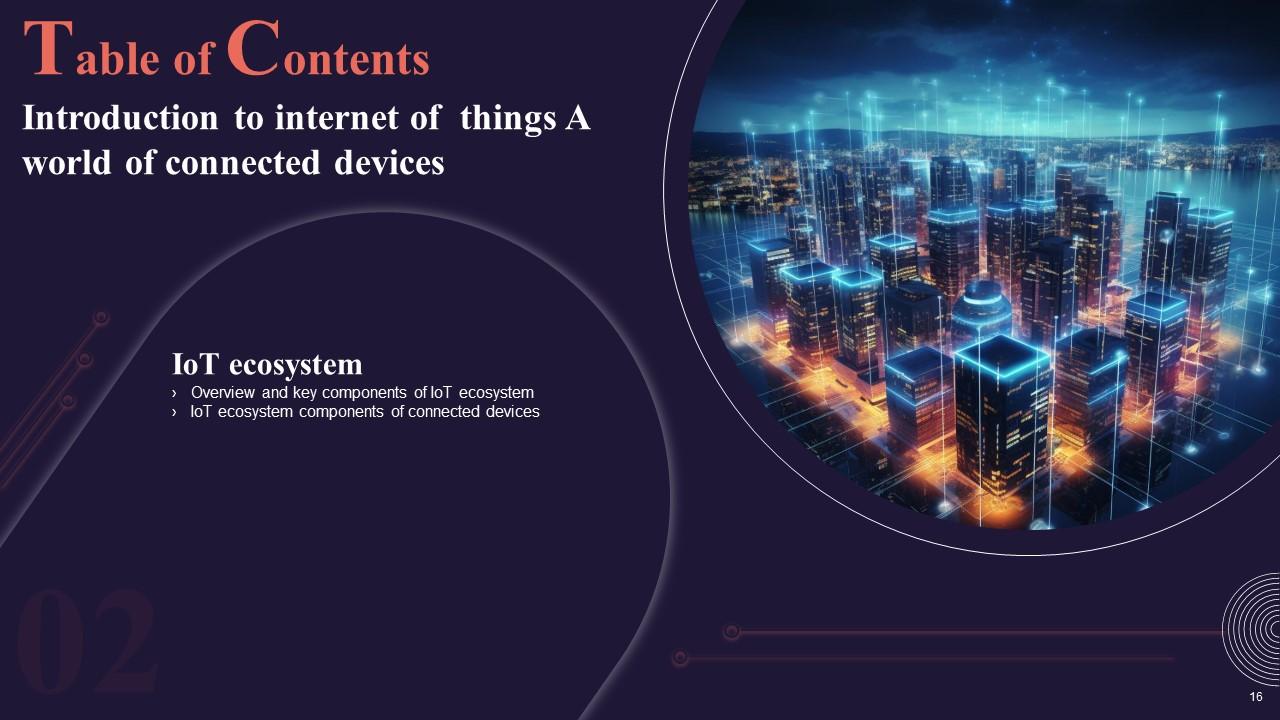
Slide 16: The slide renders Table of Contents further.
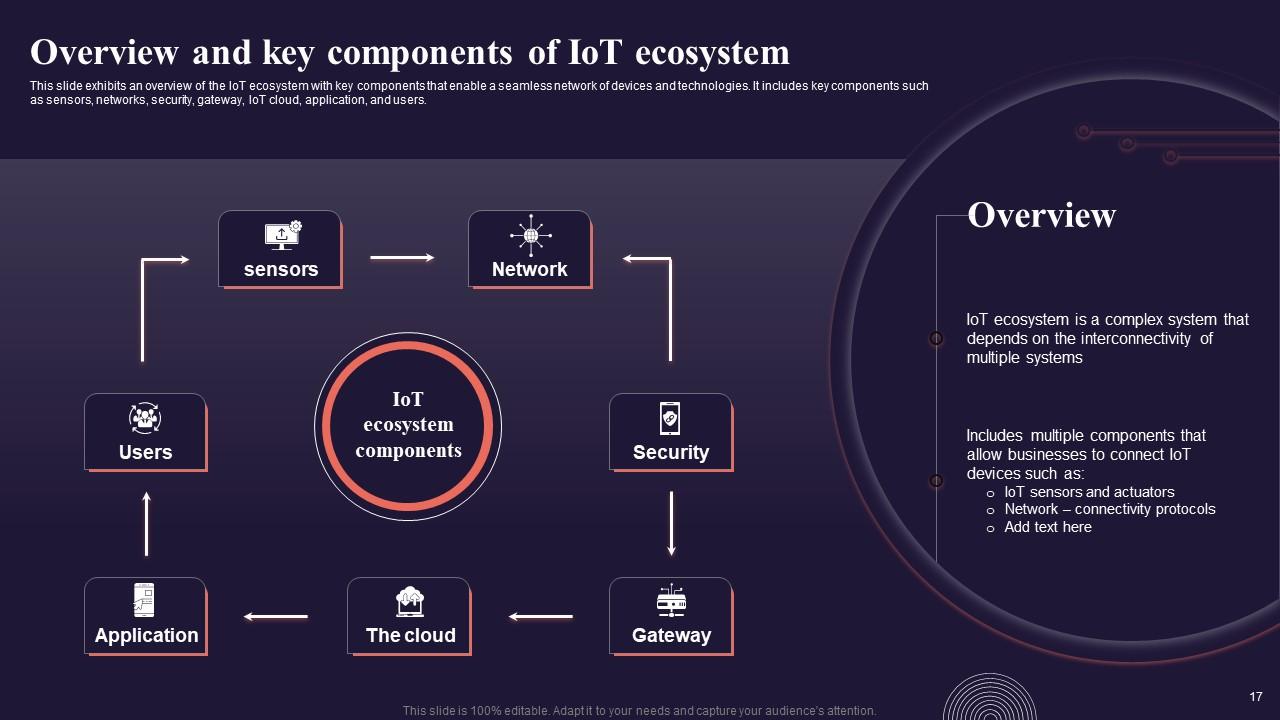
Slide 17: This slide exhibits an overview of the IoT ecosystem with key components that enable a seamless network of devices and technologies.
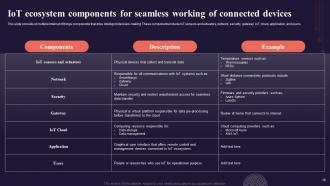
Slide 18: This slide consists of multiple Internet of things components that drive intelligent decision-making.
Slide 19: The slide represents Title of Contents which is to be discussed further.
Slide 20: This slide presents an overview of the Internet of things sensors and actuators.
Slide 21: This slide showcases the difference between internet of things sensors and actuators based on certain parameters.
Slide 22: This slide highlights a variety of sensors that helps to transfer data collected from physical environment.
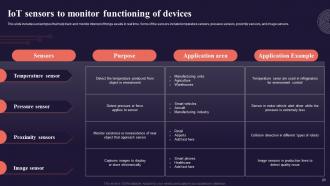
Slide 23: This slide includes sensor types that help track and monitor internet of things assets in real time.
Slide 24: This slide exhibits internet of things actuators available in the market.
Slide 25: The slide again presents Title of Contents.
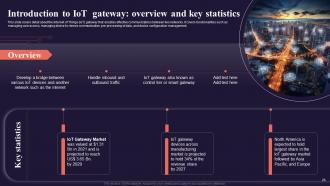
Slide 26: This slide covers detail about the Internet of Things (IoT) gateway that enables effective communications between two networks.
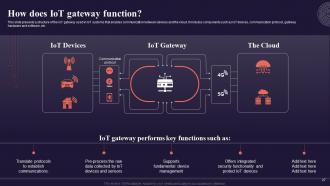
Slide 27: This slide presents a structure of the IoT gateway used in IoT systems that enables communication between devices and the cloud.
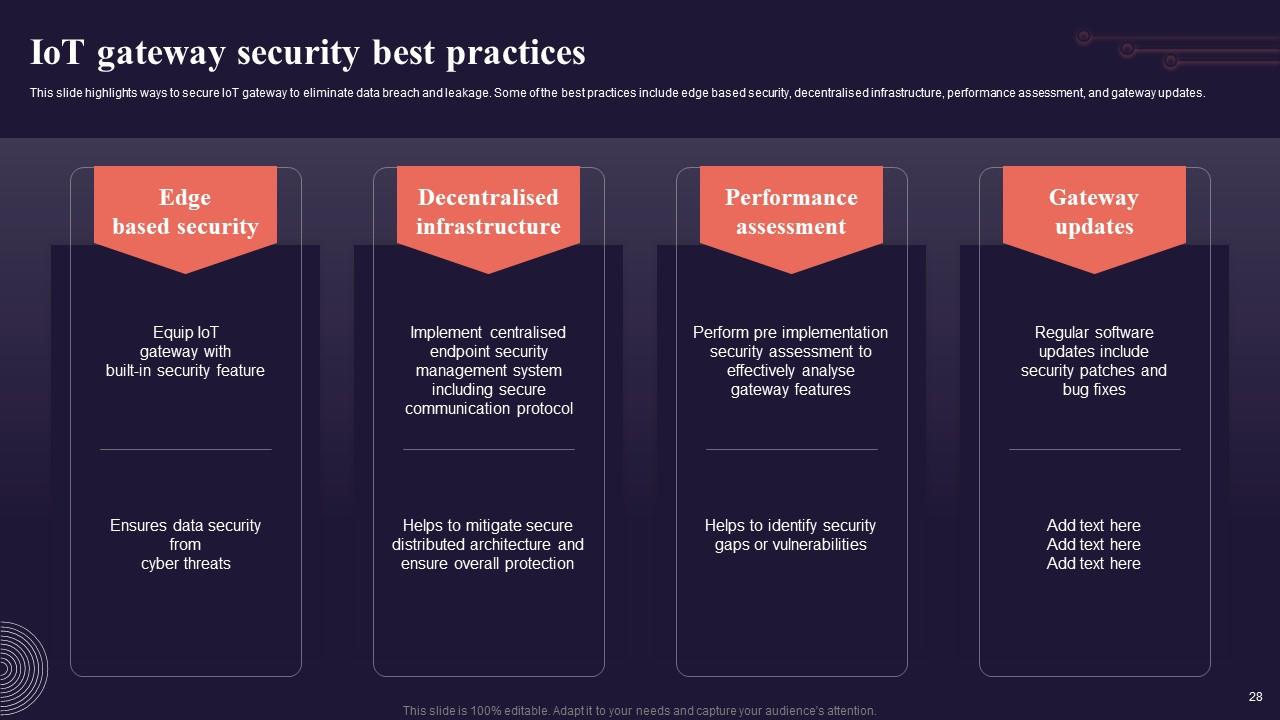
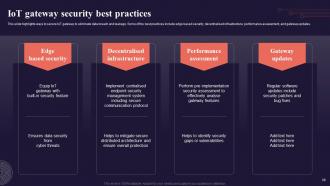
Slide 28: This slide highlights ways to secure IoT gateway to eliminate data breach and leakage.
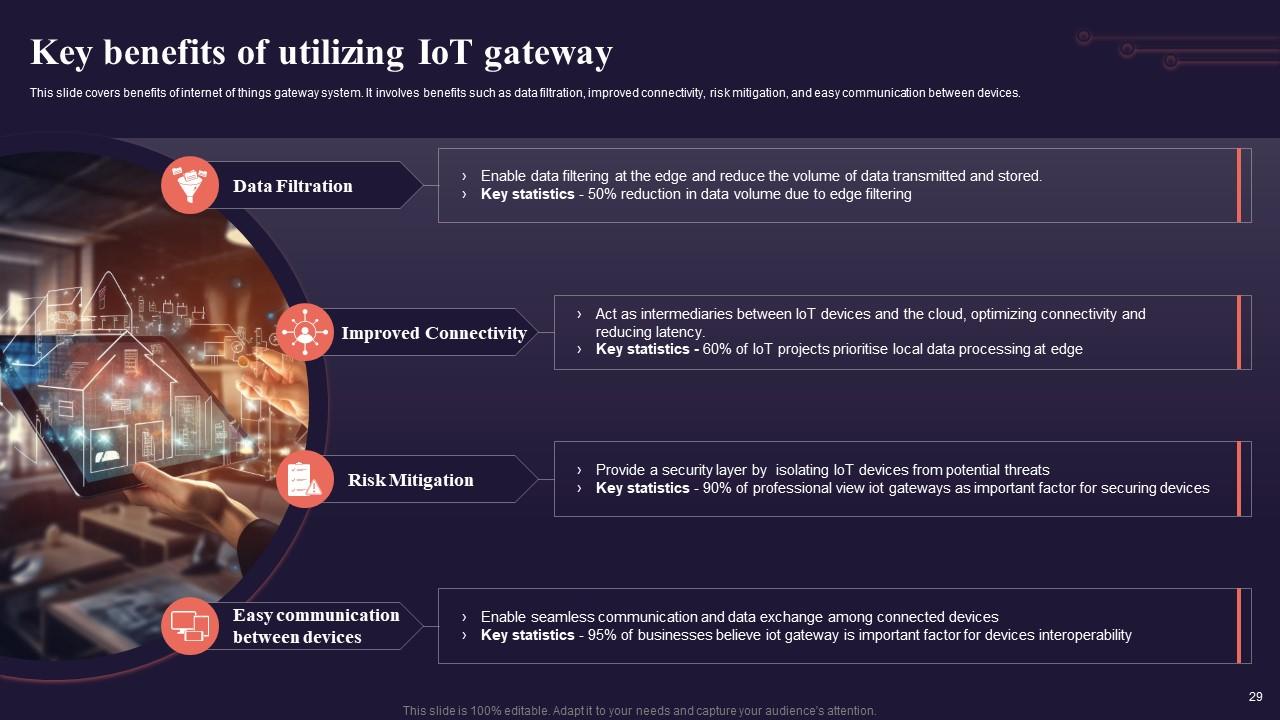
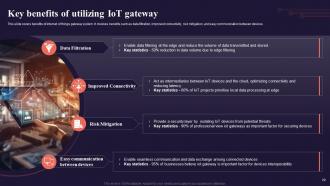
Slide 29: This slide covers benefits of internet of things gateway system.
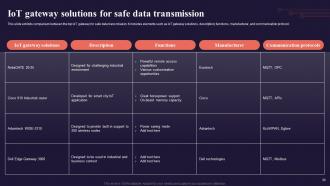
Slide 30: This slide exhibits comparison between the top IoT gateway for safe data transmission.
Slide 31: The slide illustrates another Title of Contents.
Slide 32: This slide exhibits a brief introduction to IoT security and major statistics showcasing the rising need for security in connected devices.
Slide 33: This slide illustrates data security and privacy concerns with the adoption of IoT-enabled devices.
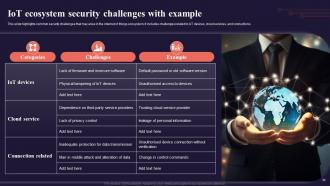
Slide 34: This slide highlights common security challenges that may arise in the internet of things ecosystem.
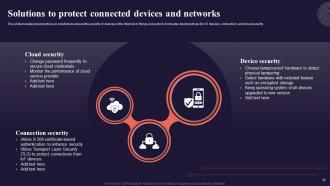
Slide 35: This slide includes best practices or solutions to ensure the security of devices in the Internet of things ecosystem.
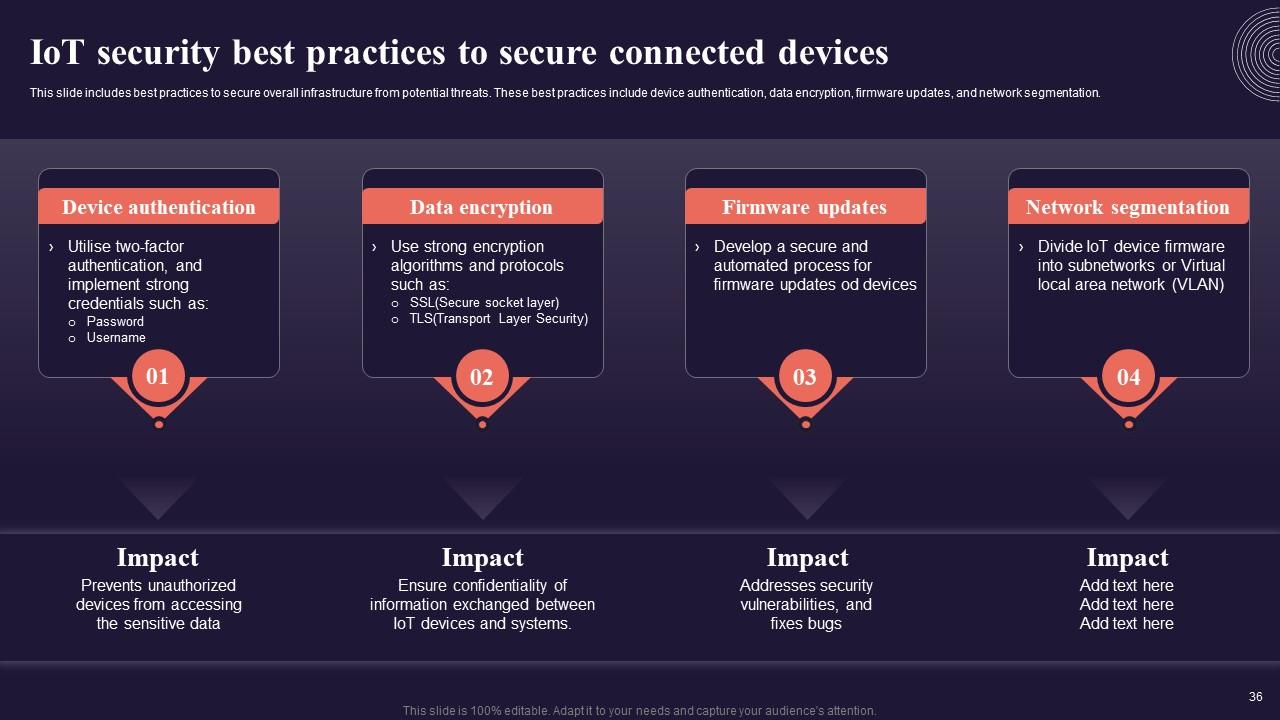
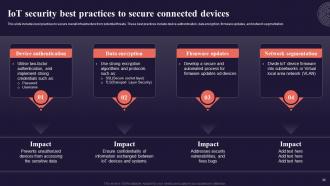
Slide 36: This slide demonstrates best practices to secure overall infrastructure from potential threats.
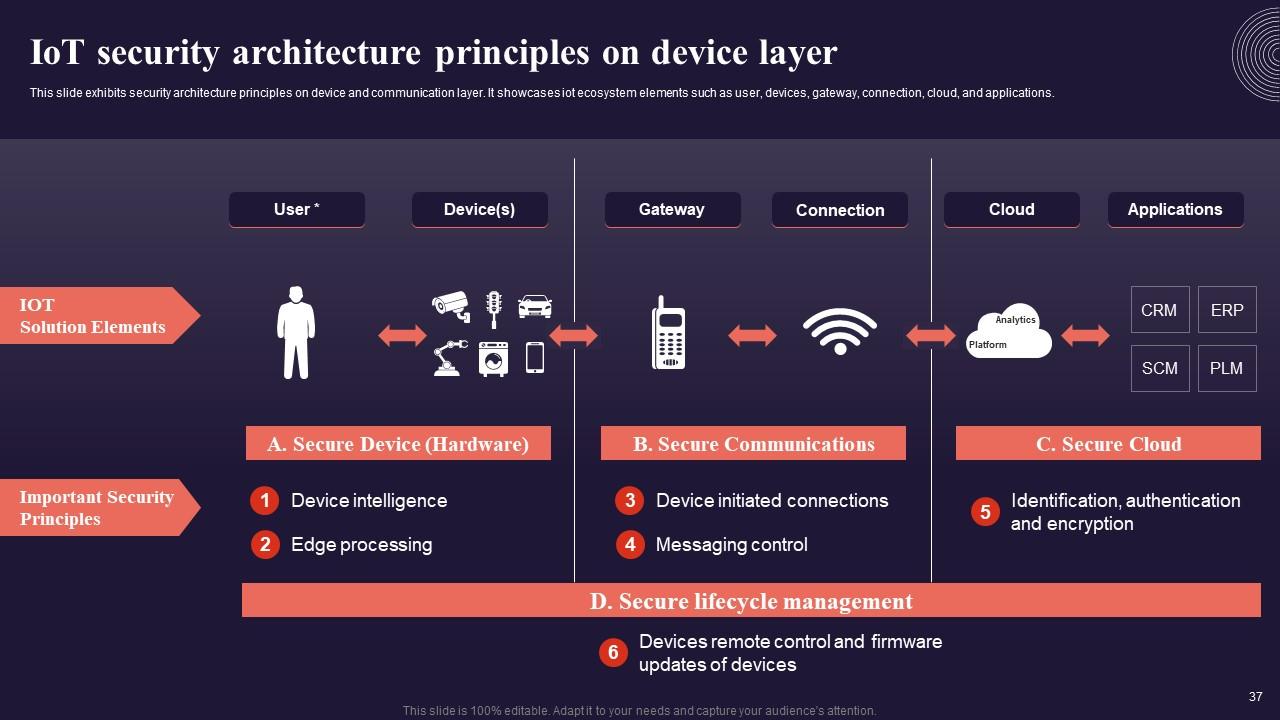
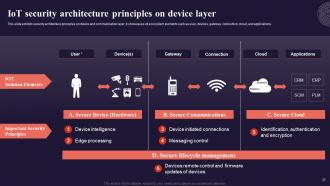
Slide 37: This slide exhibits security architecture principles on device and communication layer.
Slide 38: The slide demonstrates Title of Contents further.
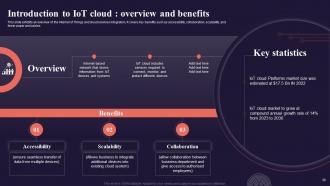
Slide 39: This slide exhibits an overview of the Internet of Things and cloud services integration.
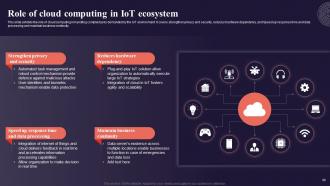
Slide 40: This slide exhibits the role of cloud computing in handling complex tasks demanded by the IoT environment.
Slide 41: This slide represents IoT cloud architecture that enables the flow of key information across many layers.
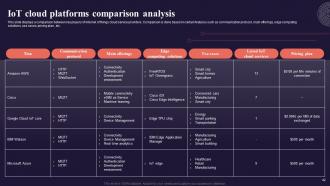
Slide 42: This slide displays a comparison between key players of Internet of things cloud service providers.
Slide 43: This slide highlights solutions for key challenges faced in adopting IoT cloud services.
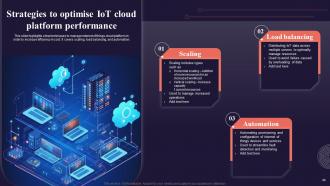
Slide 44: This slide shows a few techniques to manage internet of things cloud platform in order to increase efficiency in cost.
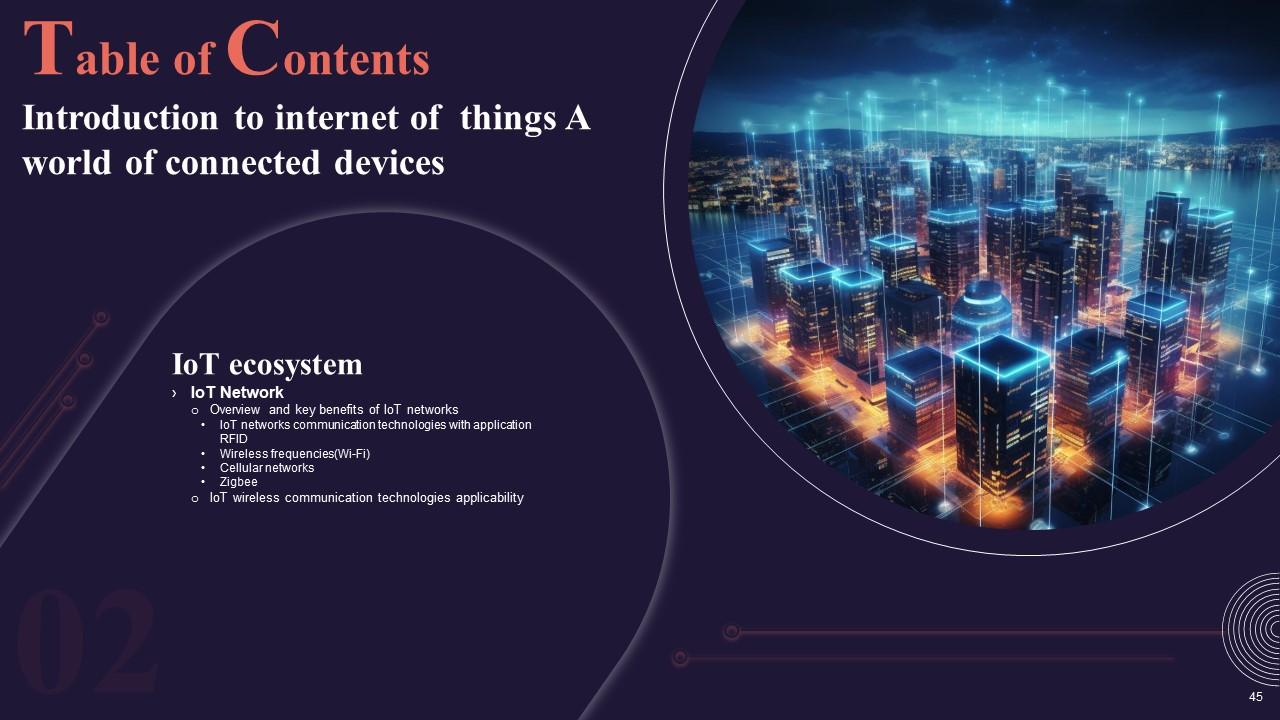
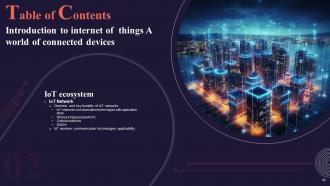
Slide 45: The slide highlights another Title of Contents.
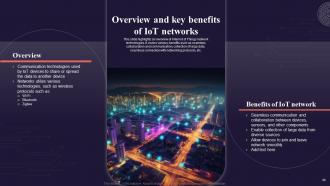
Slide 46: This slide highlights an overview of Internet of Things network technologies.
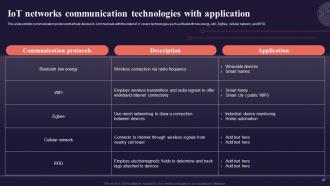
Slide 47: This slide exhibits communication protocols that help devices to communicate with the internet.
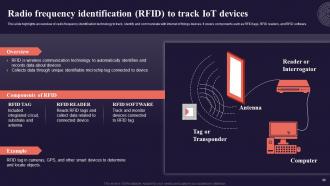
Slide 48: This slide highlights an overview of radio frequency identification technology to track, identify and communicate with internet of things devices.
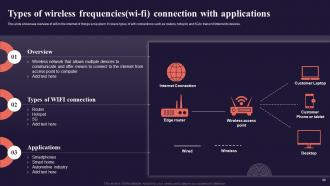
Slide 49: This slide showcase overview of wifi in the internet of things ecosystem.
Slide 50: This slide highlights information about cellular networks that helps to connect physical devices to the internet.
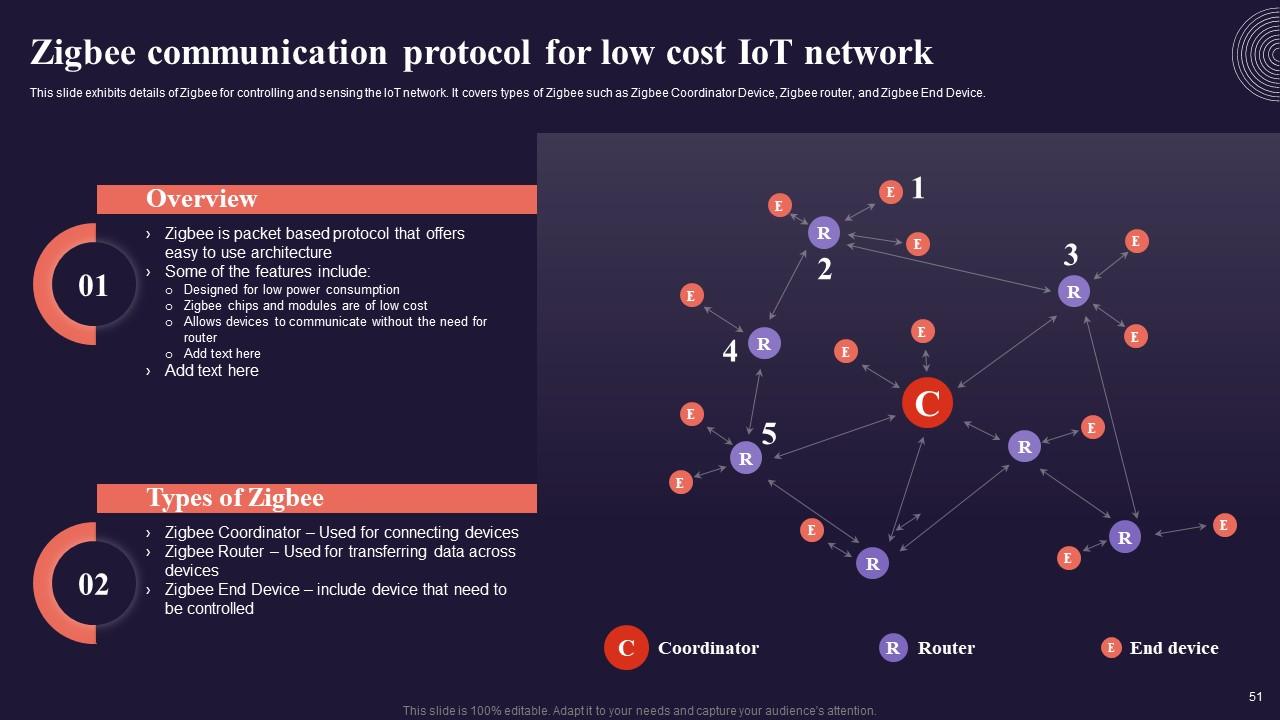
Slide 51: This slide exhibits details of Zigbee for controlling and sensing the IoT network.
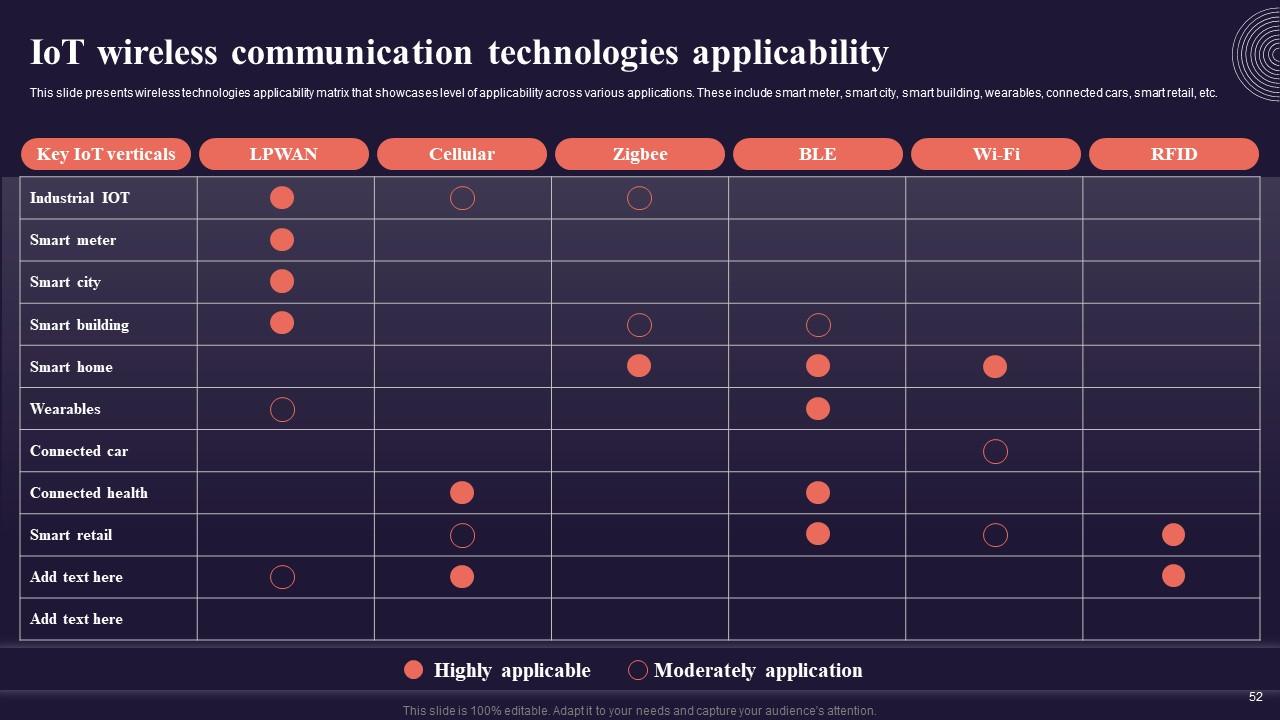
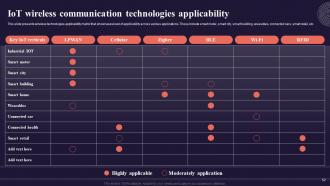
Slide 52: This slide presents wireless technologies applicability matrix that showcases level of applicability across various applications.
Slide 53: The slide displays title of Contents which is to be discussed further.
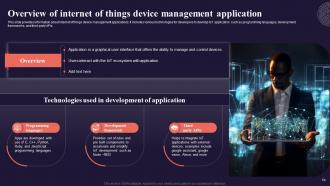
Slide 54: This slide provides information about internet of things device management applications.
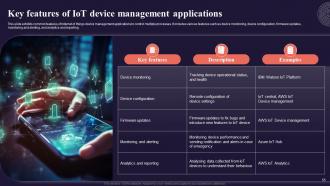
Slide 55: This slide exhibits common features of Internet of things device management applications to control multiple processes.
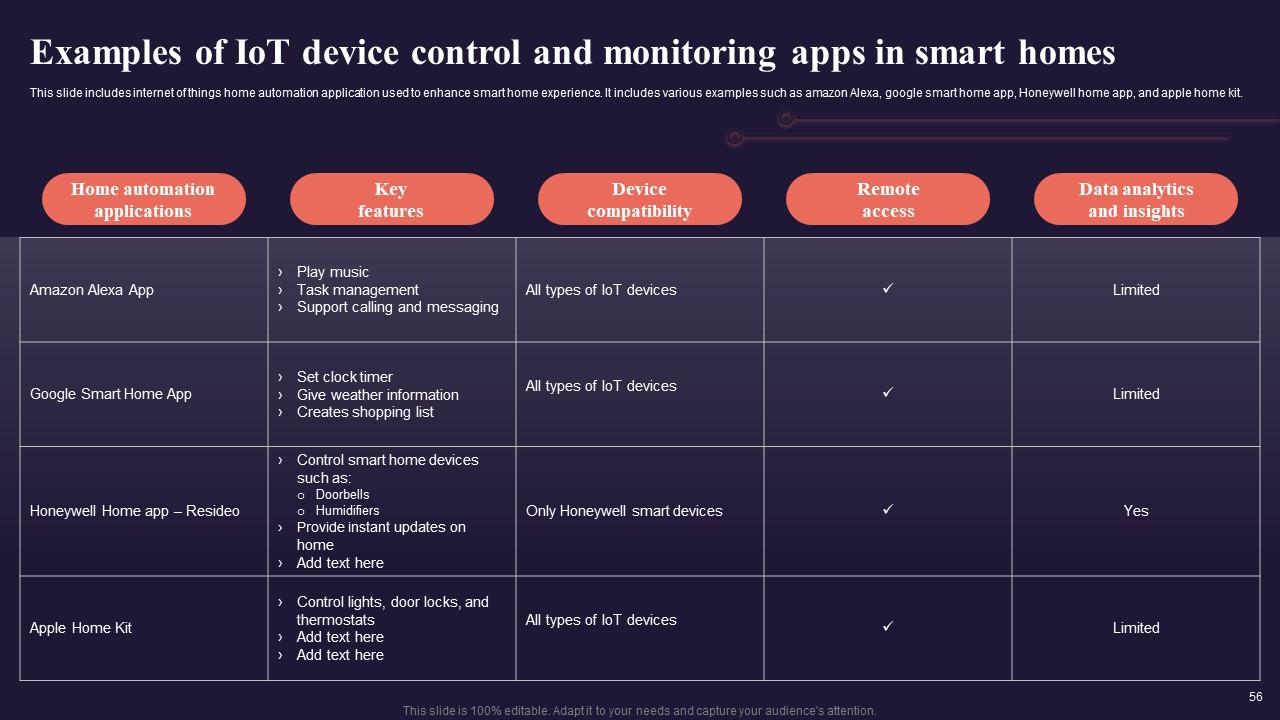
Slide 56: This slide includes internet of things home automation application used to enhance smart home experience.
Slide 57: The slide depicts title of Contents further.
Slide 58: This slide provides a brief introduction to the internet of things in smart cities.
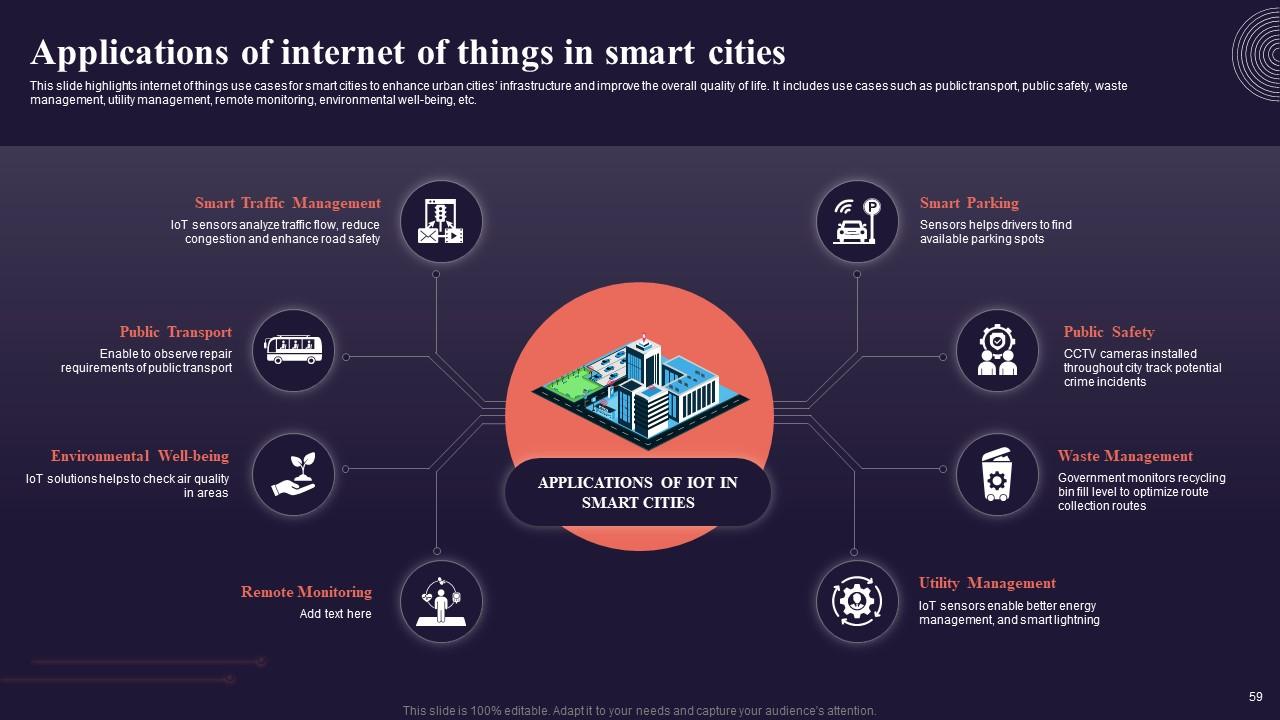
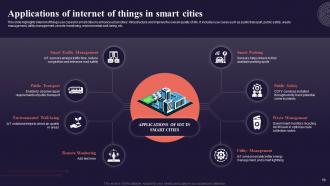
Slide 59: This slide highlights internet of things use cases for smart cities to enhance urban cities’ infrastructure and improve the overall quality of life.
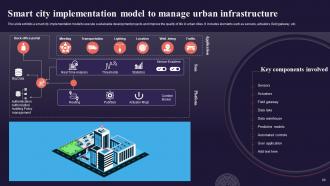
Slide 60: This slide exhibits a smart city implementation model to execute sustainable development projects and improve the quality of life in urban cities.
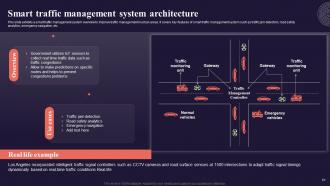
Slide 61: This slide displays a smart traffic management system overview to improve traffic management in urban areas.
Slide 62: This slide provides information about smart waste management systems to handle and mange waste.
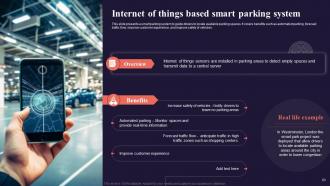
Slide 63: This slide presents a smart parking system to guide drivers to locate available parking spaces.
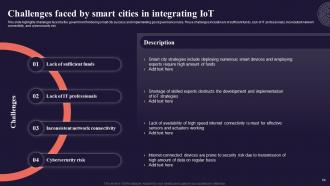
Slide 64: This slide highlights challenges faced by the government hindering smart city success and implementing good governance rules.
Slide 65: This slide presents the positive impact of internet of things integration by deploying sensors and actuators in cities.
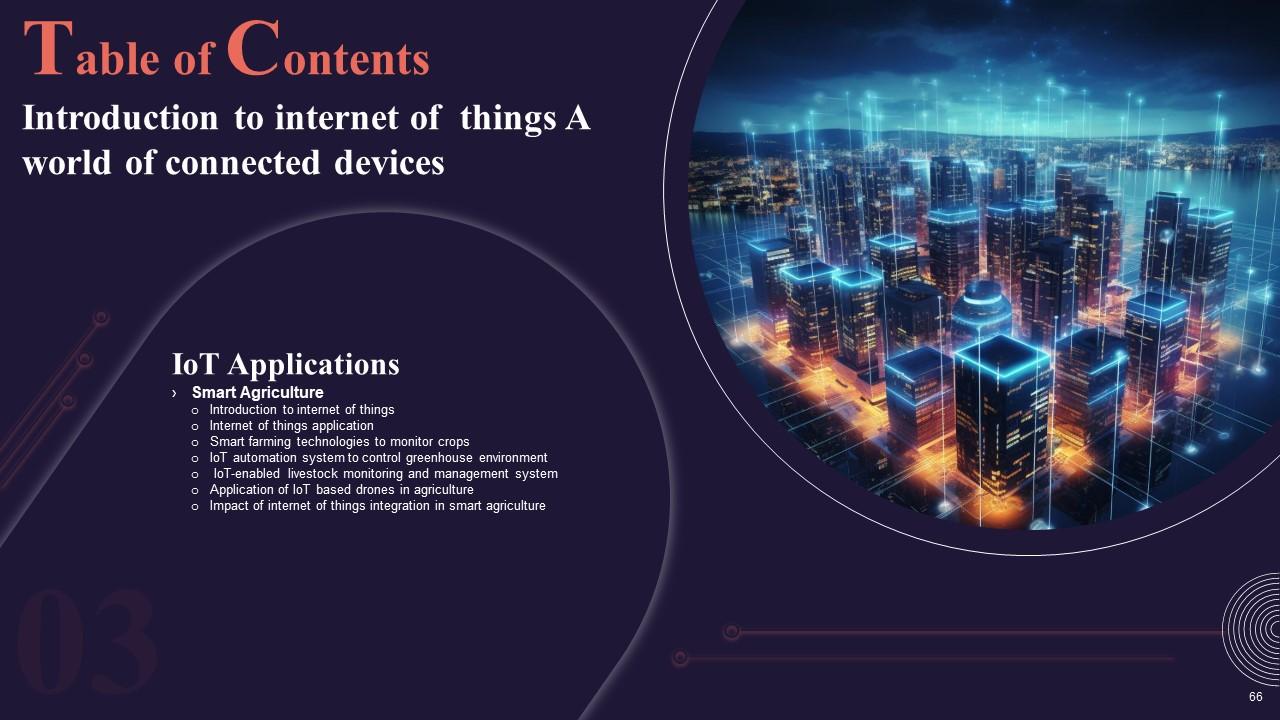
Slide 66: The slide covers another Title of Contents.
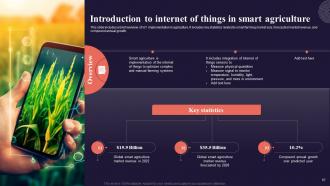
Slide 67: This slide includes a brief overview of IoT implementation in agriculture.
Slide 68: This slide highlights use cases of the Internet of things in the agriculture sector to improve crop production.
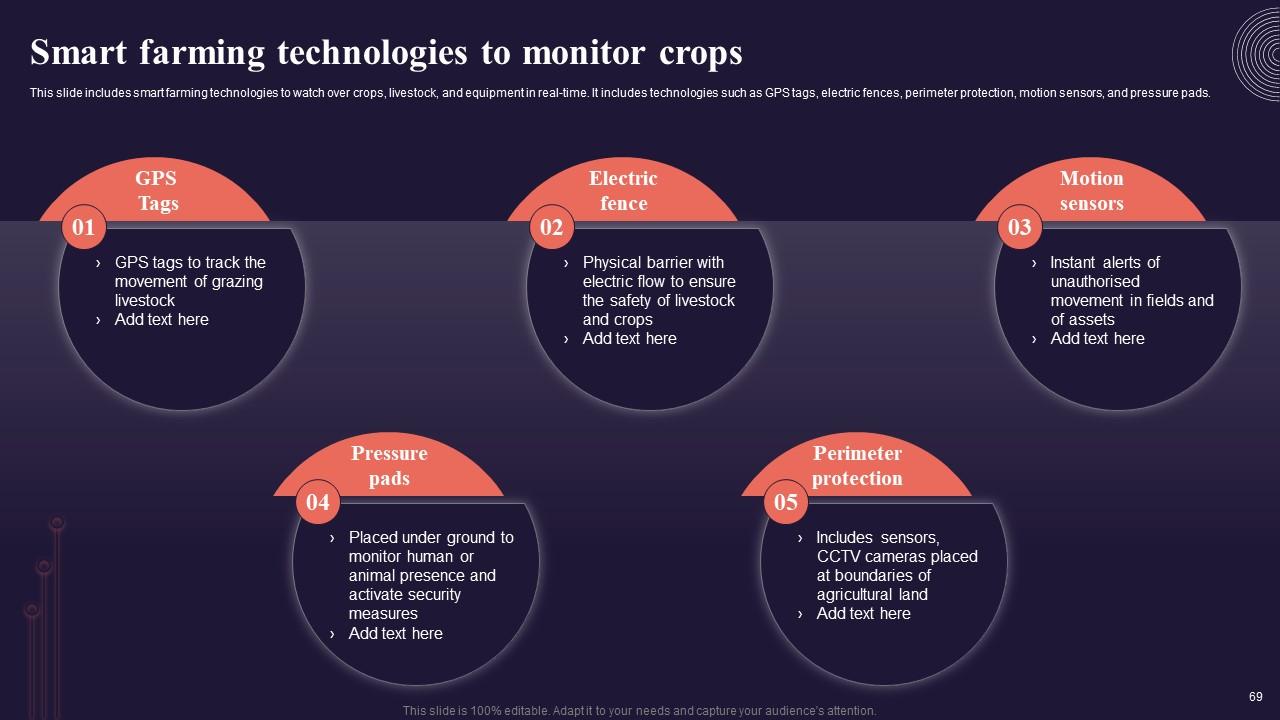
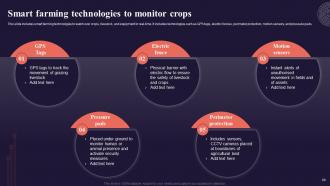
Slide 69: This slide includes smart farming technologies to watch over crops, livestock, and equipment in real-time.
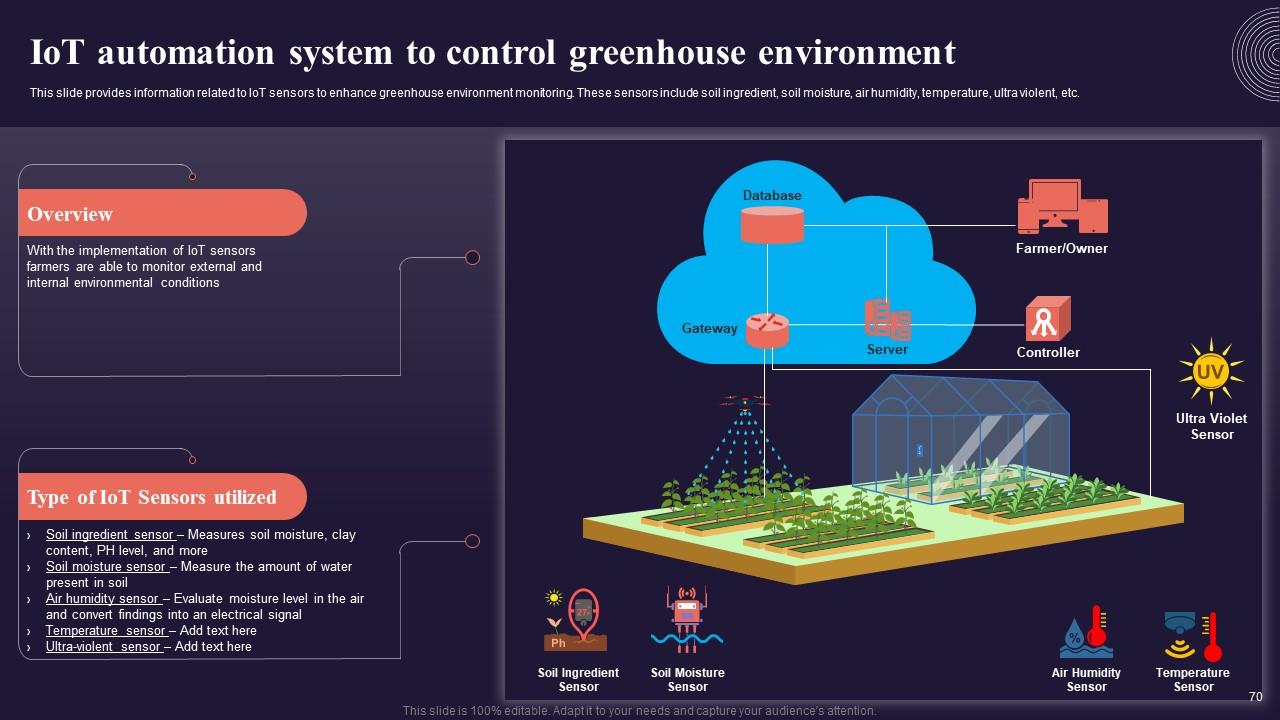
Slide 70: This slide provides information related to IoT sensors to enhance greenhouse environment monitoring.
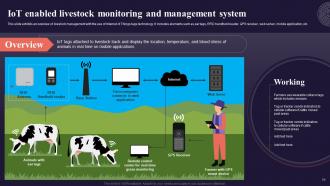
Slide 71: This slide exhibits an overview of livestock management with the use of Internet of Things tags technology.
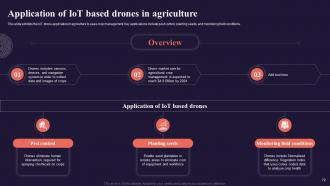
Slide 72: This slide contains the IoT drone application in agriculture to ease crop management.
Slide 73: This slide showcases impact of IoT in smart agriculture.
Slide 74: The slide again shows title of Contents.
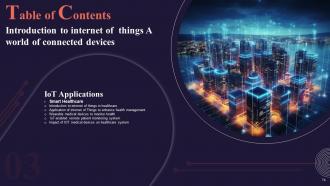
Slide 75: This slide covers an introduction to internet of things in healthcare to accelerate innovation in medical devices.
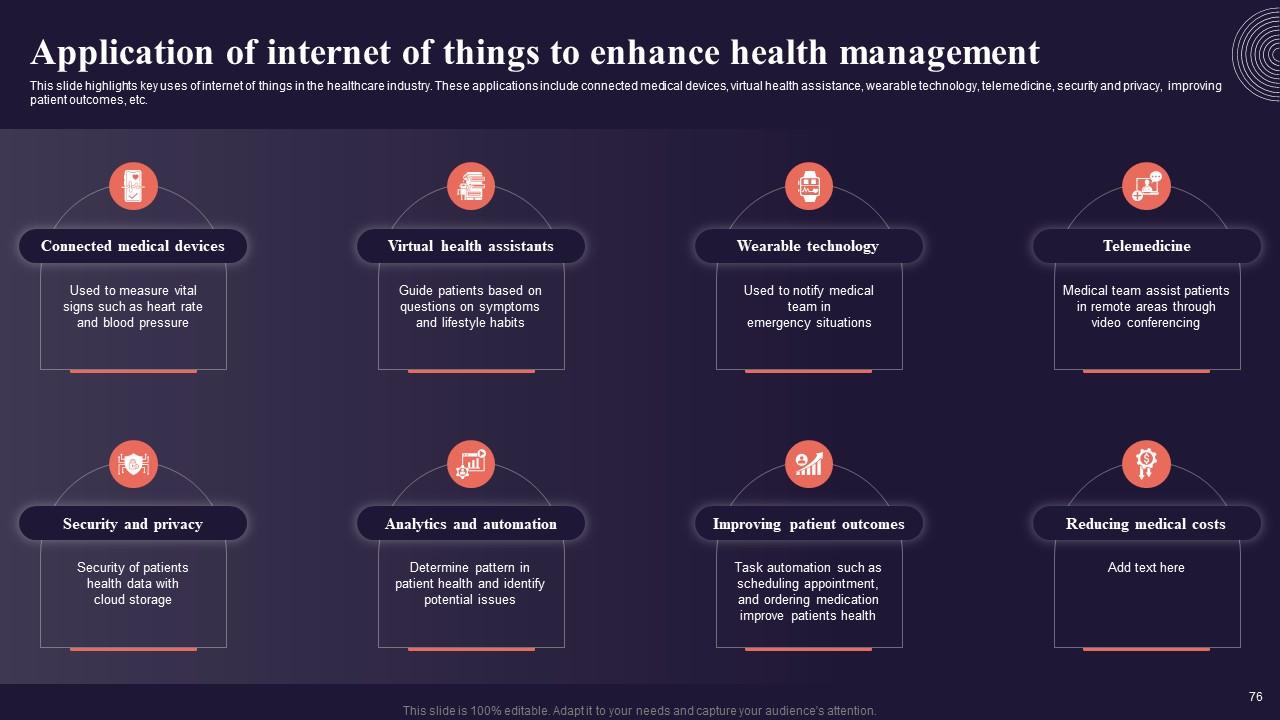
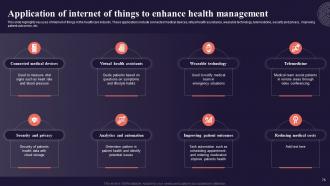
Slide 76: This slide highlights key uses of internet of things in the healthcare industry.
Slide 77: This slide provides information about medical wearable devices used for real time health monitoring.
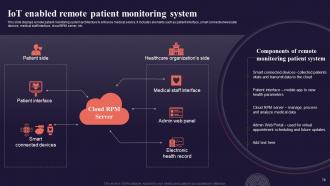
Slide 78: This slide displays remote patient monitoring system architecture to enhance medical service.
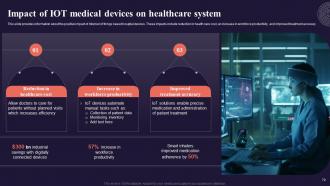
Slide 79: This slide provides information about the positive impact of Internet of things based hospital devices.
Slide 80: The slide renders Title of Contents further.
Slide 81: This slide covers an introduction to internet of things in industrial automation.
Slide 82: This slide depicts internet of Things architecture in industrial automation.
Slide 83: This slide showcases application of internet of things in improving industrial operations.
Slide 84: This slide covers an overview and ways to optimize the supply chain with IoT integration.
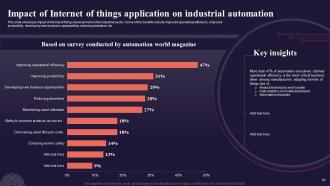
Slide 85: This slide showcase impact of internet of things development on the industrial sector.
Slide 86: The slide presents Title of Contents further.
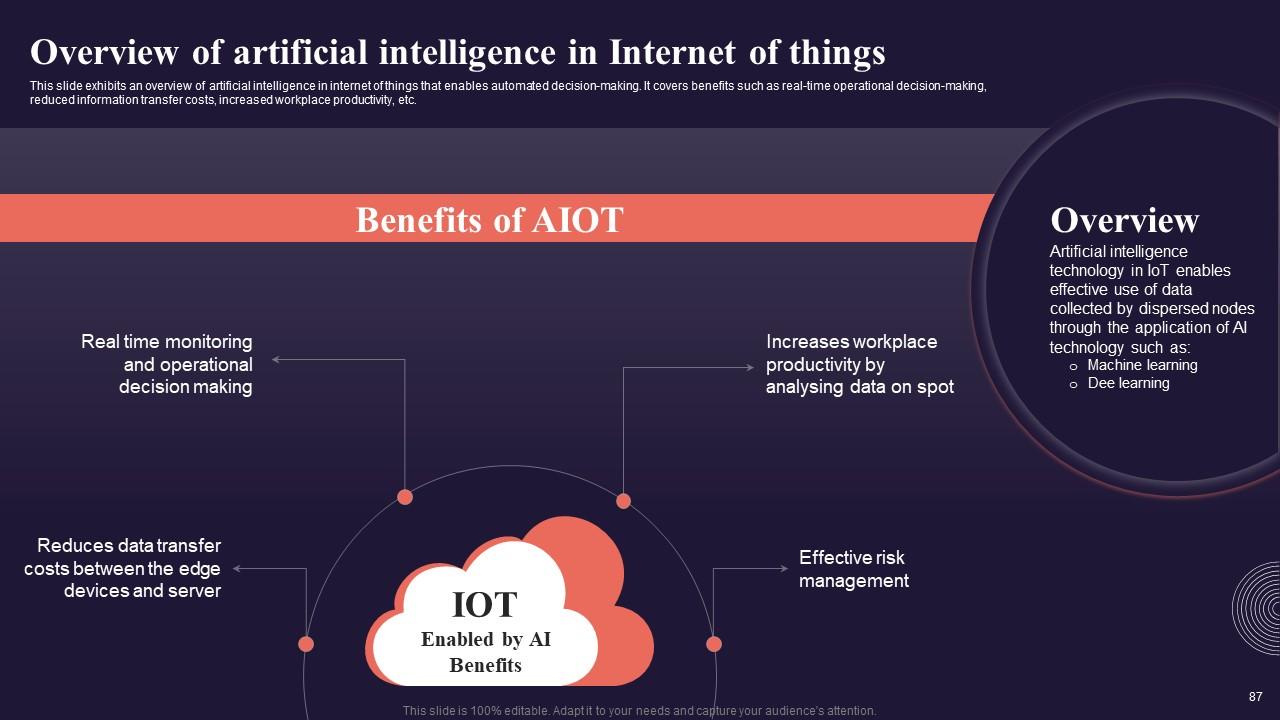
Slide 87: This slide exhibits an overview of artificial intelligence in internet of things that enables automated decision-making.
Slide 88: This slide highlights potential use cases of artificial intelligence in Internet of things to improve business efficiency and reduce costs.
Slide 89: This slide highlights key stats related to the application of artificial intelligence in internet of things infrastructure.
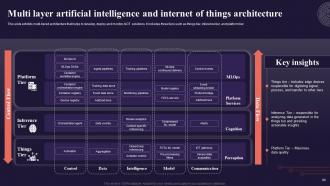
Slide 90: This slide contains multi-tiered architecture that helps to develop, deploy and monitor AIOT solutions.
Slide 91: The slide shows title of Contents which is to be discussed further.
Slide 92: This slide covers the introduction of the 5G network and IoT technology integration.
Slide 93: This slide covers key statistics related to the 5G network and internet of things devices.
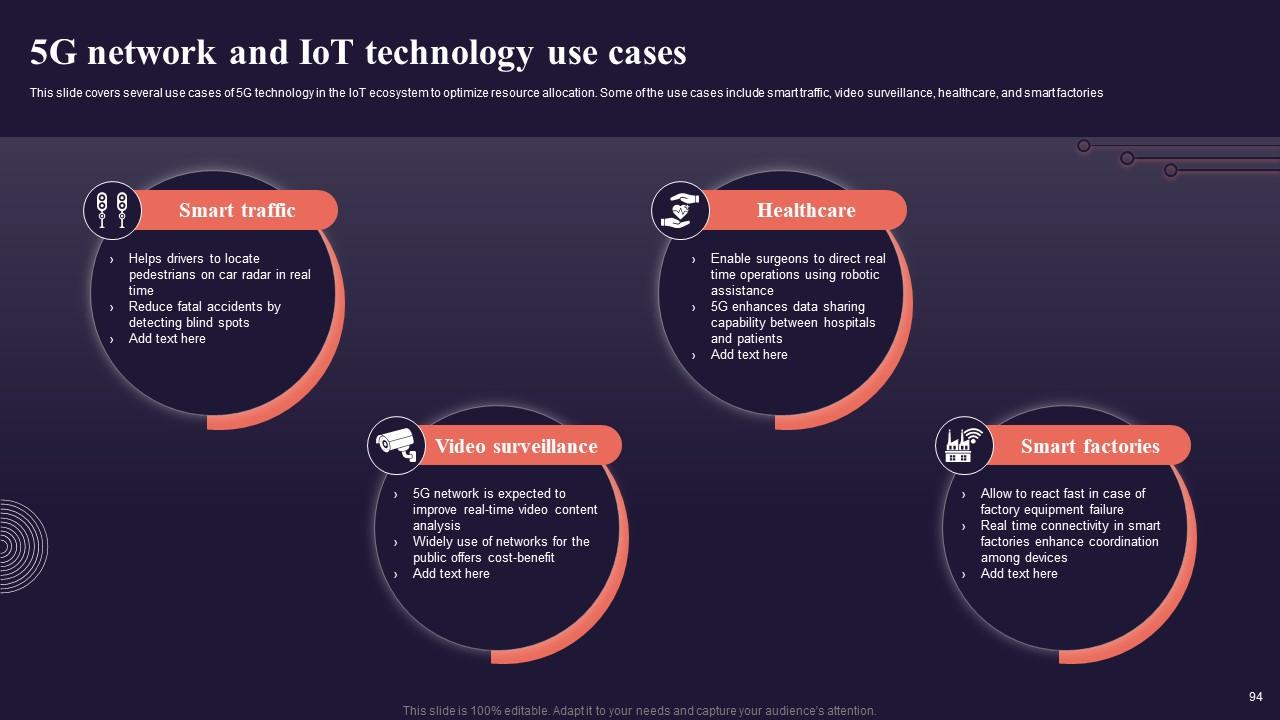
Slide 94: This slide contains several use cases of 5G technology in the IoT ecosystem to optimize resource allocation.
Slide 95: The slide presents Title of Contents further.
Slide 96: This slide exhibit overview of an IoT edge system that depends on sensors and devices.
Slide 97: This slide highlights key features of IoT devices with edge computing capabilities.
Slide 98: This slide displays edge computing enabled internet of things devices market size in the span of ten years.
Slide 99: The slide depicts title of Contents which is to be discussed further.
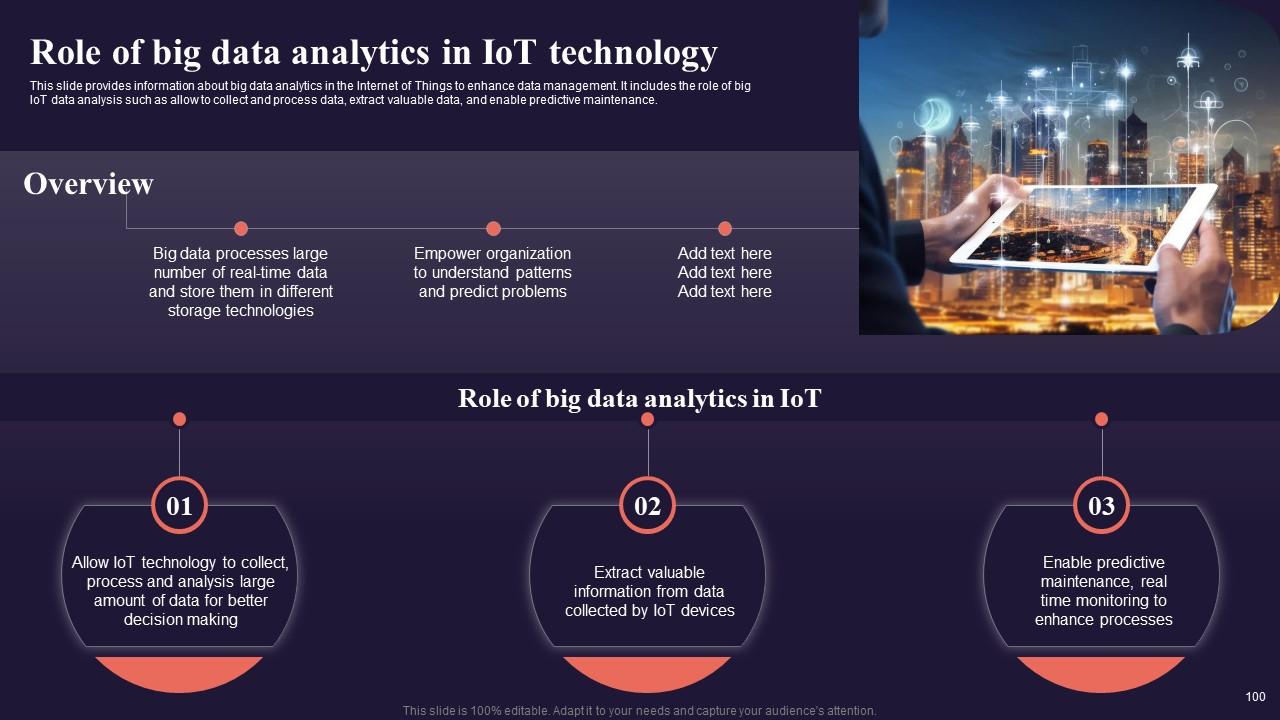
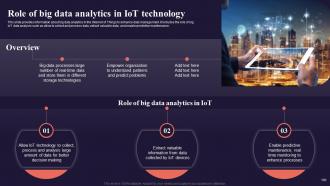
Slide 100: This slide provides information about big data analytics in the Internet of Things to enhance data management.
Slide 101: This slide exhibits steps of IoT big data processing in real-time.
Slide 102: This slide highlights the benefits of big data analytics in Internet of things technology management.
Slide 103: This slide includes challenges faced while implementing big IoT data analytics technology in business.
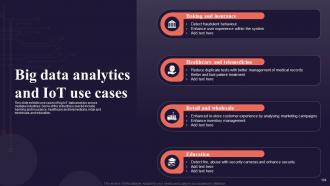
Slide 104: This slide exhibits use cases of big IoT data analysis across multiple industries.
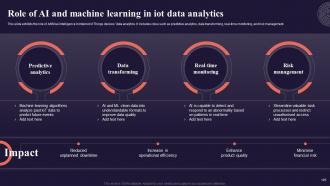
Slide 105: This slide shows the role of Artificial intelligence in Internet of Things devices’ data analytics.
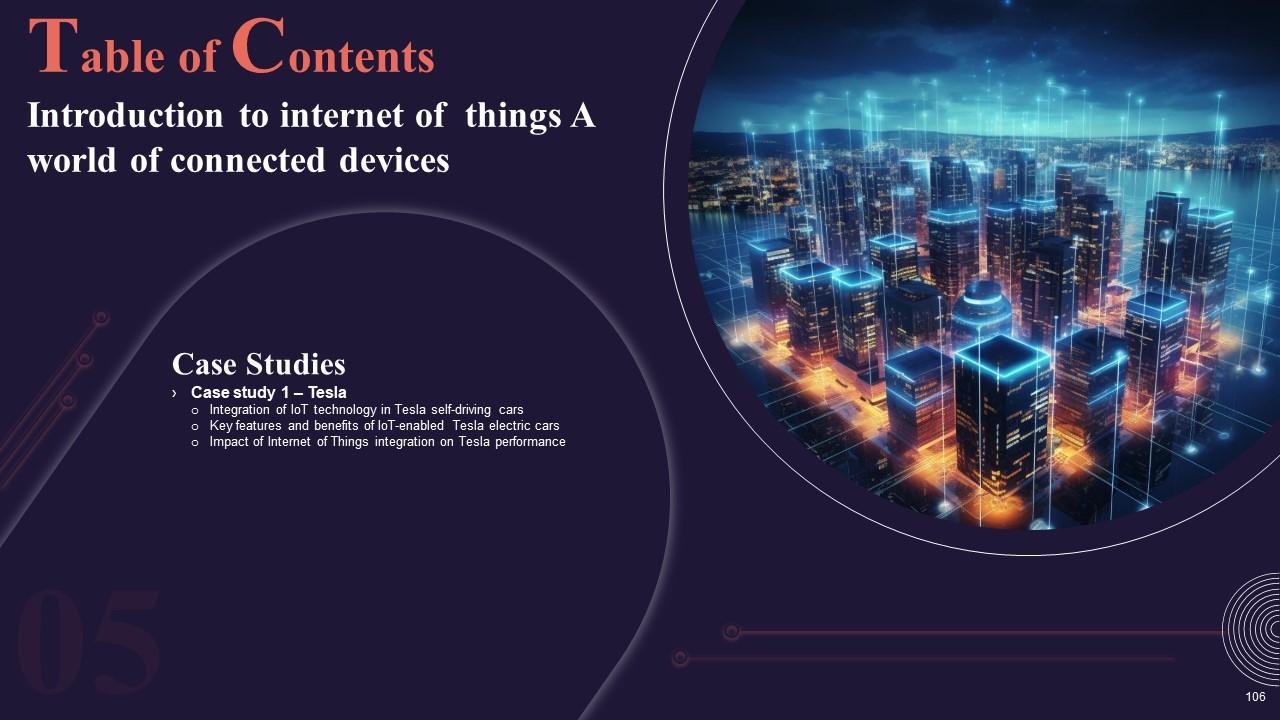
Slide 106: The slide demonstrates Title of Contents further.
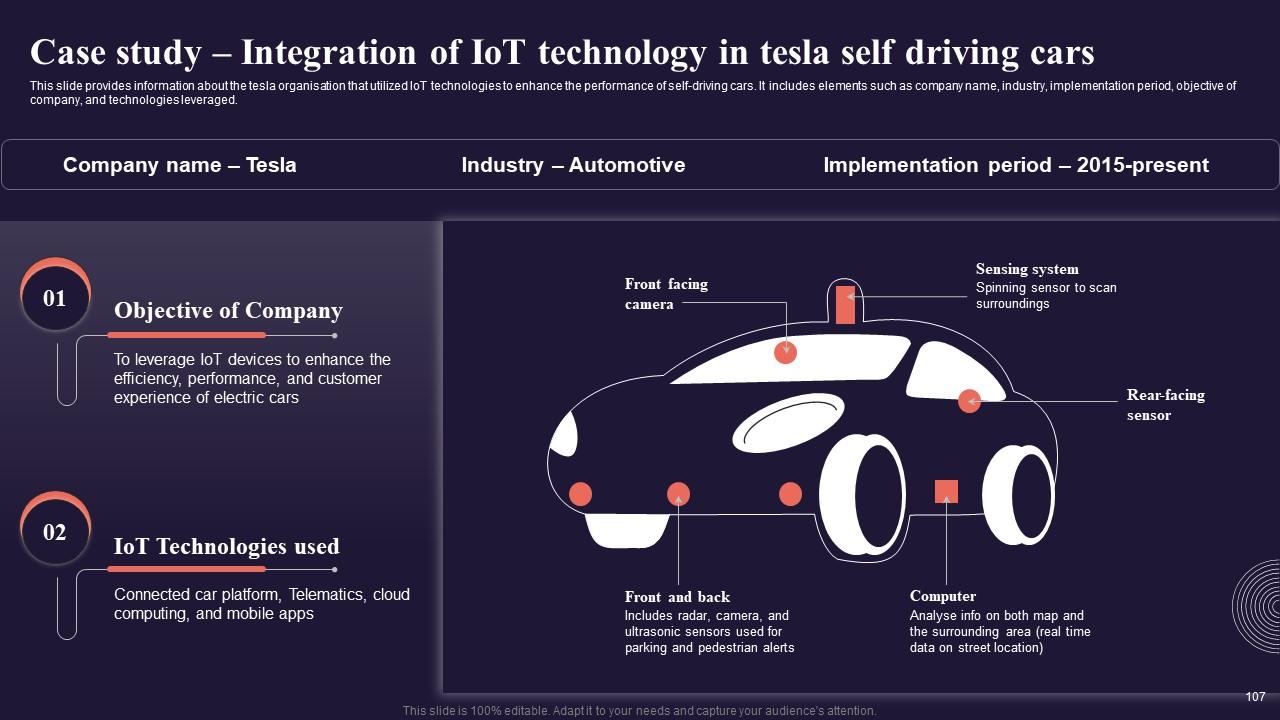
Slide 107: This slide provides information about the tesla organisation that utilized IoT technologies to enhance the performance of self-driving cars.
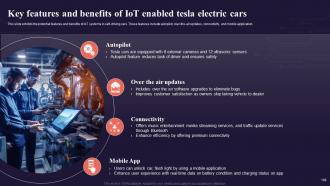
Slide 108: This slide exhibits the potential features and benefits of IoT systems in self-driving cars.
Slide 109: This slide includes the impact of Internet of things devices on company performance.
Slide 110: The slide displays another title of Contents.
Slide 111: This slide exhibits a case study on internet of things implementation for smart healthcare at Boston Children Hospital.
Slide 112: This slide highlights information about Black and Decker company deployed internet of things solutions to enhance visibility in the manufacturing unit.
Slide 113: This slide shows all the icons included in the presentation.
Slide 114: This slide is titled as Additional Slides for moving forward.
Slide 115: This slide shows Post It Notes. Post your important notes here.
Slide 116: This is an Idea Generation slide to state a new idea or highlight information, specifications etc.
Slide 117: This slide contains Puzzle with related icons and text.
Slide 118: This is Our Goal slide. State your firm's goals here.
Slide 119: This slide depicts Venn diagram with text boxes.
Slide 120: This is a Thank You slide with address, contact numbers and email address.
Introduction To Internet Of Things A World Of Connected Devices Powerpoint Presentation Slides IoT CD with all 129 slides:
Use our Introduction To Internet Of Things A World Of Connected Devices Powerpoint Presentation Slides IoT CD to effectively help you save your valuable time. They are readymade to fit into any presentation structure.
-
Superb! The innovative and inspiring template designs provide an edge to the presentation.
-
Loved the templates on SlideTeam, I believe I have found the go to place for my presentation needs!
