


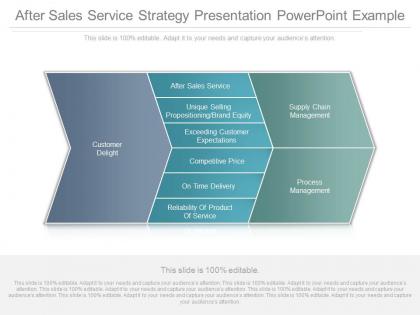
After sales service strategy presentation powerpoint example




Try Before you Buy Download Free Sample Product
 Impress Your
 Audience
 100%
100% Editable
 Save Hours
 of Time


Earn respect from your colleagues and senior managers with the help of our carefully prepared PowerPoint Templates and Slides. Sell your ideas with little effort.
People who downloaded this PowerPoint presentation also viewed the following :
After sales service strategy presentation powerpoint example with all 7 slides:
Disability disappears with our After Sales Service Strategy Presentation Powerpoint Example. They ensure everyone contributes their best,





FAQs for After sales service strategy
Key components include customer support systems, warranty management, spare parts availability, service technician training, and feedback collection mechanisms. These elements work together by ensuring rapid response times, maintaining product reliability, and building long-term customer relationships, with many organizations finding that comprehensive after-sales strategies significantly reduce churn while enhancing brand loyalty and competitive differentiation.
Technology enhances after sales service by enabling real-time issue tracking, automated troubleshooting through AI chatbots, and predictive maintenance alerts that prevent problems before they occur. Through mobile apps and cloud-based platforms, companies streamline warranty claims, provide instant access to product manuals, and deliver personalized support experiences, ultimately reducing response times while increasing customer satisfaction and loyalty.
Companies should track customer satisfaction scores, first-call resolution rates, average response times, service cost per case, and customer retention rates following service interactions. These metrics enable organizations to streamline operations, enhance customer experiences, and identify improvement opportunities, with many businesses finding that strong after-sales performance directly correlates with increased loyalty and competitive advantage.
After-sales service strategies vary significantly across industries based on product complexity, customer expectations, and regulatory requirements. Healthcare organizations emphasize compliance and training support, while automotive focuses on maintenance scheduling and parts availability, and technology companies prioritize remote troubleshooting and software updates, ultimately delivering industry-specific value and enhanced customer retention.
Feedback serves as the foundation for identifying service gaps, understanding customer pain points, measuring satisfaction levels, and pinpointing operational inefficiencies in after-sales processes. Through systematic feedback collection, companies can streamline support workflows, enhance product quality, and personalize customer interactions, with many organizations finding that structured feedback programs ultimately deliver improved customer retention and competitive advantage.
Companies integrate CRM tools into after-sales service by centralizing customer data, tracking service histories, automating follow-up communications, and enabling personalized support experiences across multiple touchpoints. These systems streamline service workflows by providing representatives instant access to purchase records, previous interactions, and customer preferences, ultimately delivering faster resolution times and enhanced customer satisfaction, with many organizations finding significant improvements in retention rates.
Best practices for training staff in after-sales service techniques include comprehensive product knowledge development, active listening skills enhancement, problem-solving methodologies, empathy training, and digital tools proficiency. These approaches streamline customer interactions by building technical expertise, improving communication effectiveness, and accelerating resolution times, with many organizations finding that well-trained teams ultimately deliver higher satisfaction rates and stronger customer retention.
After-sales service significantly strengthens customer loyalty and retention by building trust, demonstrating ongoing value, and creating positive post-purchase experiences that encourage repeat business. Through responsive support, proactive maintenance programs, and seamless issue resolution, companies reduce churn rates while increasing customer lifetime value, with many organizations finding that exceptional service transforms one-time buyers into long-term brand advocates.
Common challenges include inadequate resource allocation, inconsistent service quality across channels, poor communication between sales and service teams, limited customer data integration, and insufficient staff training. These obstacles often result in delayed response times, frustrated customers, and missed revenue opportunities, with many organizations finding that addressing these systematically through improved processes and technology integration delivers enhanced customer retention and competitive advantage.
Companies create seamless sales-to-service experiences by integrating customer data systems, establishing unified communication channels, implementing consistent service standards, and training cross-functional teams on complete customer journeys. This strategic approach enables smoother handoffs between departments, faster issue resolution, and personalized follow-up services, with many organizations finding that integrated systems ultimately deliver higher customer retention and competitive advantage.
Companies are implementing AI-powered chatbots for instant support, personalized maintenance reminders, subscription-based service models, proactive issue resolution through IoT monitoring, and omnichannel support experiences. These innovative strategies enhance customer retention by delivering faster response times, reducing operational costs, and creating predictable revenue streams, with many organizations finding that proactive service approaches significantly improve customer satisfaction and competitive differentiation.
Personalization is critical in after sales service interactions, significantly enhancing customer satisfaction, loyalty, and retention rates by addressing individual needs, preferences, and purchase history. Through personalized recommendations, tailored support solutions, and customized communication approaches, businesses across retail, automotive, and technology sectors deliver faster resolutions and stronger relationships, ultimately driving repeat purchases and competitive advantage.
Managing customer expectations during after-sales service involves clear communication timelines, proactive status updates, transparent service processes, realistic resolution timeframes, and comprehensive service level agreements. These strategies streamline customer interactions by setting proper expectations upfront, providing regular progress communication, and delivering consistent service experiences, with many organizations finding that proactive expectation management significantly reduces complaints while enhancing customer satisfaction and loyalty.
Social media enhances after-sales service communication by providing real-time customer support, proactive issue resolution, and transparent public interactions that build trust. Through platforms like Twitter and Facebook, companies streamline response times, create community-driven support networks, and deliver personalized assistance, with many organizations finding that social engagement significantly improves customer satisfaction and loyalty.
After-sales service and product warranties work together strategically, with warranties providing the legal framework for coverage periods and terms, while after-sales service delivers the actual support, repairs, and customer interactions. This combination enhances customer confidence and loyalty, with many companies finding that comprehensive warranty coverage paired with responsive service creates significant competitive advantage and reduces long-term costs.
-
Awesome presentation, really professional and easy to edit.
-
Great designs, really helpful.