


Agile Certified Practitioner Training Program Powerpoint Presentation Slides




Try Before you Buy Download Free Sample Product
 Impress Your
 Audience
 100%
100% Editable
 Save Hours
 of Time


Because most organizations adopt agile practices, Project Management Institute-Agile Certified Practitioner PMI-ACP has become one of the fastest-growing and widely accepted certifications. Here is a professionally designed template on Agile Certified Practitioner Training Program that illustrates details about globally recognized agile certified courses offered by PMI. It incorporates agile methodologies, tools, and techniques visually pleasingly. This module begins with slides that can address PMI-ACP holders key facts and figures, including rising in certificate holders, average salary, and management jobs. Additionally, you can utilize the thoughtful template to address the reasons behind pursuing the certification program, etc. This module showcases detailed information about the PMI-ACP certification program covering prerequisites, exam blueprint, target audience, exam pattern, fee structure, career path, etc. Additionally, it also provides a detailed summary about other certification programs such as Disciplined Agile Scrum Master DASM, Disciplined Agile Senior Scrum Master DASSM, Disciplined Agile Coach DAC, etc. At last, our template includes slides that will help you choose the proper certification and will assist the readers in selecting the best fit certification course for their career growth. Download it now.
People who downloaded this PowerPoint presentation also viewed the following :
Content of this Powerpoint Presentation
Slide 1: This slide introduces Agile Certified Practitioner Training Program. State Your Company Name and begin.
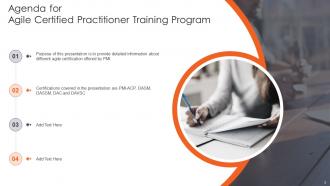
Slide 2: This is an Agenda slide. State your agendas here.
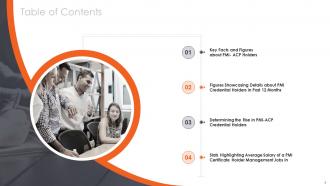
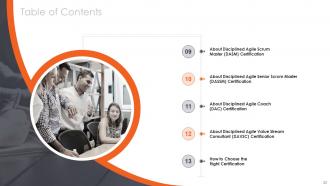
Slide 3: This slide shows Table of Content for the presentation.
Slide 4: This slide highlights title for topics that are to be covered next in the template.
Slide 5: This slide shows key facts and figures of active PMI – agile certified practitioner certificate holders.
Slide 6: This slide displays Figures Showcasing Details about PMI Credential Holders in Past 12 Months.
Slide 7: This slide represents information on the rise in PMI – ACP credential holders since 2014.
Slide 8: This slide shows informational stats on the average salary of a PMI certified professional.
Slide 9: This slide highlights title for topics that are to be covered next in the template.
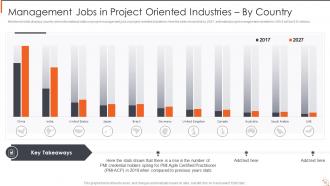
Slide 10: This slide shows informational stats on project management jobs in project-oriented industries.
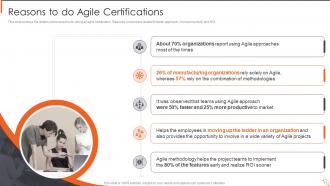
Slide 11: This slide displays details on the reasons for doing an agile certification.
Slide 12: This slide represents information on various agile certifications offered by PMI.
Slide 13: This slide highlights title for topics that are to be covered next in the template.
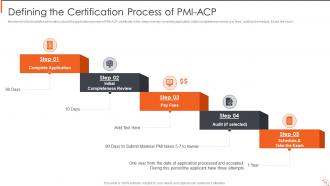
Slide 14: This slide presents application process of PMI-ACP certificate in five steps namely complete application, initial completeness review, pay fees, etc.
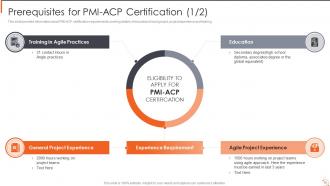
Slide 15: This slide shows PMI-ACP certification requirements covering details of educational background, project experience and training.
Slide 16: This slide displays information about PMI-ACP certification requirements covering details of educational background, project experience and training.
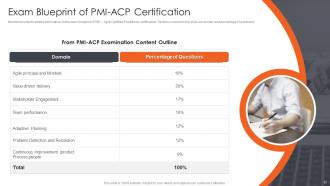
Slide 17: This slide represents information on the exam blueprint of PMI – Agile Certified Practitioner certification.
Slide 18: This slide highlights title for topics that are to be covered next in the template.
Slide 19: This slide presents information about the target audience and exam format of the PMI - ACP certification program.
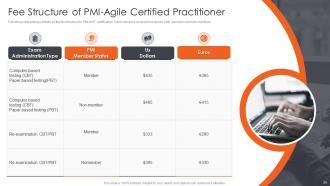
Slide 20: This slide shows Fee Structure of PMI-Agile Certified Practitioner.
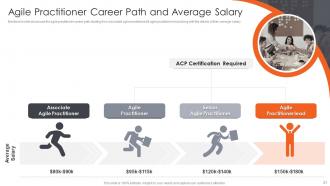
Slide 21: This slide displays agile practitioner career path starting from associate agile practitioner till agile practitioner lead along with the details of their average salary.
Slide 22: This slide highlights title for topics that are to be covered next in the template.
Slide 23: This slide shows About Disciplined Agile Scrum Master (DASM) Certification.
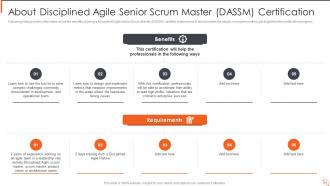
Slide 24: This slide presents About Disciplined Agile Senior Scrum Master (DASSM) Certification.
Slide 25: This slide shows information about the benefits of being a Disciplined Agile Coach (DAC) certified professional.
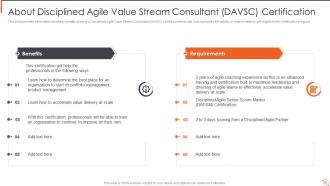
Slide 26: This slide displays About Disciplined Agile Value Stream Consultant (DAVSC) Certification.
Slide 27: This slide represents How to Choose the Right Certification.
Slide 28: This slide showcases Icons for Agile Certified Practitioner Training Program.
Slide 29: This slide is titled as Additional Slides for moving forward.
Slide 30: This slide shows respondents using scrum, average team size, average length of a sprint in weeks.
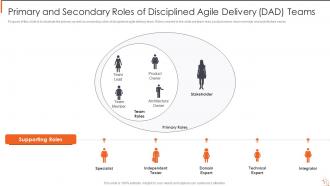
Slide 31: This slide represents Primary and Secondary Roles of Disciplined Agile Delivery (DAD) Teams.
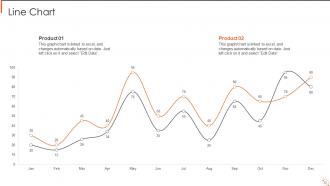
Slide 32: This slide describes Line chart with two products comparison.
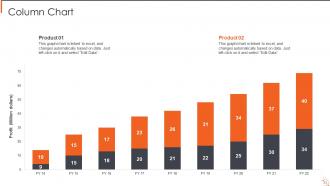
Slide 33: This slide displays Column chart with two products comparison.
Slide 34: This is a Timeline slide. Show data related to time intervals here.
Slide 35: This is Our Mission slide with related imagery and text.
Slide 36: This is Our Team slide with names and designation.
Slide 37: This slide depicts Venn diagram with text boxes.
Slide 38: This slide contains Puzzle with related icons and text.
Slide 39: This slide shows Post It Notes. Post your important notes here.
Slide 40: This is a Thank You slide with address, contact numbers and email address.
Agile Certified Practitioner Training Program Powerpoint Presentation Slides with all 45 slides:
Use our Agile Certified Practitioner Training Program Powerpoint Presentation Slides to effectively help you save your valuable time. They are readymade to fit into any presentation structure.




















FAQs for Agile Certified Practitioner Training Program
Key skills include facilitation and communication, sprint planning and backlog management, stakeholder collaboration, retrospective leadership, and adaptive problem-solving techniques. These competencies enable practitioners to streamline team dynamics, enhance project delivery timelines, and foster continuous improvement cycles, with many organizations finding that well-trained practitioners significantly boost productivity and stakeholder satisfaction.
Agile Practitioner Training emphasizes iterative development, collaborative teamwork, and adaptive planning, while traditional project management focuses on linear phases, detailed upfront planning, and rigid control mechanisms. Through hands-on sprints and retrospectives, organizations streamline product delivery, enhance customer feedback integration, and accelerate time-to-market, with many companies finding that agile approaches deliver greater flexibility and responsiveness.
Agile Practitioners learn about Scrum, Kanban, Lean, Extreme Programming (XP), and SAFe (Scaled Agile Framework), along with hybrid approaches that combine multiple methodologies. These frameworks enhance project delivery by improving team collaboration, accelerating development cycles, and increasing customer satisfaction, with many organizations finding that practitioners skilled in multiple methodologies deliver significantly better outcomes and competitive advantage.
Agile training enhances team dynamics by teaching collaborative planning, daily standups, retrospectives, and cross-functional communication methods. These practices streamline decision-making, increase transparency, and foster continuous improvement, with many organizations finding that structured ceremonies and iterative feedback loops ultimately deliver stronger team cohesion and accelerated project delivery.
Continuous improvement serves as a foundational principle in Agile Practitioner Training, emphasizing retrospectives, feedback loops, iterative learning, and adaptive methodologies throughout the development process. This approach enables practitioners to refine their skills systematically, identify process inefficiencies, and implement strategic enhancements, with many organizations finding that teams deliver higher-quality outcomes and enhanced customer satisfaction.
Agile training addresses scaling challenges by teaching framework integration, cross-team coordination, leadership alignment, and organizational change management strategies. Through structured programs covering SAFe, LeSS, and Scrum@Scale methodologies, organizations streamline communication across departments, enhance portfolio management, and maintain Agile principles at enterprise levels, ultimately delivering faster innovation and improved operational efficiency.
Essential Agile metrics include sprint velocity, burndown charts, cycle time, defect rates, and team satisfaction scores. These measurements enable practitioners to track progress, identify bottlenecks, and optimize team performance by monitoring delivery speed, quality outcomes, and stakeholder engagement, with many organizations finding that consistent metric tracking ultimately delivers improved project predictability and enhanced customer satisfaction.
Agile Practitioner Training incorporates real-world case studies through interactive workshops analyzing actual project failures and successes, simulation exercises replicating complex organizational scenarios, and industry-specific examples from sectors like healthcare, finance, and technology. These practical applications enable participants to understand Agile implementation challenges, develop problem-solving frameworks, and build confidence in applying methodologies, ultimately delivering enhanced decision-making skills and faster project delivery capabilities.
Training fosters collaborative culture by teaching shared Agile practices, establishing common communication frameworks, and breaking down traditional silos between departments. Through structured workshops and cross-functional exercises, teams develop unified problem-solving approaches, enhanced transparency in project workflows, and stronger interpersonal dynamics, ultimately delivering faster project outcomes and improved organizational efficiency.
Recommended tools for Agile Practitioners include Jira, Azure DevOps, Trello, Slack, and Miro for project management and collaboration. These platforms streamline sprint planning, backlog management, and team communication by automating workflows, enhancing transparency, and facilitating real-time collaboration, with many organizations finding that integrated toolsets significantly improve delivery speed and stakeholder engagement.
Agile Practitioner Training prepares individuals for certifications by covering core methodologies like Scrum, Kanban, and Lean principles, while providing hands-on experience with sprint planning, backlog management, and team facilitation techniques. These comprehensive programs enhance practical skills through real-world simulations and case studies, ultimately delivering the knowledge foundation and confidence needed for certification success across multiple Agile frameworks.
Agile Practitioner Training opens career paths including Scrum Master, Product Owner, Agile Coach, Project Manager, and Business Analyst roles. These positions enable professionals to drive organizational transformation, streamline project delivery, and enhance team collaboration across industries like technology, financial services, and healthcare, ultimately delivering faster time-to-market and improved customer satisfaction.
Agile techniques adapt to remote teams through enhanced digital collaboration tools, asynchronous communication protocols, and modified ceremony structures that maintain team cohesion across time zones. Virtual daily standups, collaborative sprint planning platforms, and digital retrospective boards enable distributed teams to preserve Agile principles while delivering streamlined project outcomes and maintaining team productivity regardless of geographic location.
Agile practitioner training covers stakeholder expectation management through regular communication cadences, transparent progress reporting, early and frequent feedback loops, collaborative requirement refinement, and proactive risk communication. These strategies help organizations build trust while managing scope changes, with many project teams finding that consistent stakeholder engagement throughout sprints ultimately delivers better alignment and reduces late-stage surprises.
Agile Practitioner Training effectiveness is evaluated through competency assessments, project performance metrics, team collaboration improvements, and certification completion rates. Organizations typically measure outcomes by tracking sprint velocity increases, reduced delivery timelines, and enhanced stakeholder satisfaction, with many finding that comprehensive evaluation frameworks combining technical skills and behavioral changes deliver sustained agile transformation results.
-
Loved the templates on SlideTeam, I believe I have found the go to place for my presentation needs!
-
Easy to edit slides with easy to understand instructions.