


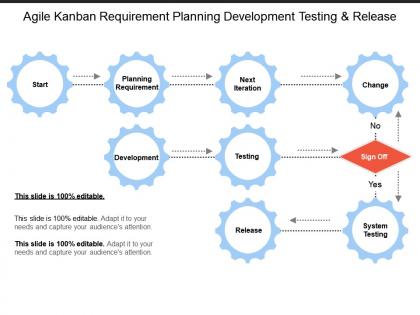
Agile kanban requirement planning development testing and release




Try Before you Buy Download Free Sample Product
 Impress Your
 Audience
 100%
100% Editable
 Save Hours
 of Time


You can talk for hours un-end but your audience may still be lost. However try using one of our Agile Kanban Requirement Planning Development Testing And Releaseand see what change it brings.
People who downloaded this PowerPoint presentation also viewed the following :
Agile kanban requirement planning development testing and release with all 5 slides:
Process the data with our Agile Kanban Requirement Planning Development Testing And Release. Your thoughts will come to firm conclusions.



FAQs for Agile kanban requirement planning development
Agile Kanban's core principles include visualizing workflow, limiting work-in-progress, managing flow, making policies explicit, and continuously improving through feedback loops. Unlike traditional Agile methods with fixed sprints and prescribed roles, Kanban emphasizes continuous delivery and evolutionary change, with many organizations finding that this approach streamlines operations while maintaining flexibility for dynamic project requirements.
Teams effectively visualize workflow using Kanban boards by creating distinct columns for each work stage, limiting work-in-progress items, and using visual cards to represent tasks with clear priorities and assignments. Through digital tools like Trello or physical boards, teams streamline task tracking, identify bottlenecks quickly, and enhance collaboration, ultimately delivering faster project completion and improved operational efficiency.
Kanban benefits for remote teams include enhanced visual workflow transparency, improved asynchronous collaboration, reduced meeting overhead, better work-in-progress management, and clearer priority alignment across time zones. Through digital Kanban boards, distributed teams streamline communication, minimize status update meetings, and maintain project visibility, with many organizations finding that remote productivity increases significantly while coordination complexity decreases.
WIP limits improve team efficiency by preventing multitasking, reducing context switching, and forcing teams to complete tasks before starting new ones. This constraint creates better workflow visibility, minimizes bottlenecks, and enables faster delivery cycles, with many software development teams and manufacturing operations finding that WIP limits ultimately enhance focus and reduce overall project completion times.
Teams should track cycle time, lead time, throughput, work-in-progress limits, cumulative flow, and blocked items to assess Kanban performance effectively. These metrics enable organizations to identify bottlenecks, optimize workflow efficiency, and enhance delivery predictability, with many software development and operations teams finding that consistent measurement ultimately delivers faster project completion and improved customer satisfaction.
Kanban integrates with Scrum by overlaying visual workflow management onto existing sprint structures, creating hybrid approaches like Scrumban that combine sprint planning with continuous flow principles. Many development teams find this integration streamlines bottleneck identification, enhances daily standups with visual progress tracking, and delivers improved sprint predictability while maintaining Scrum's iterative discipline and collaborative ceremonies.
Continuous improvement serves as Kanban's foundational principle, driving teams to regularly analyze workflow metrics, identify bottlenecks, and optimize processes through iterative adjustments. This ongoing refinement enables organizations to enhance delivery speed, reduce cycle times, and improve quality, with many software development teams and manufacturing companies finding that systematic improvements ultimately deliver greater operational efficiency and competitive advantage.
Teams handle bottlenecks in Kanban by identifying constraints through work-in-progress limits, visualizing flow disruptions on boards, and implementing swarming techniques where multiple team members collaborate on blocked items. Through continuous monitoring and daily standups, organizations streamline task progression, redistribute workloads strategically, and optimize resource allocation, ultimately delivering faster project completion and enhanced operational efficiency across development cycles.
Common Kanban adoption pitfalls include failing to limit work-in-progress, neglecting to define clear workflow stages, inadequate team training, and resistance to continuous improvement practices. Teams can avoid these challenges by establishing explicit WIP limits from the start, creating well-defined column definitions, investing in comprehensive team education, and fostering a culture of regular retrospectives, ultimately delivering improved workflow visibility and enhanced operational efficiency.
Kanban adapts to marketing and HR through visual workflow management, limiting work-in-progress, and continuous improvement principles that streamline campaign development, content creation, recruitment processes, and employee onboarding. Marketing teams use Kanban boards to track campaigns from ideation to launch, while HR departments manage hiring pipelines and training programs, ultimately delivering faster project completion and enhanced operational efficiency.
Popular digital Kanban tools include Trello, Jira, Asana, Monday.com, and Azure DevOps, each offering drag-and-drop functionality, customizable workflows, and real-time collaboration features. These platforms enhance team productivity by streamlining task visualization, automating workflow transitions, and enabling remote collaboration, with many organizations finding that integrated reporting and analytics ultimately deliver improved project transparency and faster delivery cycles.
Scaling Kanban for larger organizations involves creating hierarchical board structures, establishing clear work-in-progress limits across multiple teams, and implementing standardized workflows with consistent metrics tracking. Many enterprises successfully deploy portfolio-level Kanban boards that cascade down to team levels, enabling cross-functional coordination while maintaining autonomous team operations, ultimately delivering improved visibility and faster organizational responsiveness.
Collaboration techniques in Kanban include daily standups around the board, work-in-progress limit discussions, visual workflow mapping, cross-functional team rotations, and collaborative retrospectives. These practices enhance transparency by encouraging real-time communication, shared problem-solving, and collective ownership of workflow bottlenecks, with many organizations finding that regular board reviews ultimately deliver faster delivery cycles and improved team alignment.
Feedback loops in Kanban enhance project outcomes by enabling continuous improvement through regular retrospectives, daily standups, and stakeholder reviews that identify bottlenecks early. These mechanisms streamline workflow adjustments, accelerate delivery timelines, and improve product quality, with many development teams finding that systematic feedback collection ultimately delivers faster time-to-market and enhanced customer satisfaction.
Successful Kanban implementations span manufacturing (Toyota's production lines), software development (Spotify's feature releases), healthcare (hospital patient flow management), marketing (campaign workflow optimization), and financial services (loan processing streamlines). These organizations achieve significant improvements through visual workflow management, reduced bottlenecks, and enhanced team collaboration, with many finding 30-50% faster delivery times and improved operational efficiency.
-
Best way of representation of the topic.
-
I discovered this website through a google search, the services matched my needs perfectly and the pricing was very reasonable. I was thrilled with the product and the customer service. I will definitely use their slides again for my presentations and recommend them to other colleagues.