


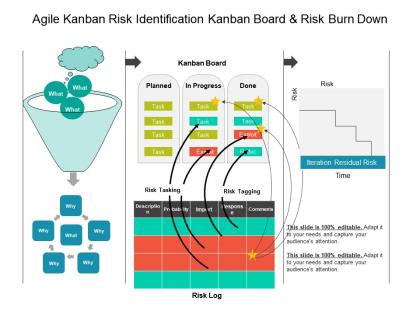
Agile kanban risk identification kanban board and risk burn down





Try Before you Buy Download Free Sample Product
 Impress Your
 Audience
 100%
100% Editable
 Save Hours
 of Time


Ensure everyone follows your cue with our Agile Kanban Risk Identification Kanban Board And Risk Burn Down. You will be able to control the field.
People who downloaded this PowerPoint presentation also viewed the following :
Agile kanban risk identification kanban board and risk burn down with all 5 slides:
Our Agile Kanban Risk Identification Kanban Board And Risk Burn Down are truly broad minded. They accept and cater for any viewpoint.


FAQs for Agile kanban risk identification kanban board and
Agile Risk Management principles include iterative risk assessment, continuous stakeholder collaboration, adaptive response strategies, lightweight documentation, and frequent risk review cycles. These approaches differentiate from traditional methods by embracing uncertainty as opportunity, enabling rapid pivot capabilities, and integrating risk management seamlessly into development sprints, with many organizations finding that this delivers faster threat identification and more responsive mitigation strategies.
Agile teams effectively identify and assess risks through daily standups, sprint retrospectives, risk burndown charts, story mapping, and continuous stakeholder feedback. These practices enable teams to surface blockers early, evaluate impact through collaborative risk assessment sessions, and prioritize mitigation strategies, with many organizations finding that regular risk reviews during sprint planning ultimately deliver faster problem resolution and improved project predictability.
Collaboration serves as the foundation of Agile Risk Management by enabling cross-functional teams to identify, assess, and address risks through shared knowledge, diverse perspectives, and collective problem-solving capabilities. Through regular stand-ups, retrospectives, and collaborative planning sessions, teams can proactively surface potential issues, develop comprehensive mitigation strategies, and respond rapidly to emerging threats, ultimately delivering more resilient projects and enhanced organizational adaptability.
Agile methodologies like Scrum and Kanban incorporate robust risk management through dedicated risk backlogs, daily standup risk assessments, sprint retrospectives focused on risk identification, and continuous stakeholder feedback loops. These frameworks enable organizations to identify potential issues early, adapt quickly to changing circumstances, and maintain project momentum while minimizing disruptions, ultimately delivering more predictable outcomes and enhanced project success rates.
Tools for Agile risk management include JIRA with risk tracking plugins, Azure DevOps, VersionOne, Rally, and specialized platforms like RiskLens or ServiceNow Risk Management. These solutions streamline risk identification, assessment, and reporting through automated dashboards, real-time collaboration features, and integration with existing development workflows, ultimately enabling teams to respond faster to emerging threats while maintaining project momentum.
Teams should prioritize risks in Agile environments by assessing impact, probability, and timing through techniques like risk matrices, story mapping, and sprint-based evaluation frameworks. This approach enables organizations to address high-impact financial, technical, and operational risks first, while maintaining sprint velocity and delivery momentum, with many development teams finding that regular risk reviews during retrospectives ultimately delivers more resilient products and competitive advantage.
Agile teams can employ strategies including daily stand-ups with risk check-ins, sprint retrospectives for risk assessment, risk burndown charts, continuous stakeholder feedback loops, and automated monitoring dashboards. These approaches enable real-time risk visibility by integrating risk discussions into existing ceremonies, tracking risk reduction progress, and facilitating immediate response, ultimately delivering more predictable project outcomes and enhanced stakeholder confidence.
Stakeholder engagement significantly enhances risk identification and management in Agile projects by providing diverse perspectives, early feedback, and collaborative problem-solving throughout development cycles. Through regular sprint reviews, retrospectives, and continuous communication, teams can identify emerging risks faster, validate mitigation strategies with end-users, and adapt responses dynamically, ultimately delivering more resilient solutions.
Common challenges include inadequate risk identification during sprint planning, insufficient stakeholder communication, lack of dedicated risk assessment time, resistance to documentation, and difficulty integrating risk management with fast-paced development cycles. These obstacles often stem from teams prioritizing speed over comprehensive planning, with many organizations finding that structured risk frameworks and regular retrospectives help balance agility with effective risk mitigation and strategic oversight.
Transparency and visibility in Agile contribute to effective risk management by enabling continuous monitoring, early detection of potential issues, and collaborative problem-solving across development teams. Through daily standups, sprint reviews, and shared dashboards, organizations streamline communication, enhance stakeholder alignment, and accelerate response times, with many software companies finding that transparent workflows ultimately deliver reduced project failures and improved competitive advantage.
Agile teams should consider metrics like risk identification rate, resolution time, impact severity scores, mitigation success rates, and risk recurrence frequency. These metrics enable organizations to streamline their risk response processes, enhance project predictability, and deliver more reliable outcomes, with many development teams finding that systematic measurement ultimately drives competitive advantage through improved delivery consistency.
Risk management integrates into Agile planning through sprint planning risk assessments, daily standups addressing emerging threats, and retrospectives analyzing risk mitigation effectiveness. These processes enable teams to identify dependencies early, adjust priorities based on risk severity, and incorporate risk responses into user stories, with many organizations finding that continuous risk evaluation throughout sprints delivers faster issue resolution and enhanced project predictability.
Cultural factors significantly influence Agile Risk Management adoption through leadership openness to change, employee willingness to embrace iterative processes, communication transparency levels, and organizational tolerance for calculated experimentation. Organizations with collaborative cultures, like those in tech startups and progressive financial services firms, typically see faster implementation and better risk identification, while hierarchical structures may require cultural transformation to fully realize agile methodologies' adaptive benefits.
Regular risk assessments in Agile environments enable continuous identification, early mitigation, and adaptive response strategies throughout development cycles, unlike post-project evaluations that only provide retrospective insights. This proactive approach streamlines decision-making, minimizes project disruptions, and enhances team responsiveness, with many organizations finding that iterative risk management delivers faster problem resolution and ultimately stronger competitive positioning.
Agile Risk Management for remote teams adapts through enhanced digital collaboration tools, frequent virtual check-ins, shared risk registers, and asynchronous communication protocols that maintain transparency across time zones. Through cloud-based dashboards and automated reporting, distributed organizations streamline risk identification, enable real-time mitigation tracking, and maintain team alignment, ultimately delivering faster response times and improved project outcomes.
-
Good research work and creative work done on every template.
-
Excellent work done on template design and graphics.